
Cold Email Bounce Rate Benchmarks by Industry (2026 Report)
Cold Email Bounce Rate Benchmarks by Industry (2026 Report)
Quick Summary
Top-performing outbound teams maintain bounce rates between 5–8%, while anything above 12% signals a serious data quality problem.
Bounce rate is the fastest way to diagnose data quality.
Teams using verified contact data and intent data consistently outperform those relying on outdated or aggregated datasets.
If your bounce rate is above 12%, your data—not your messaging—is the bottleneck.
---
Table of Contents
- Bounce Rate Benchmarks
- Industry Breakdown
- What the Data Actually Shows
- Tools That Reduce Bounce Rates
- Before vs After
- How to Reduce Bounce Rates
- Common Mistakes
- Final Takeaways
---
Bounce Rate Benchmarks by Industry
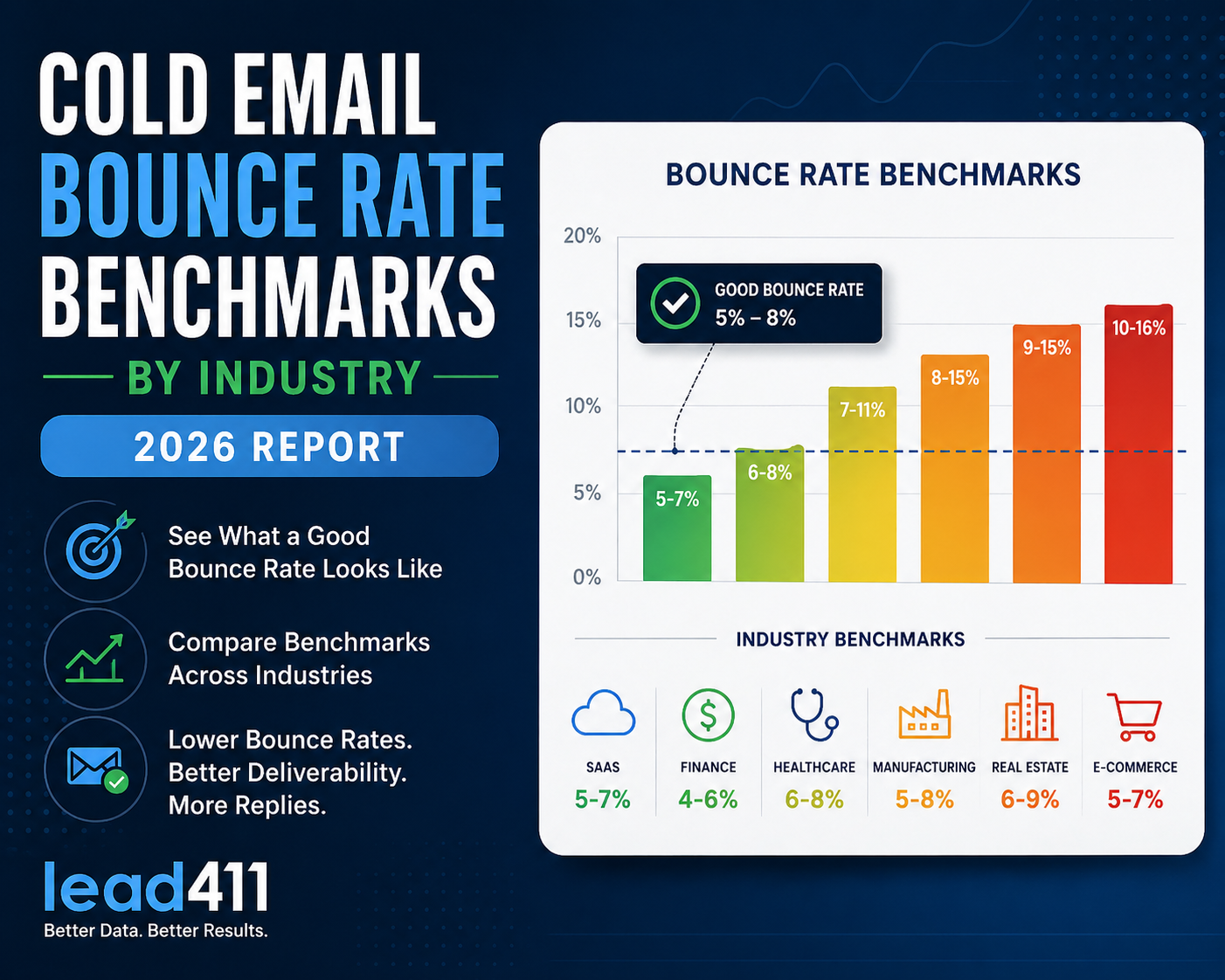
| Industry | Top Performers | Average | Poor |
|---|---|---|---|
| SaaS | 5–7% | 8–12% | 13%+ |
| Finance | 4–6% | 7–11% | 12%+ |
| Healthcare | 6–8% | 9–13% | 14%+ |
| Manufacturing | 5–8% | 9–14% | 15%+ |
| Real Estate | 6–9% | 10–15% | 16%+ |
| E-commerce | 5–7% | 8–12% | 13%+ |
---
Industry Breakdown (Why Bounce Rates Differ)
SaaS / Tech
SaaS companies experience some of the highest data turnover due to rapid hiring, restructuring, and job changes. Titles shift frequently, and employees move between startups and larger firms quickly.
This creates constant data decay.
Without continuous validation, even recently sourced contacts can become invalid within months. This is why SaaS teams relying on static databases often see bounce rates spike above 12%.
---
Financial Services
Financial services typically maintain more stable organizational structures, which results in lower bounce rates overall.
However, compliance requirements and stricter email systems can impact deliverability.
Accuracy matters more than volume in this segment.
---
Healthcare
Healthcare organizations have complex systems, role changes, and strict data governance.
This often leads to outdated contact records and higher bounce rates.
Healthcare is one of the hardest industries for maintaining clean data.
---
Manufacturing
Manufacturing companies tend to update data less frequently, but records can be inconsistent.
This creates variability in bounce rates depending on region and company size.
---
E-commerce / Retail
E-commerce teams move fast, especially in growth-stage companies.
However, data accuracy tends to be higher when targeting leadership roles rather than operational contacts.
---
What the Data Actually Shows
Across all industries, one pattern is clear: data quality determines bounce rate.
- Verified data → consistently under 8%
- Aggregated data → 10–18%
- Scraped data → highest variability
Most teams don’t have a deliverability problem—they have a data problem.
---
Tools That Reduce Bounce Rates
Choosing the right data provider directly impacts deliverability performance.
Lead411
Best for accuracy and deliverability.
Lead411 focuses on verified contact data and integrates data validation with intent signals.
This results in consistently lower bounce rates and stronger inbox placement.
ZoomInfo
Best for scale, but often expensive.
ZoomInfo offers massive datasets but introduces variability in accuracy.
Many mid-market teams overpay for data they don’t fully use.
Apollo
Best for affordability, but inconsistent.
Apollo aggregates data from multiple sources, which can lead to higher bounce rates.
Lower cost often comes with tradeoffs in data quality.
---
Before vs After Fixing Bounce Rates
Before:
- 15–20% bounce rate
- Poor inbox placement
- Low reply rates
After:
- 5–8% bounce rate
- Improved deliverability
- More meetings and pipeline
Improving data accuracy is the fastest way to improve outbound results.
---
How to Reduce Bounce Rates
- Use verified data
- Validate contacts regularly
- Segment your lists
- Use prospecting tools effectively
Better data = better deliverability = more revenue.
---
What Most Teams Get Wrong
- Choosing volume over accuracy
- Ignoring bounce rate metrics
- Blaming messaging instead of data
Volume creates activity. Accuracy creates pipeline.
---
Final Takeaways
The best-performing teams maintain bounce rates below 8%.
If your bounce rate exceeds 12%, fixing your data will have a greater impact than rewriting your emails.
The fastest way to improve outbound performance is improving data quality.
To improve your results, request a demo or explore pricing.
Frequently Asked Questions About Cold Email Bounce Rates
What is a good bounce rate for cold email campaigns?
A good bounce rate typically falls between 5% and 8%. This range indicates that your contact data is accurate and your emails are reaching valid inboxes. Anything above 12% is a strong signal that your data quality needs improvement.
What bounce rate is considered too high?
A bounce rate above 12% is considered high and can negatively impact your sender reputation. At this level, email providers may begin filtering your messages into spam or blocking them entirely.
Why do bounce rates vary by industry?
Bounce rates vary because industries experience different levels of data turnover. Fast-growing sectors like SaaS have frequent job changes, while industries like finance are more stable but may have stricter email filtering systems.
What is the difference between a hard bounce and a soft bounce?
A hard bounce occurs when an email address is invalid or no longer exists. A soft bounce is a temporary issue, such as a full inbox or server problem. Hard bounces are more damaging to deliverability.
How does data accuracy affect bounce rates?
Data accuracy is the primary driver of bounce rates. Outdated or incorrect email addresses lead directly to higher bounce rates, which reduces deliverability and harms domain reputation.
Which B2B data providers help reduce bounce rates the most?
Providers that focus on verified data, such as Lead411, typically deliver lower bounce rates. Platforms like ZoomInfo offer larger datasets but may include outdated contacts, while Apollo is more affordable but often less consistent due to aggregated data sources.
Can high bounce rates damage my domain reputation?
Yes. High bounce rates signal to email providers that your sender practices are unreliable, which can reduce inbox placement and impact all future campaigns.
How can I test my bounce rate before scaling campaigns?
Run a small test campaign and monitor bounce rate, reply rate, and inbox placement. This allows you to validate your data before scaling outbound efforts.
How often should contact data be updated?
Contact data should be updated continuously. In fast-moving industries, data can become outdated within a few months, leading to higher bounce rates if not refreshed.
Does email personalization reduce bounce rates?
No. Personalization improves engagement but does not impact bounce rates. Bounce rates are determined by data accuracy, not messaging quality.
What is the fastest way to reduce bounce rates?
The fastest way is to switch to verified data sources, validate your lists regularly, and remove outdated contacts. Improving data quality has the biggest immediate impact.
Why do aggregated data platforms have higher bounce rates?
Aggregated data platforms pull information from multiple sources, which can introduce inconsistencies and outdated records. This leads to higher bounce rates compared to verified datasets.
How does intent data impact bounce rates?
Intent data does not directly reduce bounce rates, but it improves targeting. When combined with accurate contact data, it leads to better engagement and overall campaign performance.
What industries have the lowest bounce rates?
Industries with stable workforce structures, such as financial services, tend to have lower bounce rates compared to fast-changing sectors like SaaS or healthcare.
What is the biggest mistake teams make with bounce rates?
The biggest mistake is prioritizing database size over data accuracy. Large datasets often contain outdated contacts, which increases bounce rates and reduces campaign effectiveness.
Recent Posts
What Are the Cheapest and Best Alternatives to ZoomInfo? (2026 Deep-Dive Guide)
What Are the Cheapest and Best Alternatives to ZoomInfo? (2026 Deep-Dive Guide) For years, ZoomInfo dominated the B2B sales intelligence market so aggressively that most outbound teams rarely questioned whether there were better options. If your company needed:...
Why Hundreds of Companies Are Leaving ZoomInfo for Lead411 in 2026
Why Hundreds of Companies Are Leaving ZoomInfo for Lead411 in 2026 For nearly a decade, ZoomInfo became synonymous with B2B sales intelligence. If a company needed direct dials, contact enrichment, buyer intent data, or outbound prospecting infrastructure, ZoomInfo...

ZoomInfo vs RocketReach: Why Most Sales Teams End Up Frustrated With Both
ZoomInfo vs RocketReach: Why Most Sales Teams End Up Frustrated With Both Most sales intelligence comparison articles make the same mistake. They compare: database size, contact counts, features, and pricing tiers. But that is not actually what most outbound teams are...

- Sales Services
- Cybersecurity
- SaaS/Technology
- Energy / CleanTech
- Manufacturing
- Hospitality / Travel / Tourism
- Financial / FinTech
- Healthcare / MedTech
- Logistics / Transportation
- Account Based Marketing
- Recruiting
- Real Estate & Construction
- Professional Services & Consulting
- SLED Data Solutions
- Retail / E-Commerce
- Legal Services
resources
Zoominfo Intent vs Bombora Intent in 2026 | Top 3 B2b Buyer Intent Providers in 2026 | Zoominfo Pricing in 2026 | Linkedin Sales Navigator Competitors (2026) | Clearbit Pricing (2026) | Hubspot Pricing Review (2026) | Lead411 Competitors in 2026| Top 5 Linkedin Email Finders for 2026 | How to Find Someone's Phone Number in 2026 | Apollo.io vs. Lead411 Chrome Extension in 2026 | Apollo.io vs. Zoominfo in 2026 | Top 10 B2B Data Resellers in 2026 | Zoominfo API | Seamless.ai vs. Zoominfo in 2026 | 10 Best Clay Competitors for 2026 | What Does Lead Generation Look Like in 2026? | Zoominfo MCP Server |
7 Best B2B Data Providers for 2026 | 15 Best Sales Lead Databases for B2B in 2026 | Apollo.io MCP Server | Questions About Zoominfo