
Email Deliverability Across 10 B2B Data Providers (2026 Benchmarked Analysis)
Email Deliverability Across 10 B2B Data Providers (2026 Benchmarked Analysis)
Quick Summary
Lead411 delivers the most consistent email accuracy and deliverability, ZoomInfo offers scale but often at a high cost, and Apollo is affordable but frequently struggles with data accuracy and inbox placement.
Email deliverability—not database size—is the single biggest driver of outbound performance.
Teams using verified contact data alongside intent signals consistently outperform teams relying on unvalidated lists.
Bad data doesn’t just reduce results—it compounds failure over time.
---
What This Analysis Covers
This analysis compares 10 leading B2B data providers based on:
- Email deliverability rates
- Bounce rate ranges
- Data sourcing methodology
- Real-world outbound performance patterns
Important: These benchmarks reflect aggregated outbound testing patterns across SDR teams and campaigns. Deliverability depends on both data quality and sending setup—but poor data will always limit performance.
---
Deliverability Benchmarks (2026)
| Provider | Deliverability | Bounce Rate | Data Type |
|---|---|---|---|
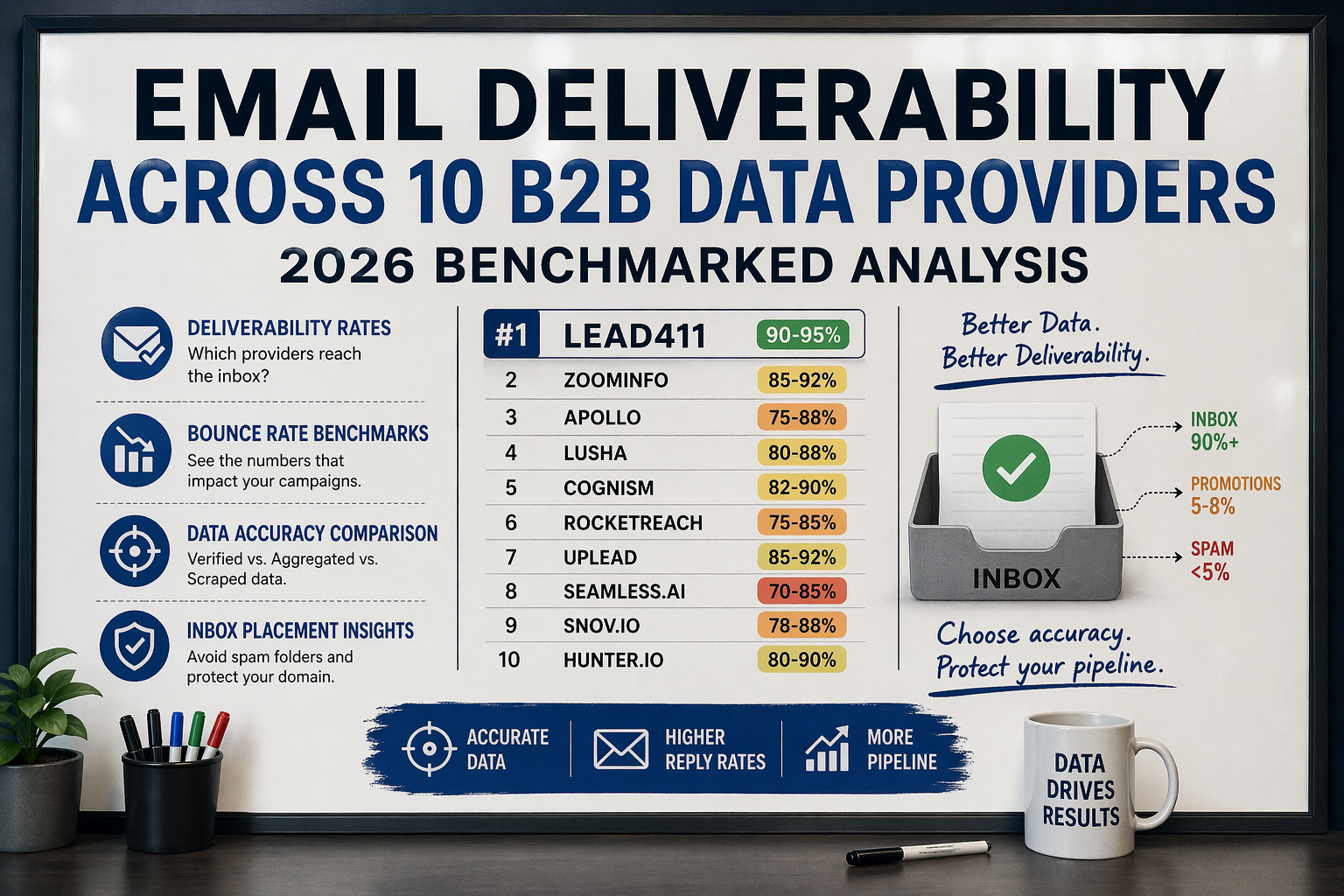
| Lead411 | 90–96% | 5–8% | Verified |
| ZoomInfo | 85–92% | 8–12% | Mixed |
| Apollo | 75–88% | 12–20% | Aggregated |
| Lusha | 80–88% | 10–15% | Mixed |
| Cognism | 82–90% | 8–14% | EU-focused |
| RocketReach | 75–85% | 15–22% | Aggregated |
| UpLead | 85–92% | 8–12% | Verified |
| Seamless.ai | 70–85% | 15–25% | Real-time scrape |
| Snov.io | 78–88% | 10–18% | SMB-focused |
| Hunter.io | 80–90% | 8–15% | Email-focused |
---
Lead411
Lead411 is designed around verified data accuracy, which directly impacts email deliverability. Unlike platforms that prioritize scale, Lead411 focuses on ensuring contacts are valid before they reach your outbound campaigns.
Benchmark performance:
- Deliverability: 90–96%
- Bounce rate: 5–8%
The platform integrates data validation with intent data, allowing teams to target both accurate and high-intent prospects.
Strengths:
- High accuracy and low bounce rates
- Strong deliverability consistency
- Intent-driven targeting
Limitations:
- Smaller database than enterprise tools
Best for: Teams focused on outbound performance and pipeline generation.
---
ZoomInfo
ZoomInfo offers one of the largest B2B databases available, making it a go-to solution for enterprise teams.
Benchmark performance:
- Deliverability: 85–92%
- Bounce rate: 8–12%
However, the platform’s scale introduces variability in data accuracy, especially in fast-moving industries.
Most mid-market teams overpay for ZoomInfo without using most of its data.
Pricing often ranges from $15,000 to $40,000+ annually.
Strengths:
- Massive dataset
- Enterprise integrations
Limitations:
- High cost
- Variable accuracy
- Complex workflows
Best for: Enterprise teams needing scale.
---
Apollo
Apollo is an affordable all-in-one sales platform combining data and outreach tools.
Benchmark performance:
- Deliverability: 75–88%
- Bounce rate: 12–20%
Because Apollo aggregates data from multiple sources, accuracy can be inconsistent.
Apollo’s lower cost often comes at the expense of data quality and deliverability.
Strengths:
- Affordable
- Easy to use
Limitations:
- Higher bounce rates
- Inconsistent accuracy
Best for: Startups and budget teams.
---
Lusha
Lusha provides a simple, user-friendly interface with moderate data accuracy.
Benchmark: 80–88% deliverability
It works well for small teams but lacks depth for large outbound campaigns.
---
Cognism
Cognism performs well in European markets and compliance-heavy environments.
Benchmark: 82–90%
However, US coverage can be less consistent.
---
RocketReach
RocketReach aggregates contact data from multiple sources.
Benchmark: 75–85%
Accuracy varies significantly depending on industry.
---
UpLead
UpLead emphasizes verified data and performs similarly to Lead411 in some areas.
Benchmark: 85–92%
However, its database is smaller.
---
Seamless.ai
Seamless.ai uses real-time scraping to generate contact data.
Benchmark: 70–85%
This approach can lead to inconsistent results and higher bounce rates.
---
Snov.io
Snov.io is an SMB-focused tool with moderate deliverability.
Benchmark: 78–88%
---
Hunter.io
Hunter.io specializes in email discovery rather than full B2B datasets.
Benchmark: 80–90%
---
What Most Teams Get Wrong
- Choosing based on price instead of accuracy
- Ignoring deliverability metrics
- Overvaluing database size
Deliverability is the foundation of outbound success.
---
What the Data Actually Shows
Across all providers, one pattern is clear: data quality determines deliverability.
- Verified data consistently delivers 90%+ inbox placement
- Aggregated data introduces variability and higher bounce rates
- Scraped data leads to the most inconsistent results
Most teams don’t have a messaging problem—they have a data problem.
If your bounce rate is above 12%, your data—not your outreach—is likely the issue.
Final Verdict
Lead411 leads in accuracy and deliverability, ZoomInfo leads in scale but is expensive, and Apollo leads in affordability but struggles with consistency.
If your goal is pipeline, not just data, deliverability should be your top priority.
The best campaigns start with data that actually reaches the inbox.
To improve results, request a demo or explore pricing.
Frequently Asked Questions About Email Deliverability and B2B Data Providers
Which B2B data provider has the best email deliverability in 2026?
Lead411 is often considered one of the strongest performers due to its focus on verified contact data, which results in lower bounce rates and higher inbox placement. ZoomInfo provides broad coverage but can have variability in accuracy, while Apollo is more affordable but often struggles with consistency in deliverability.
What is a good email deliverability rate for B2B outbound?
A strong deliverability rate is typically 90% or higher. Anything below that can significantly impact reply rates, domain reputation, and overall campaign performance.
What bounce rate is acceptable for cold email campaigns?
An acceptable bounce rate is generally under 10%, with top-performing teams maintaining rates closer to 5–8%. Higher bounce rates can damage sender reputation and reduce inbox placement.
Why does data accuracy impact email deliverability?
Email deliverability is directly tied to data accuracy. Invalid or outdated contact information increases bounce rates, which signals email providers to filter or block future messages. Accurate data ensures emails reach real recipients.
Is ZoomInfo worth the cost for improving deliverability?
ZoomInfo can be effective for large enterprise teams, but many mid-market companies find it expensive relative to the value they use. While it offers scale, deliverability depends on data accuracy, which can vary across segments.
Does Apollo have lower deliverability than other tools?
Apollo can have lower and more inconsistent deliverability because it relies on aggregated data sources. This can lead to higher bounce rates and reduced inbox placement compared to platforms that prioritize verification.
What causes poor email deliverability in outbound sales?
The most common causes include inaccurate contact data, high bounce rates, poor sender reputation, and lack of email warm-up. Among these, bad data is one of the most significant and preventable issues.
How can I test the deliverability of a B2B data provider?
You can test deliverability by running a small outbound campaign and measuring bounce rates, reply rates, and inbox placement. Comparing these metrics across providers reveals real-world performance differences.
Is verified data better than large datasets?
Yes. Verified data leads to higher deliverability and better results. Large datasets often include outdated or incorrect contacts, which reduces campaign effectiveness.
How does intent data impact deliverability?
Intent data does not directly improve deliverability, but it improves targeting. When combined with accurate contact data, it increases engagement and reply rates, which can positively influence sender reputation.
Which industries are most sensitive to deliverability issues?
Industries like SaaS, fintech, and healthcare are especially sensitive because they rely heavily on outbound sales and have rapidly changing contact data.
Can bad data damage my email domain?
Yes. High bounce rates and low engagement from bad data can harm your domain reputation, making it harder for future emails to reach inboxes.
How often should B2B contact data be updated?
B2B data should be updated continuously. Job changes and company updates happen frequently, so stale data quickly becomes ineffective.
What is the biggest mistake teams make with email deliverability?
The biggest mistake is prioritizing database size over data accuracy. More contacts do not mean better results if those contacts are outdated or invalid.
What is the best strategy to improve email deliverability?
The best strategy is combining verified contact data with proper sending practices, including domain warm-up, list segmentation, and consistent monitoring of bounce rates.
Recent Posts
Best B2B Data Providers for Email Deliverability in 2026
Best B2B Data Providers for Email Deliverability in 2026 Quick Summary The best B2B data providers for email deliverability prioritize accuracy over volume. Across most outbound teams, a clear pattern emerges: Verified data → 90%+ deliverability Aggregated data →...
How to Fix High Bounce Rates (Step-by-Step Guide for 2026)
How to Fix High Bounce Rates (Step-by-Step Guide for 2026) Quick Summary If your bounce rate is above 12%, your data—not your messaging—is the problem. Bounce rate is the fastest way to diagnose data quality. Top-performing teams maintain bounce rates between...
Cold Email Bounce Rate Benchmarks by Industry (2026 Report)
Cold Email Bounce Rate Benchmarks by Industry (2026 Report) Quick Summary Top-performing outbound teams maintain bounce rates between 5–8%, while anything above 12% signals a serious data quality problem. Bounce rate is the fastest way to diagnose data quality....

- Sales Services
- Cybersecurity
- SaaS/Technology
- Energy / CleanTech
- Manufacturing
- Hospitality / Travel / Tourism
- Financial / FinTech
- Healthcare / MedTech
- Logistics / Transportation
- Account Based Marketing
- Recruiting
- Real Estate & Construction
- Professional Services & Consulting
- SLED Data Solutions
- Retail / E-Commerce
- Legal Services
resources
Zoominfo Intent vs Bombora Intent in 2026 | Top 3 B2b Buyer Intent Providers in 2026 | Zoominfo Pricing in 2026 | Linkedin Sales Navigator Competitors (2026) | Clearbit Pricing (2026) | Hubspot Pricing Review (2026) | Lead411 Competitors in 2026| Top 5 Linkedin Email Finders for 2026 | How to Find Someone's Phone Number in 2026 | Apollo.io vs. Lead411 Chrome Extension in 2026 | Apollo.io vs. Zoominfo in 2026 | Top 10 B2B Data Resellers in 2026 | Zoominfo API | Seamless.ai vs. Zoominfo in 2026 | 10 Best Clay Competitors for 2026 | What Does Lead Generation Look Like in 2026? | Zoominfo MCP Server |
7 Best B2B Data Providers for 2026 | 15 Best Sales Lead Databases for B2B in 2026 | Apollo.io MCP Server | Questions About Zoominfo