
How B2B Buyers Actually Respond to Cold Outreach in the Age of AI (2026 Reality Check)
How B2B Buyers Actually Respond to Cold Outreach in the Age of AI (2026 Reality Check)
Cold outreach hasn’t disappeared—but average cold outreach has.
In 2026, B2B buyers are receiving more emails than ever, many of them generated or assisted by AI. The result isn’t just more noise—it’s faster filtering. Buyers aren’t overwhelmed. They’ve adapted.
AI didn’t kill cold email—it killed average cold email.
This guide breaks down how buyers actually process outreach today, what gets ignored instantly, what earns replies, and how to adapt to an AI-saturated inbox.
Table of Contents
- Quick Summary: The New Reality
- Cold Outreach Before vs After AI
- The 3 Filters Buyers Use
- What Happens When an Email Lands
- The AI Effect on Buyer Behavior
- What Gets Ignored Instantly
- What Gets Replies
- Industry Differences
- The New Outreach Playbook
- Common Mistakes
- Final Thoughts
Quick Summary: The New Reality of Cold Outreach
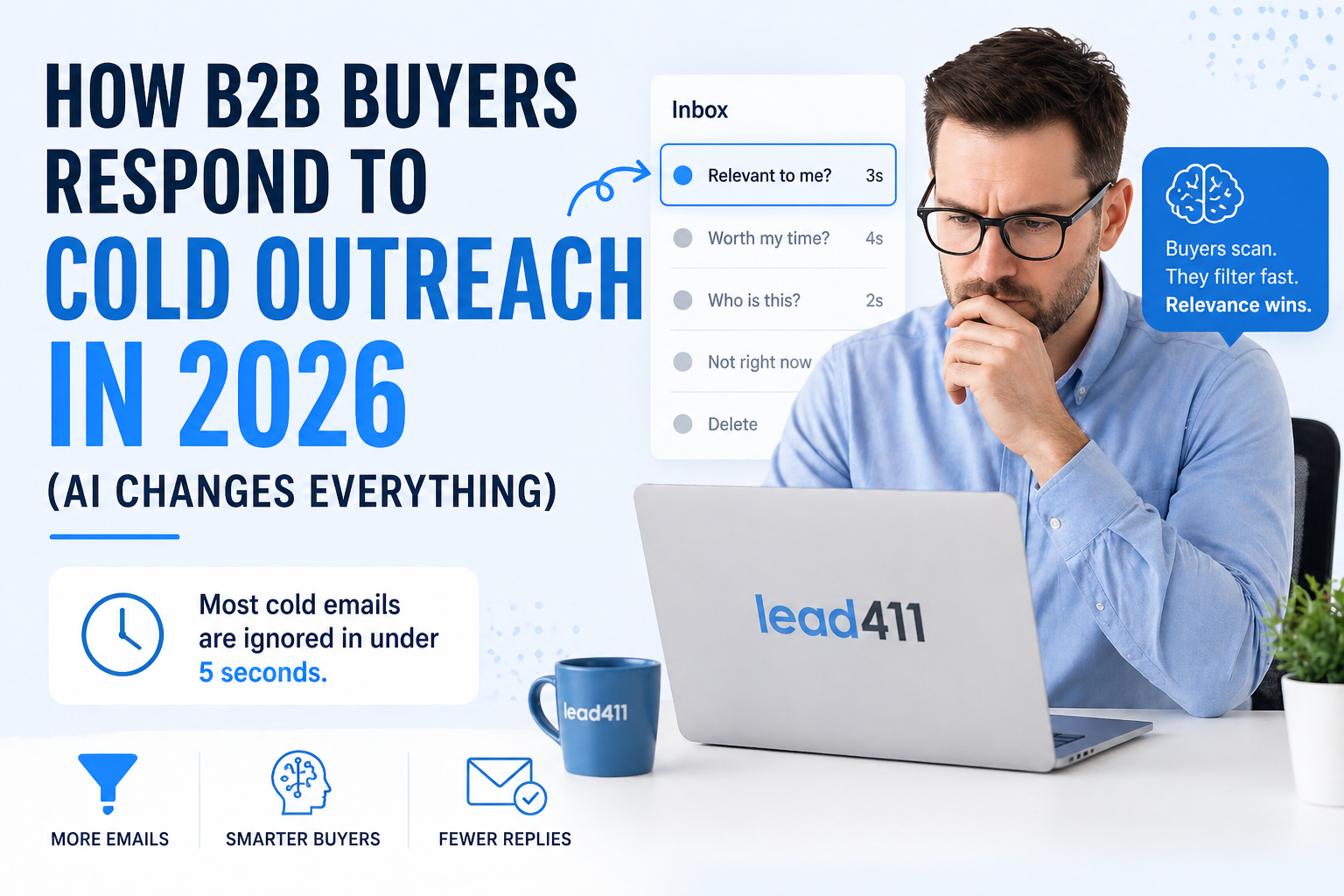
- Most cold emails are judged in under 3–5 seconds
- Buyers scan—not read—initial messages
- Generic personalization no longer works
- Relevance and timing outperform volume
Buyers don’t ignore emails—they ignore irrelevance.
Cold Outreach Before vs After AI
| Before AI | After AI (2026) |
|---|---|
| Lower email volume | Massive volume from AI-generated outreach |
| Personalization stood out | Personalization is expected baseline |
| Templates performed well | Templates are instantly recognized and ignored |
| Buyers read emails | Buyers scan in seconds |
| Volume could compensate for weak targeting | Volume exposes weak targeting |
The inbox didn’t just get crowded—buyers got faster.
Teams that still rely on outdated targeting or generic lists often see declining results. Using accurate, intent-driven data sources like Lead411’s data solutions helps ensure outreach is relevant from the start.
The 3 Filters Every Buyer Uses in 2026
1. Relevance
Does this relate directly to something I care about right now?
2. Timing
Is this aligned with a current initiative, problem, or change?
3. Effort Required
How much time or thinking will this require from me?
If any one of these fails, the email is ignored.
Relevance is the new personalization.
What Actually Happens When a Cold Email Lands
Step 1: Subject Line Scan
Buyers look for immediate relevance—not creativity.
Step 2: Sender Check
Unknown senders with generic messaging start at a disadvantage.
Step 3: First-Line Judgment
The first sentence determines whether the email continues to be read.
Step 4: Instant Decision
Delete, skim, or engage—this decision happens in seconds.
Buyers don’t read emails—they scan for signals.
The AI Effect: Why Most Outreach Fails Faster Now
AI has dramatically increased outbound volume while making patterns easier to detect.
- More AI emails → more repetition
- More repetition → faster filtering
- Faster filtering → lower response rates
This is why many teams are seeing declining performance—even with better tools.
Understanding how to evaluate and compare platforms like ZoomInfo competitors can help teams identify solutions that prioritize data accuracy and relevance over volume.
What Gets Ignored Instantly
- Generic personalization
- Long introductions
- Vague value propositions
- Template-style messaging
- Irrelevant outreach
In an AI-driven inbox, anything that feels average is filtered out immediately.
What Actually Gets Replies
- Messages tied to real-time signals (hiring, growth, expansion)
- Clear, specific value propositions
- Evidence of real context
- Low-friction calls to action
Clarity beats cleverness. Specificity beats scale.
Many high-performing teams use intent signals and verified data to improve targeting accuracy. If you want to see how this works in practice, you can request a demo here.
Industry Differences in Buyer Behavior
SaaS and Technology
Fast-moving, high competition, low tolerance for generic outreach.
Healthcare
Trust-driven, slower response cycles, higher scrutiny.
Financial Services
Risk-sensitive, requires credibility and precision.
Manufacturing
Outcome-focused, responds to clear operational value.
Understanding these nuances is critical for effective outreach.
The New Cold Outreach Playbook (2026)
1. Use Signals, Not Lists
Target based on real activity rather than static databases.
2. Keep Messages Short
Under 100 words performs best.
3. Focus on One Problem
Clarity drives responses.
4. Lower the Friction
Make it easy for buyers to respond.
5. Follow Up Consistently
Most replies come from follow-ups.
Volume used to win. Now precision wins.
For teams evaluating different pricing models and data approaches, reviewing Lead411 pricing can provide a clearer picture of predictable data access versus credit-based systems.
What Most Sales Teams Still Get Wrong
- Prioritizing volume over relevance
- Relying on surface-level personalization
- Ignoring timing signals
- Treating outreach as a one-off effort
Final Thoughts
Cold outreach still works—but only when it aligns with how buyers behave today.
The biggest shift isn’t technology—it’s attention.
Relevance, timing, and clarity now determine whether you get ignored—or get a reply.
Cold Outreach FAQs in the Age of AI (2026)
Is cold email still effective in 2026?
Yes, cold email still works—but only when it’s highly relevant and well-timed. The biggest shift is that buyers now receive more emails than ever, many generated by AI, so generic outreach is ignored almost instantly. Success today depends on precision, not volume.
How has AI changed cold outreach?
AI has dramatically increased the volume of outbound emails, making inboxes more competitive. As a result, buyers have adapted by filtering messages faster and recognizing common patterns. This means only highly relevant and specific emails stand out.
Why do most cold emails get ignored today?
Most cold emails are ignored because they lack relevance, timing, or clarity. Buyers quickly recognize generic messaging, surface-level personalization, and templated language, which signals low value and leads to immediate dismissal.
How quickly do buyers decide whether to read an email?
Most buyers make a decision within 3–5 seconds. They scan the subject line, sender, and first sentence to determine whether the message is worth their time. If it doesn’t feel immediately relevant, it’s ignored.
What is the biggest mistake in cold outreach today?
The biggest mistake is prioritizing volume over relevance. Sending more emails doesn’t increase success—in fact, it often reduces it. Precision targeting and context-driven messaging are far more effective.
What makes a cold email stand out in 2026?
Cold emails stand out when they are tied to a specific, real-world signal such as hiring, growth, or expansion. Clear, concise messaging that directly addresses a known problem is far more effective than generic personalization.
Does personalization still matter?
Yes, but only when it goes beyond surface-level details. Basic personalization like job titles or company names is now expected and often ignored. What matters is contextual relevance—showing you understand the recipient’s situation.
What is the best length for a cold email?
Short emails perform best. Most high-performing cold emails are under 100 words because buyers prefer messages that are quick to read and easy to understand.
What role does timing play in cold outreach?
Timing is one of the most important factors. Emails that align with current events—such as hiring, funding, or expansion—are far more likely to get a response than messages sent without context.
How do buyers recognize AI-generated emails?
Buyers often recognize AI-generated emails through patterns like overly polished language, generic structure, and lack of specificity. These signals make messages feel impersonal and easy to ignore.
Is sending more emails still an effective strategy?
No. Increasing volume without improving targeting usually leads to lower response rates. In today’s environment, sending fewer, more relevant emails is significantly more effective.
What is the “3-second rule” in cold outreach?
The 3-second rule refers to how quickly buyers decide whether to engage with an email. Within seconds, they assess relevance, value, and trust. If the message fails any of these, it is ignored.
Do follow-ups still work in 2026?
Yes, follow-ups are still critical. Many responses come from follow-up emails rather than the first message. However, follow-ups must remain relevant and not repetitive to be effective.
How important is data quality in cold outreach?
Data quality is essential. Accurate, verified contact data ensures your emails reach the right person and reduces bounce rates, which directly impacts deliverability and response rates.
What is the future of cold outreach?
The future of cold outreach is more targeted, signal-driven, and personalized at a deeper level. As AI continues to increase volume, success will depend on relevance, timing, and human understanding—not automation alone.
Recent Posts
How to Prospect Retail and E-Commerce Brands Using Hiring Signals (2026 Guide)
How to Prospect Retail and E-Commerce Brands Using Hiring Signals (2026 Playbook) Quick Summary Retail and e-commerce brands don’t buy on long timelines—they buy when something changes. Hiring is one of the earliest and most reliable indicators of that change....
Top 5 Best B2B Data Providers for Targeting Real Estate Investment Firms (2026 Guide)
Top 5 Best B2B Data Providers for Targeting Real Estate Investment Firms (2026 Guide) Quick Summary Real estate investment firms represent one of the highest-value but hardest-to-reach segments in B2B sales. Whether you’re selling SaaS, financial services, data...
AI + B2B Data: The New Outbound Playbook for 2026 (How Top Teams Win)
AI + B2B Data: The New Outbound Playbook for 2026 Quick Summary Outbound sales is no longer about sending more emails—it’s about sending the right message to the right buyer at the right time. The highest-performing teams in 2026 combine AI with B2B data to identify...

- Sales Services
- Cybersecurity
- SaaS/Technology
- Energy / CleanTech
- Manufacturing
- Hospitality / Travel / Tourism
- Financial / FinTech
- Healthcare / MedTech
- Logistics / Transportation
- Account Based Marketing
- Recruiting
- Real Estate & Construction
- Professional Services & Consulting
- SLED Data Solutions
- Retail / E-Commerce
- Legal Services
resources
Zoominfo Intent vs Bombora Intent in 2026 | Top 3 B2b Buyer Intent Providers in 2026 | Zoominfo Pricing in 2026 | Linkedin Sales Navigator Competitors (2026) | Clearbit Pricing (2026) | Hubspot Pricing Review (2026) | Lead411 Competitors in 2026| Top 5 Linkedin Email Finders for 2026 | How to Find Someone's Phone Number in 2026 | Apollo.io vs. Lead411 Chrome Extension in 2026 | Apollo.io vs. Zoominfo in 2026 | Top 10 B2B Data Resellers in 2026 | Zoominfo API | Seamless.ai vs. Zoominfo in 2026 | 10 Best Clay Competitors for 2026 | What Does Lead Generation Look Like in 2026? | Zoominfo MCP Server |
7 Best B2B Data Providers for 2026 | 15 Best Sales Lead Databases for B2B in 2026 | Apollo.io MCP Server | Questions About Zoominfo
© 2026 Lead411 All Rights Reserved | Your Privacy Choices | Privacy Policy | Do Not Sell | CCPA | Terms Of Use | Lead411 is a registered data broker under applicable state laws, including under Texas law. To conduct business in Texas, a data broker must register with the Texas Secretary of State (Texas SOS). Information about data broker registrants is available on the Texas SOS website.
- Sales Services
- Cybersecurity
- SaaS/Technology
- Energy / CleanTech
- Manufacturing
- Hospitality / Travel / Tourism
- Financial / FinTech
- Healthcare / MedTech
- Logistics / Transportation
- Account Based Marketing
- Recruiting
- Real Estate & Construction
- Professional Services & Consulting
- SLED Data Solutions
- Retail / E-Commerce
- Legal Services
resources
Zoominfo Intent vs Bombora Intent in 2026 | Top 3 B2b Buyer Intent Providers in 2026 | Zoominfo Pricing in 2026 | Linkedin Sales Navigator Competitors (2026) | Clearbit Pricing (2026) | Hubspot Pricing Review (2026) | Lead411 Competitors in 2026| Top 5 Linkedin Email Finders for 2026 | How to Find Someone's Phone Number in 2026 | Apollo.io vs. Lead411 Chrome Extension in 2026 | Apollo.io vs. Zoominfo in 2026 | Top 10 B2B Data Resellers in 2026 | Zoominfo API | Seamless.ai vs. Zoominfo in 2026 | 10 Best Clay Competitors for 2026 | What Does Lead Generation Look Like in 2026? | Zoominfo MCP Server |
7 Best B2B Data Providers for 2026 | 15 Best Sales Lead Databases for B2B in 2026 | Apollo.io MCP Server | Questions About Zoominfo