
How Sales and Marketing Teams Should Use B2B Data Together in 2026
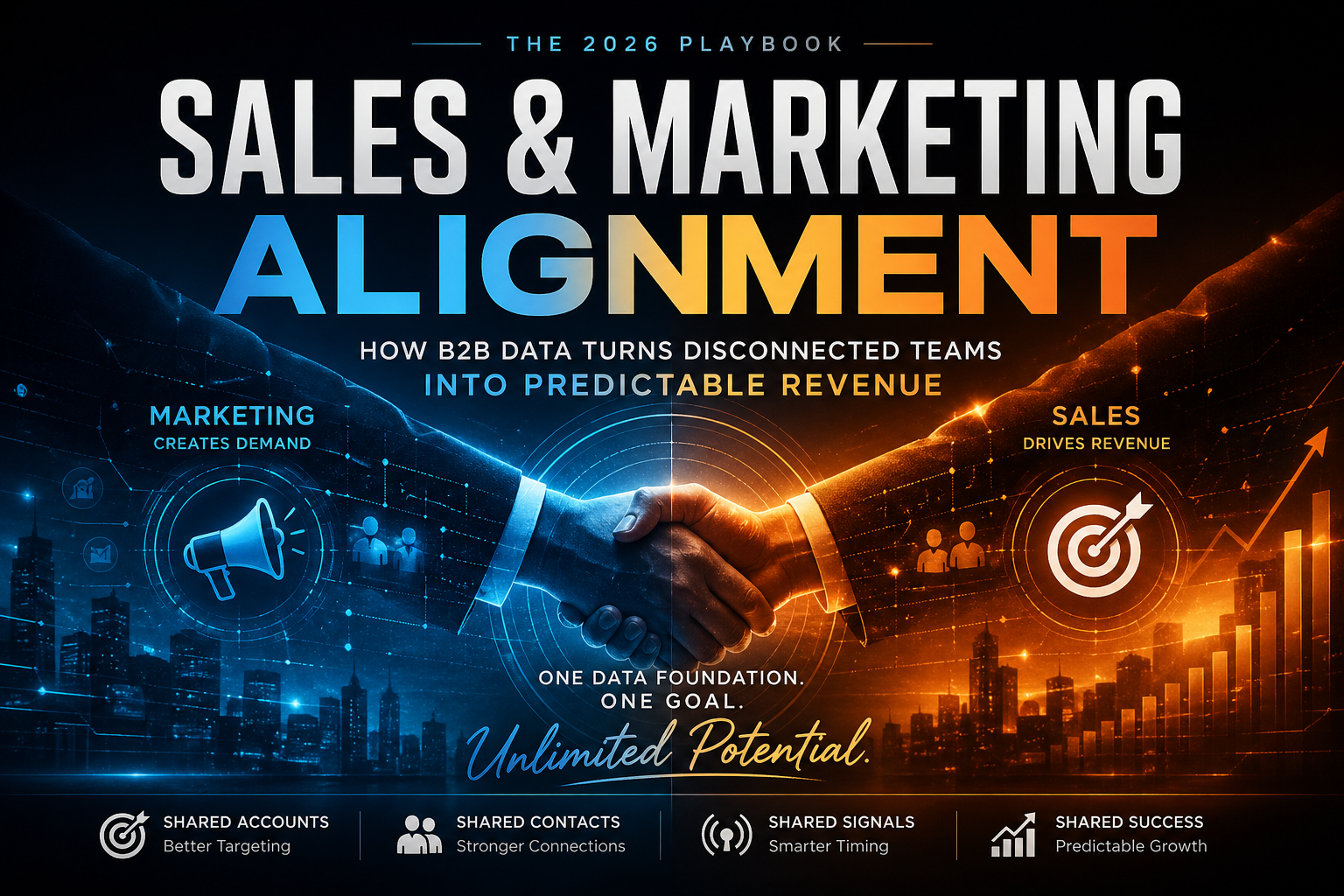
How Sales and Marketing Teams Should Use B2B Data Together in 2026
Quick Summary: Most sales and marketing misalignment isn’t a communication problem—it’s a data problem. In 2026, high-performing teams operate from shared account lists, verified contact data, and real-time signals. When both teams work from the same data, pipeline becomes predictable and conversion rates improve.
You don’t have a lead problem.
You have a visibility problem.
Sales and marketing aren’t misaligned because they don’t communicate—they’re misaligned because they’re working from different realities.
In most teams, this doesn’t show up immediately. It shows up later—as stalled deals, inconsistent pipeline, and missed opportunities that are hard to explain.
This is why pipeline feels unpredictable. It’s why deals that “should have closed” don’t. And it’s why one team always feels like the other is missing something.
This guide breaks down what’s actually happening—and how to fix it.
If you’ve already explored modern outbound strategies, you’ve probably seen parts of this problem show up in areas like AI-driven outbound or high-growth targeting. Alignment is what ties those together.
Table of Contents
- The Real Problem: Misaligned Data
- The Sales–Marketing Data Alignment Framework
- How Data Connects Both Teams
- Real-World Workflow Example
- Tools That Support Alignment
- What Breaks Alignment
- How to Fix It
- Final Takeaways
The Real Problem: Sales and Marketing Use Different Data
Most companies think they have an alignment issue.
They don’t.
They have a data fragmentation issue.
Here’s what we see in most teams:
- Marketing builds campaigns using ICP assumptions and enrichment tools
- Sales builds lists using prospecting tools and manual filtering
- Neither team is targeting the exact same accounts at the exact same time
On paper, everything looks aligned.
In practice, it’s not.
Alignment doesn’t fail in meetings—it fails in data.
This is why leads feel “low quality” to sales, and why marketing feels like sales isn’t following up.
They’re both right—because they’re both incomplete.
This disconnect becomes obvious when you compare how lists are built, as shown in this prospecting framework or how companies approach finding decision-makers across industries.
The Sales–Marketing Data Alignment Framework
Instead of trying to fix alignment with more meetings, high-performing teams fix it with systems.
The Sales–Marketing Data Alignment Framework:
1. Shared Account Layer
Both teams target the exact same companies.
2. Shared Contact Layer
Both teams see the same stakeholders inside those accounts.
3. Shared Signal Layer
Both teams act on the same timing indicators (hiring, funding, expansion).
4. Shared Execution Layer
Campaigns and outreach reinforce each other instead of competing.
In practice, most alignment breaks at step two or three.
Either the contacts don’t match, or the timing doesn’t align.
This is why strategies like targeting hiring signals or market expansion signals are so effective—they create shared timing.
How B2B Data Connects Sales and Marketing
At a high level, sales and marketing are solving different problems:
- Marketing → generates awareness and demand
- Sales → converts that demand into revenue
But both rely on the same foundation: data.
When that data is shared:
- Marketing targets accounts sales actually wants
- Sales engages contacts marketing has already warmed
- Timing aligns with real buying activity
When it’s not:
- Campaigns miss the right people
- Sales outreach feels cold
- Pipeline becomes unpredictable
You don’t fix alignment by adding tools—you fix it by aligning data.
If you’ve ever tried coordinating this manually across spreadsheets, CRMs, and enrichment tools, you’ve probably already seen how quickly it breaks down.
This is why many teams move toward unified data platforms like Lead411’s data solutions, where both teams operate from the same dataset.
Real-World Workflow: What Alignment Actually Looks Like
Let’s make this practical.
Imagine you’re targeting SaaS companies.
Step 1: Marketing Identifies Active Accounts
Instead of static ICP lists, marketing targets:
- SaaS companies hiring engineers
- Companies that recently raised funding
- Businesses expanding teams
This is not just targeting—it’s timing.
Step 2: Sales Maps the Buying Committee
Sales identifies multiple stakeholders:
- IT Director
- VP Engineering
- CFO
- Operations leaders
In most deals, if even one of these roles is missing, the process slows down or stalls entirely.
Step 3: Messaging Aligns Across Roles
- Marketing → broad narrative (growth, efficiency)
- Sales → role-specific messaging (technical, financial, operational)
Step 4: Both Teams Act on the Same Signals
Timing is coordinated across campaigns and outreach.
This is where alignment stops being theoretical—and starts driving results.
Tools That Support Sales and Marketing Alignment
Lead411
Lead411 is designed around shared data rather than isolated workflows.
Pricing: Subscription-based (predictable)
Geography: Strong US coverage, expanding globally
Strengths: High data accuracy, built-in intent signals, ease of use
The biggest advantage is consistency. Both teams can operate from the same dataset—accounts, contacts, and signals—without fragmentation.
This removes one of the biggest sources of friction between marketing and sales.
Explore prospecting tools, pricing, or request a demo to see how it works.
Apollo.io
Apollo.io is widely used for outbound prospecting and automation.
Pricing: Credit-based tiers
Geography: Global
Strengths: High-volume list building, automation capabilities
Limitations: Data consistency can vary, especially across large teams
Apollo works well when individual reps control their own workflows. But in practice, when multiple teams rely on it, differences in filtering, enrichment, and usage patterns can create inconsistencies.
This becomes an issue when marketing and sales are expected to operate from the same accounts—because they often aren’t pulling from identical datasets.
See deeper comparisons in this breakdown.
ZoomInfo
ZoomInfo is one of the largest enterprise B2B data platforms.
Pricing: Enterprise-level contracts
Geography: Global coverage
Strengths: Scale, extensive database, strong intent capabilities
Limitations: Cost, complexity, onboarding friction
ZoomInfo performs well at scale, but in many organizations, different teams end up using different segments or features of the platform.
In practice, this can reintroduce the same alignment issues—just at a higher cost.
Compare alternatives in this guide.
What Breaks Sales and Marketing Alignment
Most teams don’t fail because of effort—they fail because of inconsistency.
- Using multiple data sources
- Targeting different accounts
- Ignoring timing signals
- Working with outdated data
In practice, this creates a compounding effect:
- Marketing generates leads that don’t convert
- Sales ignores those leads and builds separate lists
- Pipeline becomes fragmented and unpredictable
What looks like a performance problem is usually a system problem.
How to Fix Alignment (Without Adding More Meetings)
1. Standardize Data Sources
One source of truth—no exceptions.
2. Align on Accounts First
Everything starts with shared targeting.
3. Use Signals, Not Just Personas
Timing matters as much as fit.
4. Build Multi-Threaded Outreach
Engage multiple stakeholders consistently.
5. Continuously Update Data
Static data breaks alignment quickly.
This is why many teams revisit their approach after issues like poor deliverability or inconsistent response rates, often tied back to data quality.
Final Takeaways
Sales and marketing alignment isn’t about better communication.
It’s about shared reality.
When both teams operate from the same data:
- Targeting improves
- Messaging aligns
- Timing becomes precise
- Pipeline becomes predictable
The teams that win in 2026 don’t just align—they operate from the same system.
Alignment isn’t a process—it’s a system. And most teams are still trying to fix it with meetings.
Sales and Marketing Alignment FAQs (B2B Data in 2026)
What is sales and marketing alignment?
Sales and marketing alignment is when both teams work toward the same revenue goals using shared data, targeting, and messaging. In practice, this means both teams are focused on the same accounts, engaging the same stakeholders, and acting on the same timing signals.
Why do sales and marketing teams become misaligned?
Most misalignment comes from using different data sources. Marketing may target accounts based on one dataset, while sales builds lists from another, leading to inconsistent targeting, messaging, and timing across teams.
What is the biggest cause of poor alignment?
The biggest cause is data fragmentation. When sales and marketing operate from different account lists, contact data, or signals, they are effectively working toward different versions of the same goal.
How does B2B data improve alignment?
B2B data creates a shared foundation for both teams. When sales and marketing use the same account data, contact information, and signals, their efforts reinforce each other instead of competing.
What is RevOps and how does it relate to alignment?
Revenue Operations (RevOps) is the function responsible for aligning sales, marketing, and customer success. It focuses on systems, data, and processes that ensure all teams operate from a unified strategy.
What are the benefits of aligning sales and marketing?
Aligned teams typically see higher conversion rates, shorter sales cycles, and more predictable pipeline. Alignment also reduces wasted outreach and improves overall efficiency across both teams.
How do you align sales and marketing teams effectively?
Effective alignment starts with shared data. Both teams should use the same account lists, contact data, and signals, then build coordinated messaging and outreach strategies on top of that foundation.
What role does intent data play in alignment?
Intent data helps both teams identify when accounts are actively researching or preparing to buy. This allows marketing and sales to engage at the right time instead of relying on static targeting.
What happens if sales and marketing are not aligned?
When alignment is missing, teams often experience lower conversion rates, inconsistent pipeline, and missed opportunities. Deals may stall because key stakeholders were never engaged or messaging was not aligned.
How do shared account lists improve performance?
Shared account lists ensure both teams focus on the same companies. This improves consistency across campaigns and outreach, making it more likely that accounts are engaged from multiple angles.
What is multi-threaded outreach and why does it matter?
Multi-threaded outreach involves engaging multiple stakeholders within the same account. It increases alignment with buying committees and reduces reliance on a single contact to drive the deal forward.
How does data accuracy impact sales and marketing alignment?
Accurate data ensures both teams are targeting the right people. Inaccurate or outdated data leads to missed contacts, bounced emails, and gaps in outreach that weaken alignment.
What tools help align sales and marketing teams?
Tools that combine account data, contact information, and intent signals in one platform are most effective. These tools allow both teams to operate from the same dataset and coordinate their efforts.
Can alignment improve ROI from outbound campaigns?
Yes. When sales and marketing are aligned, outreach becomes more targeted and timely, which improves response rates and reduces wasted effort, leading to better overall ROI.
What is the future of sales and marketing alignment?
Alignment is becoming more data-driven and system-based. Teams that rely on shared data, real-time signals, and coordinated execution will outperform those that rely on disconnected tools and processes.
Recent Posts
Why AI SDRs Won’t Replace Human Outbound Teams in 2026
Why AI SDRs Won’t Replace Human Outbound Teams in 2026 Quick Summary AI SDR tools are exploding across the sales industry. Automated outbound systems can now generate prospect lists, write cold emails, personalize messaging, trigger workflows, and manage...
Why Revenue Performance Infrastructure Companies Like Lead411 are Replacing B2B Data Providers like Zoominfo
Why Revenue Performance Infrastructure Companies Like Lead411 Are Replacing B2B Data Providers Like ZoomInfo Quick Summary The B2B data industry is evolving beyond static databases. For years, providers competed by claiming larger datasets, more...

What Is Technographic Data? (Full Guide for B2B Targeting in 2026)
What Is Technographic Data? (How It Actually Works and When It Fails) Quick Summary Technographic data is information about the software and systems a company uses. Unlike traditional firmographic data, which tells you what a company looks like on paper,...

- Sales Services
- Cybersecurity
- SaaS/Technology
- Energy / CleanTech
- Manufacturing
- Hospitality / Travel / Tourism
- Financial / FinTech
- Healthcare / MedTech
- Logistics / Transportation
- Account Based Marketing
- Recruiting
- Real Estate & Construction
- Professional Services & Consulting
- SLED Data Solutions
- Retail / E-Commerce
- Legal Services
resources
Zoominfo Intent vs Bombora Intent in 2026 | Top 3 B2b Buyer Intent Providers in 2026 | Zoominfo Pricing in 2026 | Linkedin Sales Navigator Competitors (2026) | Clearbit Pricing (2026) | Hubspot Pricing Review (2026) | Lead411 Competitors in 2026| Top 5 Linkedin Email Finders for 2026 | How to Find Someone's Phone Number in 2026 | Apollo.io vs. Lead411 Chrome Extension in 2026 | Apollo.io vs. Zoominfo in 2026 | Top 10 B2B Data Resellers in 2026 | Zoominfo API | Seamless.ai vs. Zoominfo in 2026 | 10 Best Clay Competitors for 2026 | What Does Lead Generation Look Like in 2026? | Zoominfo MCP Server |
7 Best B2B Data Providers for 2026 | 15 Best Sales Lead Databases for B2B in 2026 | Apollo.io MCP Server | Questions About Zoominfo
© 2026 Lead411 All Rights Reserved | Your Privacy Choices | Privacy Policy | Do Not Sell | CCPA | Terms Of Use | Lead411 is a registered data broker under applicable state laws, including under Texas law. To conduct business in Texas, a data broker must register with the Texas Secretary of State (Texas SOS). Information about data broker registrants is available on the Texas SOS website.
- Sales Services
- Cybersecurity
- SaaS/Technology
- Energy / CleanTech
- Manufacturing
- Hospitality / Travel / Tourism
- Financial / FinTech
- Healthcare / MedTech
- Logistics / Transportation
- Account Based Marketing
- Recruiting
- Real Estate & Construction
- Professional Services & Consulting
- SLED Data Solutions
- Retail / E-Commerce
- Legal Services
resources
Zoominfo Intent vs Bombora Intent in 2026 | Top 3 B2b Buyer Intent Providers in 2026 | Zoominfo Pricing in 2026 | Linkedin Sales Navigator Competitors (2026) | Clearbit Pricing (2026) | Hubspot Pricing Review (2026) | Lead411 Competitors in 2026| Top 5 Linkedin Email Finders for 2026 | How to Find Someone's Phone Number in 2026 | Apollo.io vs. Lead411 Chrome Extension in 2026 | Apollo.io vs. Zoominfo in 2026 | Top 10 B2B Data Resellers in 2026 | Zoominfo API | Seamless.ai vs. Zoominfo in 2026 | 10 Best Clay Competitors for 2026 | What Does Lead Generation Look Like in 2026? | Zoominfo MCP Server |
7 Best B2B Data Providers for 2026 | 15 Best Sales Lead Databases for B2B in 2026 | Apollo.io MCP Server | Questions About Zoominfo