
How to Build a High-Converting B2B Prospect List (2026 Framework)
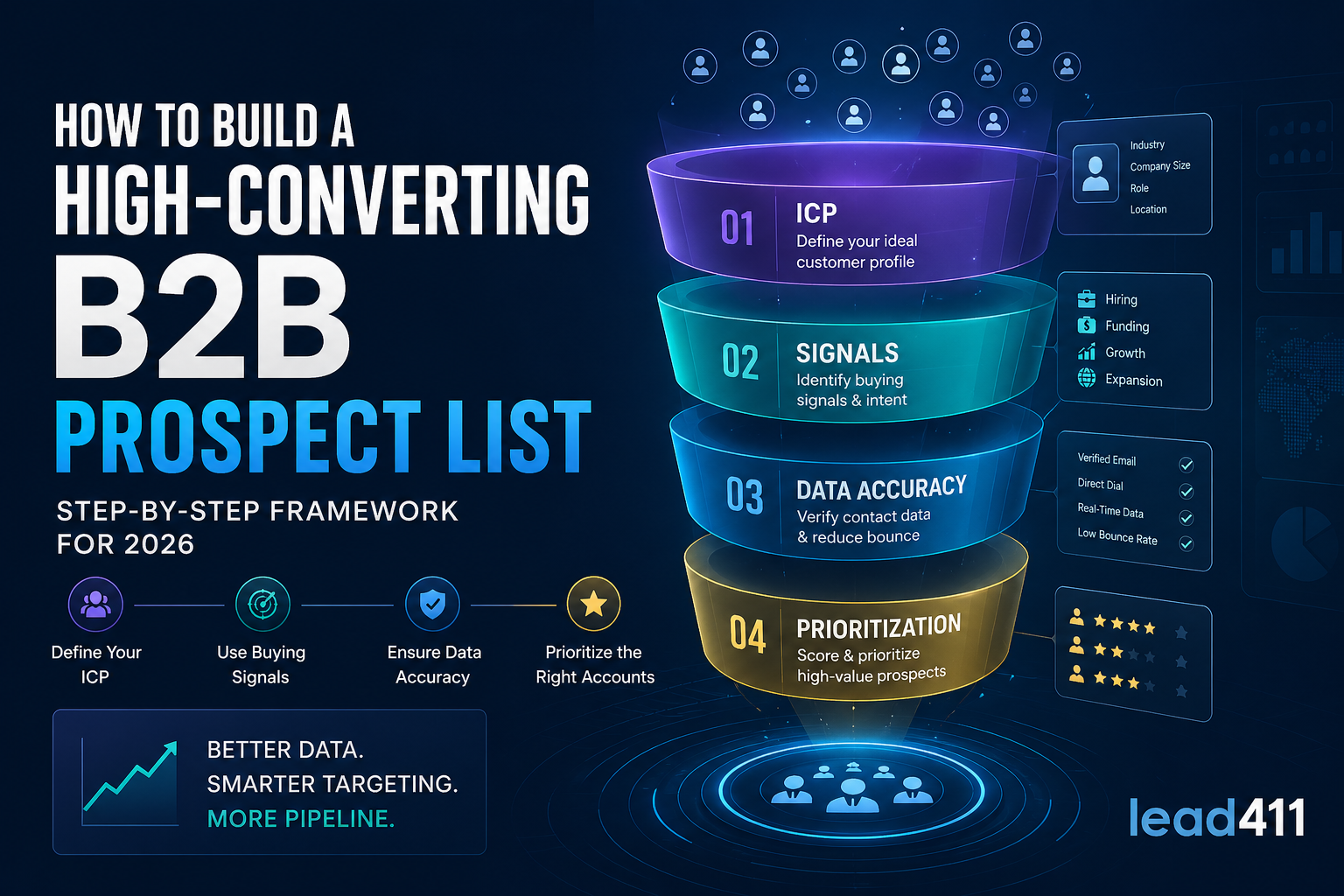
How to Build a High-Converting B2B Prospect List (Step-by-Step Framework for 2026)
Quick Summary
Most prospect lists fail before the first email is even sent. Teams often assume the issue is messaging, but in reality, poor list construction is the root cause of low response rates, high bounce rates, and missed opportunities.
The highest-performing outbound teams don’t rely on static lists or mass data pulls. Instead, they build structured systems that combine accurate data, real-time signals, and prioritization. When these elements are aligned, outreach becomes more relevant, deliverability improves, and conversion rates increase.
If your current campaigns are underperforming, it’s worth reviewing how your data is impacting results. For example, bounce rate benchmarks by industry show how quickly performance drops when data quality declines, while this guide on fixing high bounce rates explains how data accuracy directly affects deliverability.
What the Data Actually Shows
Across thousands of outbound campaigns, a consistent pattern emerges. Prospecting success is not random—it follows predictable inputs based on data quality and timing.
When teams combine verified data with strong buying signals, they consistently achieve the highest conversion rates. When they rely on data alone without considering timing, results become inconsistent. And when they depend on large, unfiltered lists, performance drops significantly due to poor targeting and outdated contacts.
Most outbound problems start with bad data and poor timing—not bad messaging. Improving these two areas often produces faster and more measurable gains than rewriting emails or increasing send volume.
Why Most B2B Prospect Lists Fail
The majority of prospect lists fail for predictable reasons. First, many teams rely on outdated or aggregated data sources that haven’t been recently verified. As people change roles and companies evolve, this leads to inaccurate contact information and higher bounce rates.
Second, most lists are built without considering timing. Even if the right person is targeted, reaching them when they are not actively evaluating solutions significantly lowers the likelihood of engagement.
Finally, there is often no prioritization strategy. All prospects are treated equally, which results in wasted effort on low-value or low-intent accounts.
Volume creates activity, but accuracy and timing create pipeline. Without those two elements, even the largest lists will underperform.
Why Most Prospect Lists Never Convert
The biggest mistake teams make is prioritizing volume over relevance. There is a common assumption that sending more emails will produce better results, but in reality, increasing volume without improving data quality often has the opposite effect.
Larger lists introduce more inaccuracies, more irrelevant contacts, and more noise. This leads to lower engagement rates and damages sender reputation over time.
More data does not equal more pipeline. Better data does. The highest-performing teams focus on precision rather than scale.
The 4-Layer Prospecting Framework
To consistently build high-converting prospect lists, top-performing teams use a structured approach based on four key layers: defining the right audience, identifying the right timing, ensuring data accuracy, and prioritizing outreach effectively.
Each layer plays a critical role. If one is missing, performance drops. When all four are aligned, prospecting becomes significantly more effective and predictable.
Layer 1: Define Your ICP
Everything starts with a clearly defined ideal customer profile (ICP). This includes identifying the industries, company sizes, and roles that are most likely to benefit from your solution.
For example, if you are targeting technical buyers, your ICP may focus on mid-sized SaaS companies and roles such as IT Directors or DevOps leaders. You can see how this targeting works in practice in this guide on finding IT Directors at SaaS companies, while marketing-focused targeting strategies are outlined in this post on targeting CMOs at e-commerce brands.
Without a clear ICP, even the most accurate data will fail to convert.
Layer 2: Use Buying Signals
Timing is one of the most overlooked elements in prospecting. Reaching the right person at the wrong time produces minimal results, while reaching them during a period of change or investment dramatically increases engagement.
Common buying signals include hiring trends, funding events, and expansion into new markets. For example, companies hiring IT teams are often investing in infrastructure, which creates an opportunity for relevant solutions, as explained in this guide on finding companies hiring IT teams. Similarly, organizations that have recently raised funding tend to increase spending, which is covered in this walkthrough on targeting companies after funding events, while expansion signals are explored further in this article on companies entering new markets.
Sending at the right time matters more than sending to more people.
Layer 3: Ensure Data Accuracy
Even the best targeting strategy will fail if the underlying data is inaccurate. Invalid email addresses lead to higher bounce rates, which negatively impact deliverability and reduce the likelihood of reaching the inbox.
High-performing teams typically maintain bounce rates below 8%, which is a strong indicator of data quality. When bounce rates exceed 12%, it usually signals that the data source is outdated or unreliable.
Bounce rate is the fastest way to diagnose data quality. Improving accuracy often produces immediate improvements in campaign performance.
Layer 4: Prioritize Accounts
Not all prospects are equal. Prioritization ensures that your highest-value opportunities are addressed first, maximizing efficiency and impact.
This can be based on a combination of intent signals, company growth indicators, and recent activity. Companies that show multiple signals, such as hiring and expansion, typically represent higher-value opportunities.
By focusing on these accounts first, teams can improve both response rates and pipeline generation.
Example: Building a High-Converting Prospect List
To illustrate how this framework works in practice, consider a team targeting SaaS companies that are actively hiring IT leaders. The ICP would include mid-sized SaaS companies with 50 to 500 employees, while the signal would focus on hiring for DevOps or IT roles.
The data layer would ensure that contact information for IT Directors is verified and up to date, and prioritization would focus on companies hiring multiple technical roles, as this often indicates active investment.
This structured approach consistently outperforms generic list-building strategies because it aligns targeting, timing, and data quality.
Tools That Support High-Performing Prospect Lists
Lead411
Best for accuracy and intent-driven prospecting. Lead411 focuses on verified contact data, which helps reduce bounce rates and improve deliverability. Unlike platforms that prioritize database size, Lead411 emphasizes data freshness and accuracy, ensuring outreach reaches real decision-makers.
In addition to data accuracy, Lead411 integrates intent signals, allowing teams to identify companies actively researching solutions. This combination enables more targeted outreach and improves the likelihood of engagement.
Best for: teams that prioritize precision, deliverability, and timing over raw volume.
ZoomInfo
Best for scale—but often expensive. ZoomInfo provides one of the largest B2B databases available, making it a common choice for enterprise organizations. However, large datasets can introduce variability in accuracy, particularly in rapidly changing industries.
Many teams find that they pay for more data than they actually use, and additional filtering is often required to isolate high-quality contacts.
Best for: enterprise teams that require broad coverage and have the resources to manage large datasets.
Apollo
Best for affordability—but less consistent. Apollo combines prospecting data with outreach tools, making it accessible for startups and smaller teams. However, because it relies on aggregated data sources, accuracy can vary.
This often leads to higher bounce rates and requires additional validation to maintain deliverability.
Best for: teams with limited budgets that are willing to trade accuracy for cost savings.
The key difference between these platforms comes down to accuracy versus volume.
Quick Checklist
To build a high-converting prospect list, teams should ensure they have clearly defined their ICP, incorporated real buying signals, validated contact data, prioritized high-value accounts, and continuously monitored performance metrics.
Improving these five areas can significantly increase outbound performance in a short period of time.
Final Takeaways
The best prospect lists are built, not downloaded. Success in outbound sales comes from combining accurate data, relevant timing, and strategic prioritization.
Teams that invest in these areas consistently outperform those that rely on large, unfiltered datasets.
If you're looking to improve your prospecting results, you can request a demo or explore pricing options to see how verified data and intent signals can improve performance.
Frequently Asked Questions About Building B2B Prospect Lists
What is a B2B prospect list?
A B2B prospect list is a curated set of companies and contacts that match your ideal customer profile. High-performing lists include accurate contact data, relevant targeting, and timing signals that indicate when a company is likely to buy.
How do you build a high-quality B2B prospect list?
High-quality lists are built using a combination of ICP targeting, buying signals, verified contact data, and prioritization. The most effective lists focus on accuracy and timing rather than volume.
Why do most prospect lists fail?
Most lists fail because they rely on outdated or unverified data, lack timing signals, and are not prioritized. This leads to low response rates and poor deliverability.
What data should be included in a prospect list?
A strong prospect list includes company information, decision-maker contact details, intent signals, and recent activity such as hiring or funding events.
What is the best way to find decision-makers?
The best approach is to use verified data providers that specialize in accurate contact information. Combining this with targeting by role and company size improves results.
How important is data accuracy in prospecting?
Data accuracy is critical. Inaccurate data leads to high bounce rates, poor deliverability, and reduced engagement.
What is a good bounce rate for prospecting lists?
A good bounce rate is typically between 5% and 8%. Anything above 12% indicates a data quality problem.
How do buying signals improve prospect lists?
Buying signals help identify when a company is likely to purchase. This allows teams to prioritize outreach and improve conversion rates.
What tools are best for building prospect lists?
Tools that combine verified data with intent signals are the most effective. Platforms like Lead411 focus on accuracy and timing, while others may prioritize scale.
Is ZoomInfo good for building prospect lists?
ZoomInfo provides large datasets, but accuracy can vary. Many teams find it expensive relative to usage.
Does Apollo have accurate data?
Apollo is affordable but relies on aggregated data sources, which can lead to inconsistencies in accuracy.
How often should prospect lists be updated?
Prospect lists should be updated regularly, ideally before each campaign, to remove outdated contacts and maintain accuracy.
What is the difference between verified and aggregated data?
Verified data is actively validated for accuracy, while aggregated data is collected from multiple sources and may include outdated information.
How do you prioritize prospects?
Prioritization should be based on intent signals, company activity, and relevance to your ICP. This ensures high-value prospects are contacted first.
What is the fastest way to improve prospecting results?
The fastest way is to improve data quality and target companies based on buying signals rather than sending to large, unfiltered lists.
Recent Posts
Lead411 vs Cognism: Which B2B Data Provider Delivers Better Data, More Meetings, and Higher ROI in 2026?
If you're evaluating B2B data providers in 2026, there's a good chance Lead411 and Cognism are both on your shortlist. Both platforms help sales and marketing teams identify decision-makers, access contact information, improve prospecting efficiency, and generate more...
Why Companies Move On From Clay: The Hidden Cost of Chasing More Data
Over the past few years, few platforms have generated as much excitement in sales, RevOps, and growth circles as Clay. It has become one of the most talked-about prospecting platforms in modern outbound sales, helping teams automate research, enrich contacts, build...

Why Outbound Feels Harder Than It Did 3 Years Ago
Talk to almost any SDR leader, founder, VP of Sales, CRO, or RevOps professional today and you'll hear some version of the same concern: Outbound feels harder than it used to. Three years ago, many sales teams could build a prospect list, launch a sequence, make a few...

- Sales Services
- Cybersecurity
- SaaS/Technology
- Energy / CleanTech
- Manufacturing
- Hospitality / Travel / Tourism
- Financial / FinTech
- Healthcare / MedTech
- Logistics / Transportation
- Account Based Marketing
- Recruiting
- Real Estate & Construction
- Professional Services & Consulting
- SLED Data Solutions
- Retail / E-Commerce
- Legal Services
resources
Zoominfo Intent vs Bombora Intent in 2026 | Top 3 B2b Buyer Intent Providers in 2026 | Zoominfo Pricing in 2026 | Linkedin Sales Navigator Competitors (2026) | Clearbit Pricing (2026) | Hubspot Pricing Review (2026) | Lead411 Competitors in 2026| Top 5 Linkedin Email Finders for 2026 | How to Find Someone's Phone Number in 2026 | Apollo.io vs. Lead411 Chrome Extension in 2026 | Apollo.io vs. Zoominfo in 2026 | Top 10 B2B Data Resellers in 2026 | Zoominfo API | Seamless.ai vs. Zoominfo in 2026 | 10 Best Clay Competitors for 2026 | What Does Lead Generation Look Like in 2026? | Zoominfo MCP Server |
7 Best B2B Data Providers for 2026 | 15 Best Sales Lead Databases for B2B in 2026 | Apollo.io MCP Server | Questions About Zoominfo
© 2026 Lead411 All Rights Reserved | Your Privacy Choices | Privacy Policy | Do Not Sell | CCPA | Terms Of Use | Lead411 is a registered data broker under applicable state laws, including under Texas law. To conduct business in Texas, a data broker must register with the Texas Secretary of State (Texas SOS). Information about data broker registrants is available on the Texas SOS website.
- Sales Services
- Cybersecurity
- SaaS/Technology
- Energy / CleanTech
- Manufacturing
- Hospitality / Travel / Tourism
- Financial / FinTech
- Healthcare / MedTech
- Logistics / Transportation
- Account Based Marketing
- Recruiting
- Real Estate & Construction
- Professional Services & Consulting
- SLED Data Solutions
- Retail / E-Commerce
- Legal Services
resources
Zoominfo Intent vs Bombora Intent in 2026 | Top 3 B2b Buyer Intent Providers in 2026 | Zoominfo Pricing in 2026 | Linkedin Sales Navigator Competitors (2026) | Clearbit Pricing (2026) | Hubspot Pricing Review (2026) | Lead411 Competitors in 2026| Top 5 Linkedin Email Finders for 2026 | How to Find Someone's Phone Number in 2026 | Apollo.io vs. Lead411 Chrome Extension in 2026 | Apollo.io vs. Zoominfo in 2026 | Top 10 B2B Data Resellers in 2026 | Zoominfo API | Seamless.ai vs. Zoominfo in 2026 | 10 Best Clay Competitors for 2026 | What Does Lead Generation Look Like in 2026? | Zoominfo MCP Server |
7 Best B2B Data Providers for 2026 | 15 Best Sales Lead Databases for B2B in 2026 | Apollo.io MCP Server | Questions About Zoominfo