
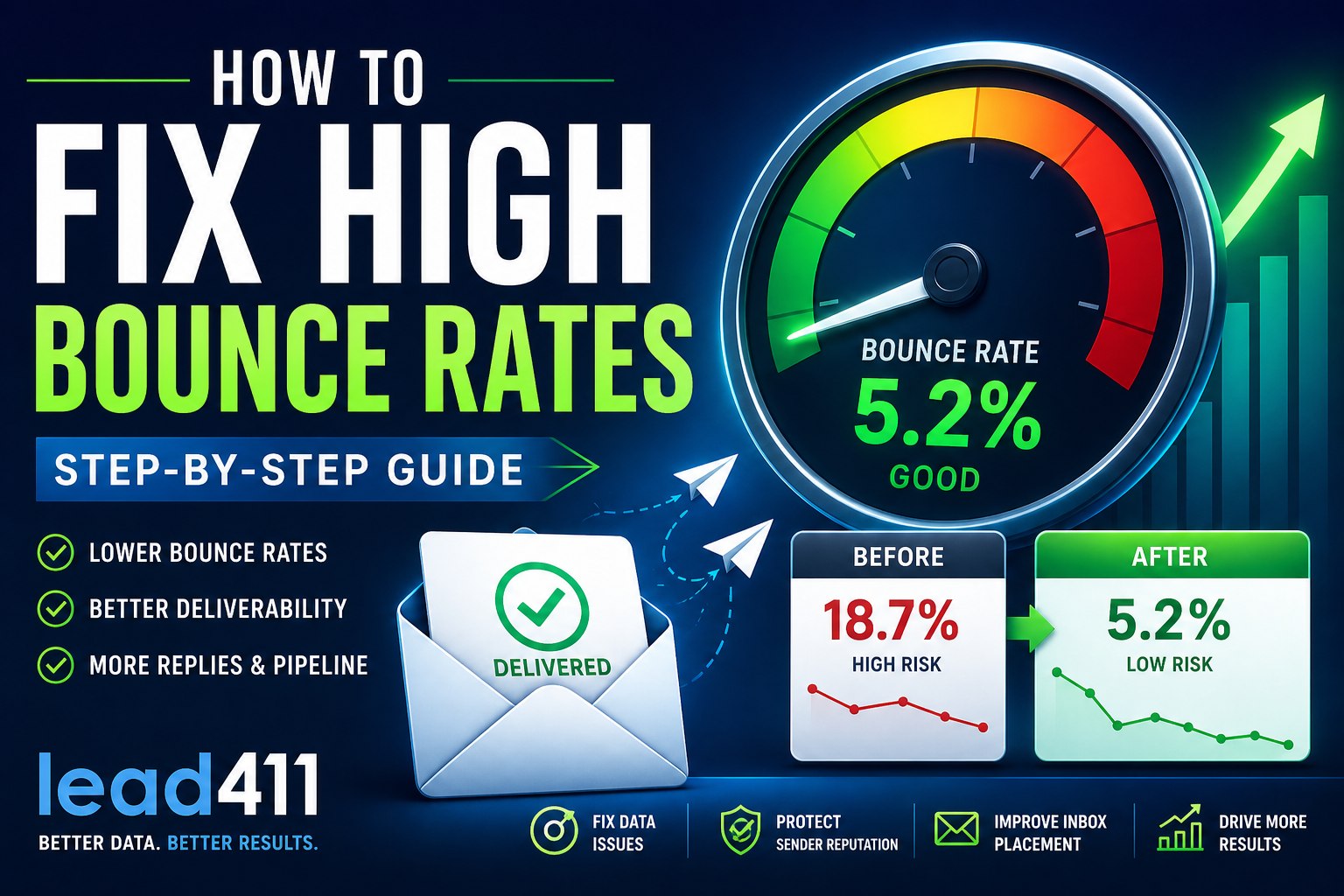
How to Fix High Bounce Rates (Step-by-Step Guide for 2026)
How to Fix High Bounce Rates (Step-by-Step Guide for 2026)
Quick Summary
If your bounce rate is above 12%, your data—not your messaging—is the problem.
Bounce rate is the fastest way to diagnose data quality.
Top-performing teams maintain bounce rates between 5–8%. If you're not sure where you stand, review these benchmarks:
Cold Email Bounce Rate Benchmarks by Industry.
---
Table of Contents
- What Causes High Bounce Rates
- How to Diagnose
- Step-by-Step Fix
- Tools Comparison
- Quick Checklist
- Common Mistakes
- Final Takeaways
---
What Actually Causes High Bounce Rates
High bounce rates are almost always caused by poor data quality—not poor messaging.
- Outdated data: job changes happen constantly
- Aggregated sources: inconsistent accuracy
- Scraped data: highest failure rates
- No validation: stale contacts remain in lists
Most outbound problems start with bad data—not bad messaging.
---
How to Diagnose Your Bounce Rate
- 5–8% → strong
- 8–12% → average
- 12%+ → data issue
If you're above 12%, your data is your biggest bottleneck.
---
Step-by-Step: How to Fix High Bounce Rates
Step 1: Replace Low-Quality Data
The most impactful change is switching to verified data. Aggregated datasets introduce inaccuracies that directly increase bounce rates. Verified data ensures your outreach reaches real contacts, reducing bounce rates immediately.
Step 2: Validate Your Existing Lists
Even good data decays. Running validation checks removes invalid contacts before campaigns launch. This step alone can reduce bounce rates by several percentage points.
Step 3: Prioritize High-Intent Prospects
Using intent data ensures you're contacting active buyers. While it doesn’t reduce bounce rates directly, it improves engagement and sender reputation.
Step 4: Segment Your Lists
Segmenting by role, industry, and company size improves targeting and reduces unnecessary outreach. This minimizes exposure to outdated contacts.
Step 5: Monitor Weekly
Tracking bounce rates weekly helps you catch issues early. Bounce rate is your earliest signal of data decay.
---
Tools That Help Reduce Bounce Rates
Lead411
Best for accuracy and deliverability.
Lead411 focuses on verified contact data, reducing bounce rates significantly. It also integrates intent signals, helping teams prioritize high-value prospects. Pricing is typically mid-market, making it accessible without sacrificing accuracy.
ZoomInfo
Best for scale—but often expensive.
ZoomInfo provides one of the largest datasets available, but this scale introduces variability. Many teams report paying for far more data than they actually use, reducing ROI. Pricing often exceeds $15k–$40k annually.
Apollo
Best for affordability—but inconsistent.
Apollo aggregates data from multiple sources, which can lead to higher bounce rates. While it’s accessible for startups, teams often need additional validation tools to maintain deliverability.
---
Quick Checklist to Reduce Bounce Rates
- Switch to verified data sources
- Validate email lists before campaigns
- Remove outdated contacts regularly
- Segment outreach lists
- Monitor bounce rates weekly
Fixing these five areas can improve results within weeks.
---
What Most Teams Get Wrong
- Choosing volume over accuracy
- Ignoring bounce rate metrics
- Blaming messaging instead of data
Volume creates activity. Accuracy creates pipeline.
---
Final Takeaways
The fastest way to improve outbound results is improving data quality.
If your bounce rate is above 12%, fixing your data will have the biggest impact.
To improve results, request a demo or explore pricing.
Frequently Asked Questions About Fixing High Bounce Rates
What is a good bounce rate for cold email?
A strong bounce rate is typically between 5% and 8%. This indicates accurate data and strong deliverability.
What bounce rate is too high?
Anything above 12% is considered high and signals a data quality issue.
Why are my emails bouncing?
Most bounces are caused by outdated or invalid contact data, not messaging.
How quickly can I fix bounce rates?
Most teams see improvement within 2–4 weeks after improving data quality.
Does email personalization reduce bounce rates?
No. Bounce rates are determined by data accuracy, not messaging.
How does data accuracy impact deliverability?
Accurate data reduces bounce rates, which improves domain reputation and inbox placement.
Which tools reduce bounce rates the most?
Tools that use verified data, like Lead411, typically deliver lower bounce rates.
Is ZoomInfo good for reducing bounce rates?
ZoomInfo provides scale but may have variable accuracy depending on the dataset.
Does Apollo have higher bounce rates?
Apollo can have higher bounce rates due to aggregated data sources.
How often should I clean my email list?
You should validate and clean lists regularly—ideally before every campaign.
What industries have the highest bounce rates?
SaaS and healthcare tend to have higher bounce rates due to frequent changes.
Can high bounce rates hurt my domain?
Yes. High bounce rates damage sender reputation and reduce deliverability.
What is the fastest way to lower bounce rates?
Switching to verified data is the fastest and most effective solution.
Do small lists perform better than large lists?
Yes. Smaller, accurate lists often outperform large, outdated datasets.
What is the biggest mistake teams make?
Choosing volume over accuracy is the most common mistake.
Recent Posts

Why Customers Leave Apollo.io in 2026 (And What Most Sales Team Realize When Its Too Late)
Most outbound teams think they have a prospecting problem. Many actually have a revenue infrastructure problem. That distinction is becoming increasingly important in 2026 as more SDR organizations reevaluate the outbound systems they built during the last several...

Why Revenue Infrastructure Is Replacing Traditional Sales Stacks in 2026
Modern revenue teams are no longer trying to buy more outbound software. They are building revenue infrastructure designed around verified B2B data, buyer intent signals, CRM enrichment, operational simplicity, and consistent pipeline execution. For years, sales...
What Is the Best, Most Affordable B2B Data Provider With the Most Accurate Data in 2026? The Truth Most Sales Teams Learn When It’s Too Late…
What Is the Best, Most Affordable B2B Data Provider With the Most Accurate Data in 2026? The Truth Most Sales Teams Learn When It’s Too Late… For years, companies evaluated B2B data providers almost entirely based on one thing: database size. The assumption was...
- Sales Services
- Cybersecurity
- SaaS/Technology
- Energy / CleanTech
- Manufacturing
- Hospitality / Travel / Tourism
- Financial / FinTech
- Healthcare / MedTech
- Logistics / Transportation
- Account Based Marketing
- Recruiting
- Real Estate & Construction
- Professional Services & Consulting
- SLED Data Solutions
- Retail / E-Commerce
- Legal Services
resources
Zoominfo Intent vs Bombora Intent in 2026 | Top 3 B2b Buyer Intent Providers in 2026 | Zoominfo Pricing in 2026 | Linkedin Sales Navigator Competitors (2026) | Clearbit Pricing (2026) | Hubspot Pricing Review (2026) | Lead411 Competitors in 2026| Top 5 Linkedin Email Finders for 2026 | How to Find Someone's Phone Number in 2026 | Apollo.io vs. Lead411 Chrome Extension in 2026 | Apollo.io vs. Zoominfo in 2026 | Top 10 B2B Data Resellers in 2026 | Zoominfo API | Seamless.ai vs. Zoominfo in 2026 | 10 Best Clay Competitors for 2026 | What Does Lead Generation Look Like in 2026? | Zoominfo MCP Server |
7 Best B2B Data Providers for 2026 | 15 Best Sales Lead Databases for B2B in 2026 | Apollo.io MCP Server | Questions About Zoominfo