
How to Identify and Target Buying Committees in B2B Sales (2026 Guide)
How to Identify and Target Buying Committees in B2B Sales (2026 Guide)
Quick Summary: Most B2B deals now involve 5–10 stakeholders across technical, financial, and executive roles. Teams that rely on a single contact see stalled deals and lower win rates, while those that engage buying committees early close faster and more consistently.
If your outbound strategy is still built around one “decision-maker,” you’re not just behind—you’re losing deals you should be winning.
This shift is already reshaping how modern outbound works. If you’ve been exploring changes in prospecting or AI-driven outreach, you’ve probably seen it show up in approaches like AI-driven B2B outbound strategies.
The Reality of B2B Buying in 2026
B2B buying has changed quietly—but completely.
Most teams haven’t adjusted yet. They’re still targeting one person, sending one message, and hoping it sticks.
Meanwhile, the actual decision is happening across a group of stakeholders who may never see that message.
This is where most deals get lost—and most teams don’t even realize it.
If you’ve ever had a deal go cold after a strong initial conversation, or lost to a competitor you thought you beat, chances are you were only seeing part of the decision.
Most deals don’t die—they stall quietly inside buying committees you never reached.
What Is a Buying Committee?
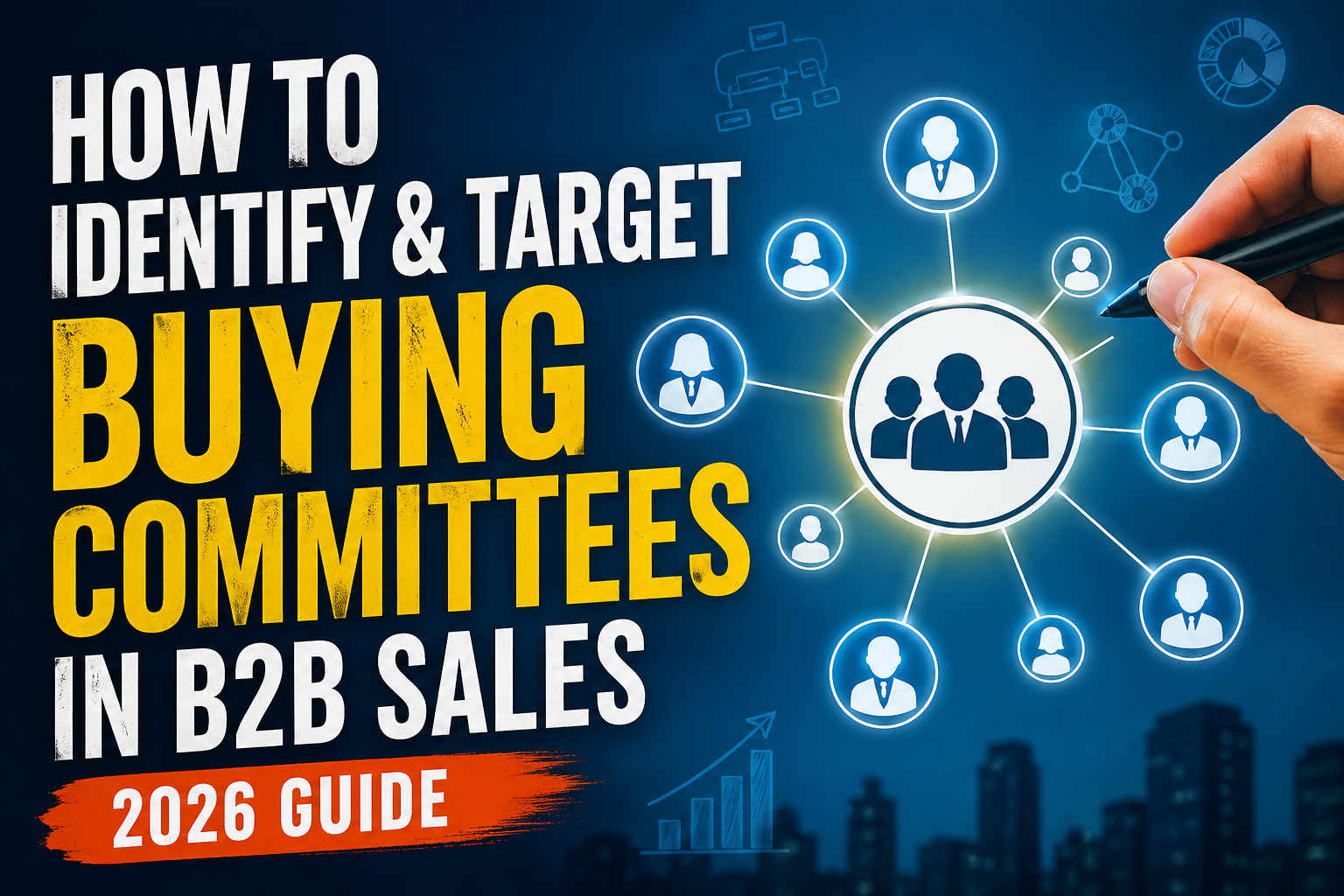
A buying committee is the group of people involved in evaluating and approving a purchase.
In practice, this usually includes:
- Economic buyer: Owns the budget
- Technical buyer: Evaluates feasibility
- End user: Cares about usability
- Executive sponsor: Aligns with company goals
- Blockers: Procurement, legal, finance
Each of these roles has different priorities—and different concerns.
If you’re only talking to one person, you’re only hearing part of the decision.
Why Single-Threaded Outreach Fails
Most outbound strategies are still single-threaded. That means everything depends on one contact.
And that’s where things break down.
- Your contact agrees—but can’t get internal buy-in
- Another stakeholder raises concerns you never addressed
- A competitor engages multiple roles and controls the narrative
Deals aren’t lost because your product isn’t good—they’re lost because you didn’t reach the full buying group.
This is also why many teams struggle with inconsistent pipeline, even when their targeting looks strong on paper. If you’ve run into that, it often connects back to how lists are built and validated—like in this guide to building high-converting prospect lists.
The Buying Committee Mapping Framework
Instead of guessing, high-performing teams follow a repeatable system:
Step 1: Identify the Entry Point
Start with the most obvious role (e.g., IT Director, Head of Sales).
Step 2: Expand Across Roles
Map adjacent stakeholders—finance, operations, leadership.
Step 3: Validate Data
Bad data breaks multi-threading instantly. If emails bounce or roles are outdated, you lose visibility.
Step 4: Layer in Timing Signals
Use signals like hiring or expansion to identify when buying committees are active.
This is where platforms like Lead411’s data solutions stand out—because they combine verified contact data with real-time signals.
If you’ve ever tried doing this manually, you already know how quickly it breaks down without reliable data.
Example: Selling Into a SaaS Company
Let’s make this real.
You’re targeting a SaaS company that’s hiring engineers.
Most teams would:
- Find the IT Director
- Send a few emails
- Wait
Here’s what actually works:
- IT Director → technical fit
- VP Engineering → scalability
- CFO → budget approval
- COO → operational impact
Now your outreach looks different:
- Technical messaging → IT + Engineering
- ROI messaging → CFO
- Efficiency messaging → COO
Instead of hoping one person pushes internally, you’re aligning the entire group.
This is the difference between interest and momentum.
This approach becomes even more effective when paired with targeted data strategies like SaaS prospecting workflows or identifying companies hiring IT teams.
Tools for Identifying Buying Committees
Lead411
Lead411 is designed to help teams identify multiple stakeholders within the same account—not just individual contacts.
Pricing: Subscription-based (predictable)
Geography: Strong US coverage with expanding global data
Re-verification: Continuous validation
Intent Data: Yes (hiring, funding, growth signals)
The key advantage is consistency. You’re not guessing who else is involved—you’re seeing accurate contacts across roles, paired with signals that indicate when decisions are happening.
Explore prospecting tools, review pricing, or request a demo.
Apollo.io
Apollo.io is widely used for outbound list building and automation.
Pricing: Credit-based
Geography: Global
Re-verification: Moderate
Apollo works well for generating volume quickly, but when mapping buying committees, inconsistencies in data can create gaps—especially across multiple roles within the same account.
See how it compares in this comparison guide.
ZoomInfo
ZoomInfo provides one of the largest contact databases available.
Pricing: Enterprise-level contracts
Geography: Strong global coverage
Re-verification: Frequent
It performs well for large teams, but cost and complexity can be limiting. Identifying precise buying committees often requires additional filtering.
Compare options in this ZoomInfo competitors breakdown.
Lusha
Lusha is built for quick contact discovery.
Pricing: Credit-based
Geography: US + Europe
It’s useful for individual prospecting, but lacks the depth needed to map full buying committees.
See alternatives in this guide.
Comparison: What This Actually Means
On paper, most tools look similar.
In practice, the difference shows up quickly:
- High-volume tools → more contacts, less consistency
- Verified data tools → fewer contacts, better outcomes
When you’re targeting buying committees, consistency matters more than scale.
If even one key stakeholder is missing or inaccurate, the entire strategy weakens.
What Happens If You Ignore This
This isn’t theoretical—you can see it play out.
Teams that ignore buying committees typically experience:
- Deals that stall late-stage
- Lower win rates despite strong demos
- Unpredictable pipeline
Over time, this compounds.
What looks like a conversion problem is often a visibility problem—you simply weren’t part of the full conversation.
This is closely tied to data accuracy and deliverability, which is why many teams revisit their approach after issues like high bounce rates—something explored in accuracy comparisons.
Common Mistakes
- Only contacting one stakeholder
- Using identical messaging across roles
- Ignoring internal influence dynamics
- Relying on outdated data
Final Recommendation
If your goal is to send more emails, tools like Apollo or Lusha can help increase volume.
If your goal is to close more deals, you need visibility into buying committees—not just individual contacts.
Lead411 stands out because it combines verified data with intent signals, allowing teams to identify and engage entire buying groups at the right time.
Deals aren’t won by one contact anymore—they’re won by aligning the entire buying committee.
Buying Committee FAQs (B2B Sales in 2026)
What is a buying committee in B2B sales?
A buying committee is a group of stakeholders involved in evaluating and approving a purchase. Instead of one decision-maker, modern B2B deals typically involve multiple roles across departments—such as technical leaders, finance, operations, and executives—each with their own priorities and concerns.
How many people are usually in a buying committee?
Most B2B buying committees include between 5 and 10 stakeholders, depending on company size and deal complexity. Smaller companies may involve fewer people, while enterprise deals can include even more participants across multiple departments.
Why are buying committees important in modern sales?
Buying committees reflect how companies actually make decisions today. Large purchases require alignment across technical, financial, and strategic perspectives, which means sales teams need to engage multiple stakeholders—not just a single contact—to move deals forward.
What happens if you only target one decision-maker?
Targeting only one contact often leads to stalled deals. Even if that person is interested, they may not have the authority or internal support to move forward. Without engaging other stakeholders, objections can surface later in the process and slow or stop the deal entirely.
What roles are typically part of a buying committee?
Common roles include an economic buyer (budget owner), a technical evaluator (IT or engineering), end users, an executive sponsor, and sometimes procurement or legal stakeholders. Each role evaluates the solution from a different perspective.
How do you identify a buying committee?
Identifying a buying committee starts with your initial contact and expands to adjacent roles within the organization. By analyzing job functions, reporting structures, and team responsibilities, you can map out who influences and approves the decision.
How do you target multiple stakeholders effectively?
Effective multi-threading involves tailoring your messaging to each role. For example, technical stakeholders may care about integration and performance, while finance focuses on cost and ROI. Engaging each perspective increases alignment across the group.
What is multi-threaded outreach?
Multi-threaded outreach is the process of engaging multiple stakeholders within the same account simultaneously. Instead of relying on one contact, it ensures your message reaches the full buying committee and reduces dependency on a single champion.
What tools help identify buying committees?
Tools that provide accurate contact data across roles and include company-level insights are most effective. Platforms that combine verified data with signals—such as hiring or expansion—make it easier to identify active buying groups.
How does data accuracy impact buying committee targeting?
Accurate data is critical because missing or outdated contacts can leave gaps in your outreach. If key stakeholders are not included—or emails bounce—you lose visibility into the full decision-making process.
What is the biggest mistake sales teams make with buying committees?
The most common mistake is focusing too heavily on one contact. Even strong relationships can fail if other stakeholders are not engaged early, leading to misalignment and delayed decisions.
Do buying committees slow down the sales process?
Buying committees can extend timelines if not handled properly. However, engaging multiple stakeholders early often speeds up decisions by aligning priorities upfront and reducing objections later in the process.
How can you shorten sales cycles with buying committees?
Sales cycles can be shortened by proactively identifying stakeholders, aligning messaging across roles, and addressing concerns early. This reduces back-and-forth during later stages and helps maintain deal momentum.
Is it better to prioritize one stakeholder or multiple?
While it’s important to have a primary contact, engaging multiple stakeholders typically leads to stronger outcomes. It reduces risk, increases internal alignment, and improves the likelihood of closing the deal.
What’s the future of buying committees in B2B sales?
Buying committees are becoming more complex as organizations prioritize collaboration and risk management. Sales teams that adapt by using multi-threaded strategies and accurate data will be better positioned to win deals in this environment.
Recent Posts
What are the Best Data Providers for Staffing Firms?
Best Data Providers for Staffing Firms (2026 Guide) Quick Summary The best data providers for staffing firms are those that deliver verified contact data, direct dials, and precise targeting for both hiring managers and candidates. Recruiters operate in a...
How to Get a List of Companies That Use Salesforce? (2026 Guide)
How to Get a List of Companies That Use Salesforce (2026 Guide) Quick Summary The fastest way to get a list of companies that use Salesforce is to use a B2B data provider with technographic filtering. Technographic data identifies which software companies use,...

How to Find Executive Phone Numbers (2026 Guide)
How to Find Executive Phone Numbers (Step-by-Step Guide for 2026) Quick Summary The fastest way to find executive phone numbers is to use a verified B2B data provider that includes direct dials, real-time validation, and intent-based targeting. Manual research methods...

- Sales Services
- Cybersecurity
- SaaS/Technology
- Energy / CleanTech
- Manufacturing
- Hospitality / Travel / Tourism
- Financial / FinTech
- Healthcare / MedTech
- Logistics / Transportation
- Account Based Marketing
- Recruiting
- Real Estate & Construction
- Professional Services & Consulting
- SLED Data Solutions
- Retail / E-Commerce
- Legal Services
resources
Zoominfo Intent vs Bombora Intent in 2026 | Top 3 B2b Buyer Intent Providers in 2026 | Zoominfo Pricing in 2026 | Linkedin Sales Navigator Competitors (2026) | Clearbit Pricing (2026) | Hubspot Pricing Review (2026) | Lead411 Competitors in 2026| Top 5 Linkedin Email Finders for 2026 | How to Find Someone's Phone Number in 2026 | Apollo.io vs. Lead411 Chrome Extension in 2026 | Apollo.io vs. Zoominfo in 2026 | Top 10 B2B Data Resellers in 2026 | Zoominfo API | Seamless.ai vs. Zoominfo in 2026 | 10 Best Clay Competitors for 2026 | What Does Lead Generation Look Like in 2026? | Zoominfo MCP Server |
7 Best B2B Data Providers for 2026 | 15 Best Sales Lead Databases for B2B in 2026 | Apollo.io MCP Server | Questions About Zoominfo
© 2026 Lead411 All Rights Reserved | Your Privacy Choices | Privacy Policy | Do Not Sell | CCPA | Terms Of Use | Lead411 is a registered data broker under applicable state laws, including under Texas law. To conduct business in Texas, a data broker must register with the Texas Secretary of State (Texas SOS). Information about data broker registrants is available on the Texas SOS website.
- Sales Services
- Cybersecurity
- SaaS/Technology
- Energy / CleanTech
- Manufacturing
- Hospitality / Travel / Tourism
- Financial / FinTech
- Healthcare / MedTech
- Logistics / Transportation
- Account Based Marketing
- Recruiting
- Real Estate & Construction
- Professional Services & Consulting
- SLED Data Solutions
- Retail / E-Commerce
- Legal Services
resources
Zoominfo Intent vs Bombora Intent in 2026 | Top 3 B2b Buyer Intent Providers in 2026 | Zoominfo Pricing in 2026 | Linkedin Sales Navigator Competitors (2026) | Clearbit Pricing (2026) | Hubspot Pricing Review (2026) | Lead411 Competitors in 2026| Top 5 Linkedin Email Finders for 2026 | How to Find Someone's Phone Number in 2026 | Apollo.io vs. Lead411 Chrome Extension in 2026 | Apollo.io vs. Zoominfo in 2026 | Top 10 B2B Data Resellers in 2026 | Zoominfo API | Seamless.ai vs. Zoominfo in 2026 | 10 Best Clay Competitors for 2026 | What Does Lead Generation Look Like in 2026? | Zoominfo MCP Server |
7 Best B2B Data Providers for 2026 | 15 Best Sales Lead Databases for B2B in 2026 | Apollo.io MCP Server | Questions About Zoominfo