
Signal-Based Prospecting: The New Outbound Playbook
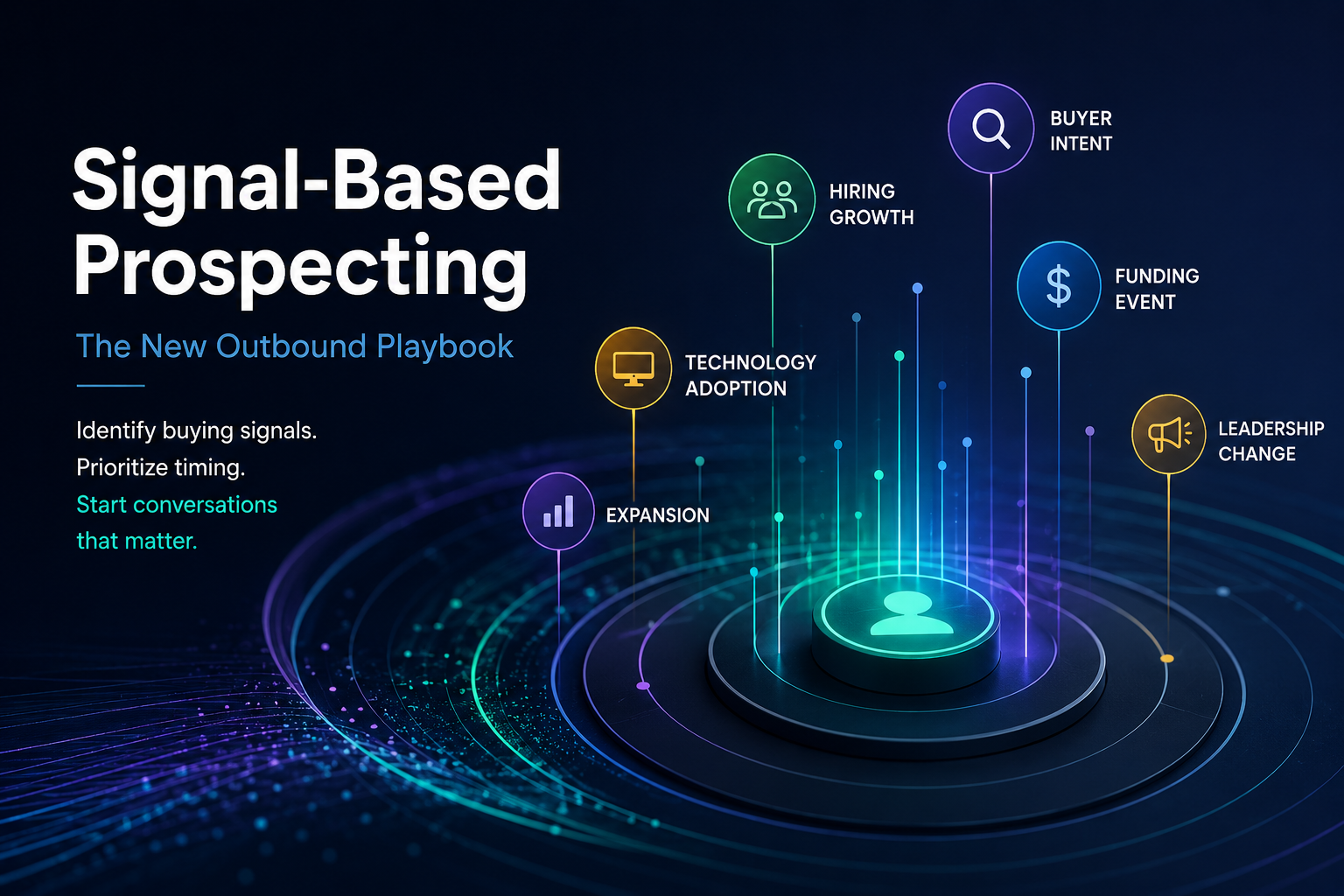
Signal-Based Prospecting: The New Outbound Playbook
Outbound sales changed quietly.
Most companies just have not fully realized it yet.
For years, the dominant outbound model was simple:
- build a giant list,
- load a sequence,
- send enough emails,
- and let volume do the work.
That approach created an entire generation of GTM software built around:
- database size,
- seat expansion,
- activity metrics,
- and outbound scale.
And for a long time, it worked.
But today, most buyers live in permanent outreach saturation.
Every SDR team has automation.
Every company has AI-generated personalization.
Every inbox is crowded.
Which means the competitive advantage is no longer:
“Who can contact the most people?”
The competitive advantage is increasingly:
“Who can identify buying windows before everyone else does?”
That shift is what created signal-based prospecting.
And it is rapidly becoming the foundation of modern outbound sales.
Quick Summary
- Signal-based prospecting focuses on identifying accounts showing operational change, buying intent, or timing indicators.
- Modern SDR teams increasingly prioritize signals over static lead volume.
- The strongest outbound workflows combine buyer intent, hiring activity, technographic data, funding events, and AI-assisted research.
- Traditional volume-based outbound is becoming less effective because buyers are overwhelmed with automated outreach.
- Lead411 helps SDR teams operationalize signal-based prospecting using verified B2B data, intent signals, technographics, and outbound intelligence.
Table of Contents
- Why Traditional Outbound Is Breaking
- What Is Signal-Based Prospecting?
- Why Timing Matters More Than Volume
- The Most Important Sales Signals Right Now
- The Signal Hierarchy Framework
- How Top SDR Teams Use Signals
- What Signal Stacking Actually Looks Like
- Why Most Sales Signals Fail
- The Buying Window Framework
- How AI SDR Workflows Use Signals
- Traditional vs Signal-Based Prospecting
- What Most Teams Get Wrong
- The Future of Outbound
- FAQ
Why Traditional Outbound Is Breaking
Most outbound systems were built during a very different era of B2B sales.
An era when:
- buyers received fewer cold emails,
- automation was less common,
- data providers were less saturated,
- and SDR teams could still win primarily through activity volume.
That environment no longer exists.
Modern buyers are overwhelmed with outbound.
And the average prospect can immediately recognize:
- generic messaging,
- forced personalization,
- AI-generated filler,
- and low-context outreach.
This is one reason reply rates have dropped so aggressively across the industry.
The problem is not necessarily that outbound stopped working.
The problem is that:
Most outbound still operates like timing does not matter.
But timing matters enormously.
In reality, most buyers only seriously evaluate solutions during specific operational moments:
- team expansion,
- process breakdowns,
- new leadership,
- funding growth,
- system migrations,
- or active vendor research.
The companies identifying those moments earliest increasingly win the outbound game.
What Is Signal-Based Prospecting?
Signal-based prospecting is an outbound strategy built around identifying measurable indicators that suggest a company may be entering a buying window.
Instead of prioritizing static lists, SDR teams prioritize:
- operational change,
- buying intent,
- growth signals,
- and timing indicators.
These indicators are commonly referred to as sales signals or buying signals.
Examples include:
- Hiring SDR teams
- Hiring RevOps leaders
- Funding announcements
- Technology adoption
- CRM migrations
- Executive leadership changes
- Intent data spikes
- New office expansion
- Rapid employee growth
These signals matter because they frequently correlate with:
- budget allocation,
- process change,
- vendor evaluation,
- and operational urgency.
That creates dramatically stronger outbound timing.
Why Timing Matters More Than Volume
This is the biggest mental shift happening in outbound sales right now.
For years, sales organizations optimized around volume.
But the best SDR teams increasingly optimize around:
- relevance,
- context,
- and timing.
Because most outbound problems today are not actually data problems.
They are prioritization problems.
Most teams already have access to:
- millions of contacts,
- automation systems,
- AI writing tools,
- and sequencing software.
What they lack is clarity around:
“Who is most likely to care right now?”
That is what signals solve.
A company hiring 15 SDRs, expanding RevOps, and researching sales engagement software is fundamentally different from a random company sitting inside a database.
The timing is different.
The urgency is different.
The probability of engagement is different.
That is why modern outbound increasingly revolves around signal prioritization.
The Most Important Sales Signals Right Now
Not all signals carry equal weight.
Some are weak indicators.
Others strongly correlate with active buying behavior.
Here are some of the highest-value signals modern SDR teams prioritize today.
1. Hiring Signals
Hiring activity is one of the strongest outbound indicators because it often reflects operational expansion.
- Hiring SDRs
- Hiring RevOps leaders
- Hiring marketing operations teams
- Hiring IT infrastructure staff
2. Buyer Intent Data
Intent data tracks companies actively researching solution categories.
Lead411 Intent Data helps SDR teams identify companies researching relevant technologies before competitors engage them.
3. Technographic Signals
Technographic prospecting identifies the technologies companies already use.
Technographic targeting has become foundational for modern outbound segmentation.
4. Funding Signals
Funding events often create immediate operational change, hiring expansion, and infrastructure investment.
5. Leadership Changes
New executives frequently reevaluate vendors, workflows, and GTM systems.
The Signal Hierarchy Framework
One of the biggest mistakes companies make when adopting signal-based prospecting is assuming all signals carry equal weight.
They do not.
In reality, outbound signals exist on a hierarchy.
Level 1: Static Firmographic Data
Firmographics help define ICP fit but are weak timing indicators.
Level 2: Technographic Signals
Technographics create operational context.
Level 3: Growth & Expansion Signals
Hiring and operational growth create stronger buying probability.
Level 4: Intent Signals
Intent data helps identify active research behavior.
Level 5: Compound Signals
Compound signals occur when multiple buying indicators align simultaneously.
| Compound Signal | Why It Matters |
|---|---|
| Intent Data + SDR Hiring | Signals outbound scaling pressure |
| HubSpot Usage + RevOps Hiring | Suggests GTM process expansion |
| Funding + CRM Migration | Often creates operational disruption |
How Top SDR Teams Use Signals
The best outbound teams treat signals like probability indicators — not guarantees.
For example:
- A company hiring SDRs is interesting.
- A company hiring SDRs while researching sales engagement software is significantly more interesting.
- A company hiring SDRs, researching sales engagement platforms, and migrating CRMs becomes extremely high priority.
This is known as signal stacking.
What Signal Stacking Actually Looks Like
| Signal Combination | Why It Matters |
|---|---|
| Intent Data + SDR Hiring | Strong outbound expansion indicator |
| Funding + RevOps Hiring | Signals scaling infrastructure |
| CRM Migration + AI Tool Research | Suggests operational transformation |
| Leadership Change + Hiring Growth | Creates new buying windows |
Why Most Sales Signals Fail
Treating Every Signal Equally
Not every signal deserves equal urgency.
Ignoring Signal Decay
Signals lose value quickly over time.
Confusing Activity With Intent
Operational activity does not always equal active buying readiness.
Automating Before Defining Signal Logic
The strongest AI SDR systems refine signal intelligence before automating execution.
The Buying Window Framework
Most software purchases happen during periods of operational change.
| Buying Window Type | Common Signals |
|---|---|
| Growth Windows | Hiring expansion, funding, SDR growth |
| Operational Stress Windows | RevOps hiring, infrastructure scaling |
| Leadership Transition Windows | New CROs, executive turnover |
| Technology Transition Windows | CRM migrations, AI adoption |
| Research & Evaluation Windows | Intent spikes, vendor comparisons |
How AI SDR Workflows Use Signals
Step 1: Detect Signals
Identify companies showing intent spikes, hiring growth, funding activity, or technographic changes.
Step 2: Enrich Accounts
Use Lead411 sales intelligence data to enrich contacts and company context.
Step 3: Generate AI Research
Use AI systems like Claude to summarize operational context and messaging opportunities.
Step 4: Human Refinement
Strong SDR teams still apply judgment, timing awareness, and operational nuance.
Traditional vs Signal-Based Prospecting
| Traditional Outbound | Signal-Based Prospecting |
|---|---|
| Large static lists | Dynamic account prioritization |
| Volume-focused | Timing-focused |
| Generic personalization | Operational context |
| Broad targeting | Precision targeting |
| Sequence-first workflows | Research-first workflows |
What Most Teams Get Wrong
Many companies automate outreach before clearly defining which signals actually correlate with buying behavior.
The result is usually:
- high activity,
- low relevance,
- and noisy outbound.
The Future of Outbound
The future of outbound belongs to teams that:
- identify buying windows earliest,
- understand operational context fastest,
- and combine AI with signal intelligence most effectively.
Because outbound is becoming less about scale alone — and far more about timing, relevance, and precision.
Request a Lead411 demo to see how modern SDR teams use intent data, hiring signals, technographic targeting, and verified B2B data to operationalize signal-based prospecting at scale.
Frequently Asked Questions About Signal-Based Prospecting
What is signal-based prospecting?
Signal-based prospecting is a modern outbound sales strategy focused on identifying operational changes, buyer intent, hiring activity, and timing indicators that suggest a company may be entering a buying window.
What are buying signals in sales?
Buying signals are measurable indicators that suggest a company may be researching, evaluating, or preparing to purchase a product or service.
Why is signal-based prospecting becoming more popular?
Traditional volume-based outbound has become less effective because buyers are overwhelmed with automated outreach.
What are the best sales signals for outbound prospecting?
Strong sales signals include hiring SDRs, buyer intent spikes, funding rounds, CRM migrations, leadership changes, and rapid employee growth.
What is signal stacking in outbound sales?
Signal stacking is the process of combining multiple buying signals together to identify higher-probability sales opportunities.
How do SDR teams use signal-based prospecting?
Modern SDR teams use signals to prioritize accounts, personalize outreach, improve timing, and identify companies actively experiencing operational change.
What’s the difference between signal-based prospecting and traditional outbound?
Traditional outbound focuses heavily on list volume and activity metrics, while signal-based prospecting focuses on timing, operational context, buyer readiness, and relevance.
How does buyer intent data work?
Buyer intent data tracks online research behavior to identify companies actively researching specific topics, products, or solution categories.
Can signal-based prospecting improve reply rates?
Yes. Outreach tied to relevant operational signals and buying windows is typically more timely and contextual.
What tools are used for signal-based prospecting?
Popular tools include Lead411, Bombora, Clay, ZoomInfo, Apollo.io, and LinkedIn Sales Navigator.
Recent Posts

Lead411 vs Cognism: Which B2B Data Provider Delivers Better Data, More Meetings, and Higher ROI in 2026?
If you're evaluating B2B data providers in 2026, there's a good chance Lead411 and Cognism are both on your shortlist. Both platforms help sales and marketing teams identify decision-makers, access contact information, improve prospecting efficiency, and generate more...

Why Companies Move On From Clay: The Hidden Cost of Chasing More Data
Over the past few years, few platforms have generated as much excitement in sales, RevOps, and growth circles as Clay. It has become one of the most talked-about prospecting platforms in modern outbound sales, helping teams automate research, enrich contacts, build...

Why Outbound Feels Harder Than It Did 3 Years Ago
Talk to almost any SDR leader, founder, VP of Sales, CRO, or RevOps professional today and you'll hear some version of the same concern: Outbound feels harder than it used to. Three years ago, many sales teams could build a prospect list, launch a sequence, make a few...

- Sales Services
- Cybersecurity
- SaaS/Technology
- Energy / CleanTech
- Manufacturing
- Hospitality / Travel / Tourism
- Financial / FinTech
- Healthcare / MedTech
- Logistics / Transportation
- Account Based Marketing
- Recruiting
- Real Estate & Construction
- Professional Services & Consulting
- SLED Data Solutions
- Retail / E-Commerce
- Legal Services
resources
Zoominfo Intent vs Bombora Intent in 2026 | Top 3 B2b Buyer Intent Providers in 2026 | Zoominfo Pricing in 2026 | Linkedin Sales Navigator Competitors (2026) | Clearbit Pricing (2026) | Hubspot Pricing Review (2026) | Lead411 Competitors in 2026| Top 5 Linkedin Email Finders for 2026 | How to Find Someone's Phone Number in 2026 | Apollo.io vs. Lead411 Chrome Extension in 2026 | Apollo.io vs. Zoominfo in 2026 | Top 10 B2B Data Resellers in 2026 | Zoominfo API | Seamless.ai vs. Zoominfo in 2026 | 10 Best Clay Competitors for 2026 | What Does Lead Generation Look Like in 2026? | Zoominfo MCP Server |
7 Best B2B Data Providers for 2026 | 15 Best Sales Lead Databases for B2B in 2026 | Apollo.io MCP Server | Questions About Zoominfo
© 2026 Lead411 All Rights Reserved | Your Privacy Choices | Privacy Policy | Do Not Sell | CCPA | Terms Of Use | Lead411 is a registered data broker under applicable state laws, including under Texas law. To conduct business in Texas, a data broker must register with the Texas Secretary of State (Texas SOS). Information about data broker registrants is available on the Texas SOS website.
- Sales Services
- Cybersecurity
- SaaS/Technology
- Energy / CleanTech
- Manufacturing
- Hospitality / Travel / Tourism
- Financial / FinTech
- Healthcare / MedTech
- Logistics / Transportation
- Account Based Marketing
- Recruiting
- Real Estate & Construction
- Professional Services & Consulting
- SLED Data Solutions
- Retail / E-Commerce
- Legal Services
resources
Zoominfo Intent vs Bombora Intent in 2026 | Top 3 B2b Buyer Intent Providers in 2026 | Zoominfo Pricing in 2026 | Linkedin Sales Navigator Competitors (2026) | Clearbit Pricing (2026) | Hubspot Pricing Review (2026) | Lead411 Competitors in 2026| Top 5 Linkedin Email Finders for 2026 | How to Find Someone's Phone Number in 2026 | Apollo.io vs. Lead411 Chrome Extension in 2026 | Apollo.io vs. Zoominfo in 2026 | Top 10 B2B Data Resellers in 2026 | Zoominfo API | Seamless.ai vs. Zoominfo in 2026 | 10 Best Clay Competitors for 2026 | What Does Lead Generation Look Like in 2026? | Zoominfo MCP Server |
7 Best B2B Data Providers for 2026 | 15 Best Sales Lead Databases for B2B in 2026 | Apollo.io MCP Server | Questions About Zoominfo