
The Great Resignation – Re-Verification of Data is more Important than Ever

, evenThis year has been an unprecedented time for employers as they struggle to maintain a full workforce. Some media outlets are calling it the Great Resignation as people are leaving their current jobs in search of better opportunities. New opportunities that include better compensation with more work-life flexibility, work from home options and better benefits. Some employees are deciding to quit all together and take some time off from working for awhile, and some people are even finding that now is the best time to retire early.
Regardless of the reasons, B2B data companies are struggling to keep up with accuracy rates, as email and phone numbers shut down or are no longer usable. During the last 2 years, unemployment rates have a range of 3.6% to as high as nearly 15%. As you can imagine, data companies have struggled to keep up with accuracy rates as the workforce fluctuates each month. B2B Data Companies that are seeing the biggest accuracy dips are the ones that struggle with a broad re-verification schedule. Those that don’t re-verify data at all or are only re-verifying data between 6 and 36 months.
Some data companies like Seamless.ai rely heavily on a third-party, like Linkedin for their data and don’t have a re-verification schedule at all. Unfortunately, Linkedin advertises that less than half of the profiles (310M out of 722M) on their website are active profiles and these are depreciating further with the “great resignation”, meaning the data is average and barely usable at best.
Recently, companies that have a broad re-verification schedule like Zoominfo, (advertising a 6 month to 3 year re-verification process) are struggling to keep their vast database, even semi-usable to customers. In fact, there have been quite a few complaints about Zoominfo data on various forums and review sites, suggesting that the deterioration of Zoominfo data stems back to March of this year (which makes sense since the unemployment rate in March was approaching 15%), making it difficult for Zoominfo to scale with the amount of B2B data that they have.
Bottom line is that it’s not the amount of data a company has, or the sources - it’s the accuracy of that data and how often it is checked, the process in which it is verified, and the presentation of that data to the customer that is most important. Verification processes differ between most data providers and when it comes to email verification, Lead411 has the edge.
During the verification process, most providers have some type of SMTP handshake to make sure the recipient server exists, and then the email is considered “valid”. Lead411 has always taken this process seriously, and provides further verification by sending, recording and confirming the email is in fact valid and opened by the correct recipient. Customers enjoy less than a 5% bounce rate with this process (even during the last 2 years), and this level of verification is unmatched in the industry.
To Learn more about Lead411 and the quality data you can expect, contact us today for a demo.
Recent Posts
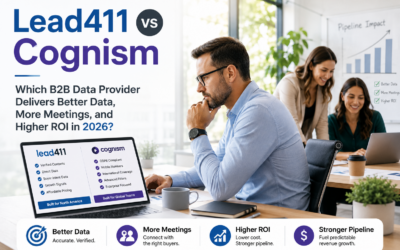
Lead411 vs Cognism: Which B2B Data Provider Delivers Better Data, More Meetings, and Higher ROI in 2026?
If you're evaluating B2B data providers in 2026, there's a good chance Lead411 and Cognism are both on your shortlist. Both platforms help sales and marketing teams identify decision-makers, access contact information, improve prospecting efficiency, and generate more...
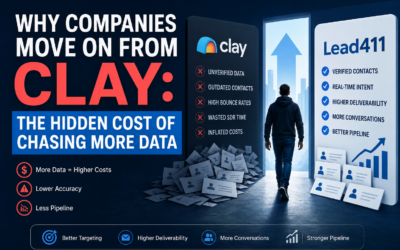
Why Companies Move On From Clay: The Hidden Cost of Chasing More Data
Over the past few years, few platforms have generated as much excitement in sales, RevOps, and growth circles as Clay. It has become one of the most talked-about prospecting platforms in modern outbound sales, helping teams automate research, enrich contacts, build...

Why Outbound Feels Harder Than It Did 3 Years Ago
Talk to almost any SDR leader, founder, VP of Sales, CRO, or RevOps professional today and you'll hear some version of the same concern: Outbound feels harder than it used to. Three years ago, many sales teams could build a prospect list, launch a sequence, make a few...