
Top 5 Best Ways to Target CMOs at E-Commerce Brands with B2B Data
Quick Summary
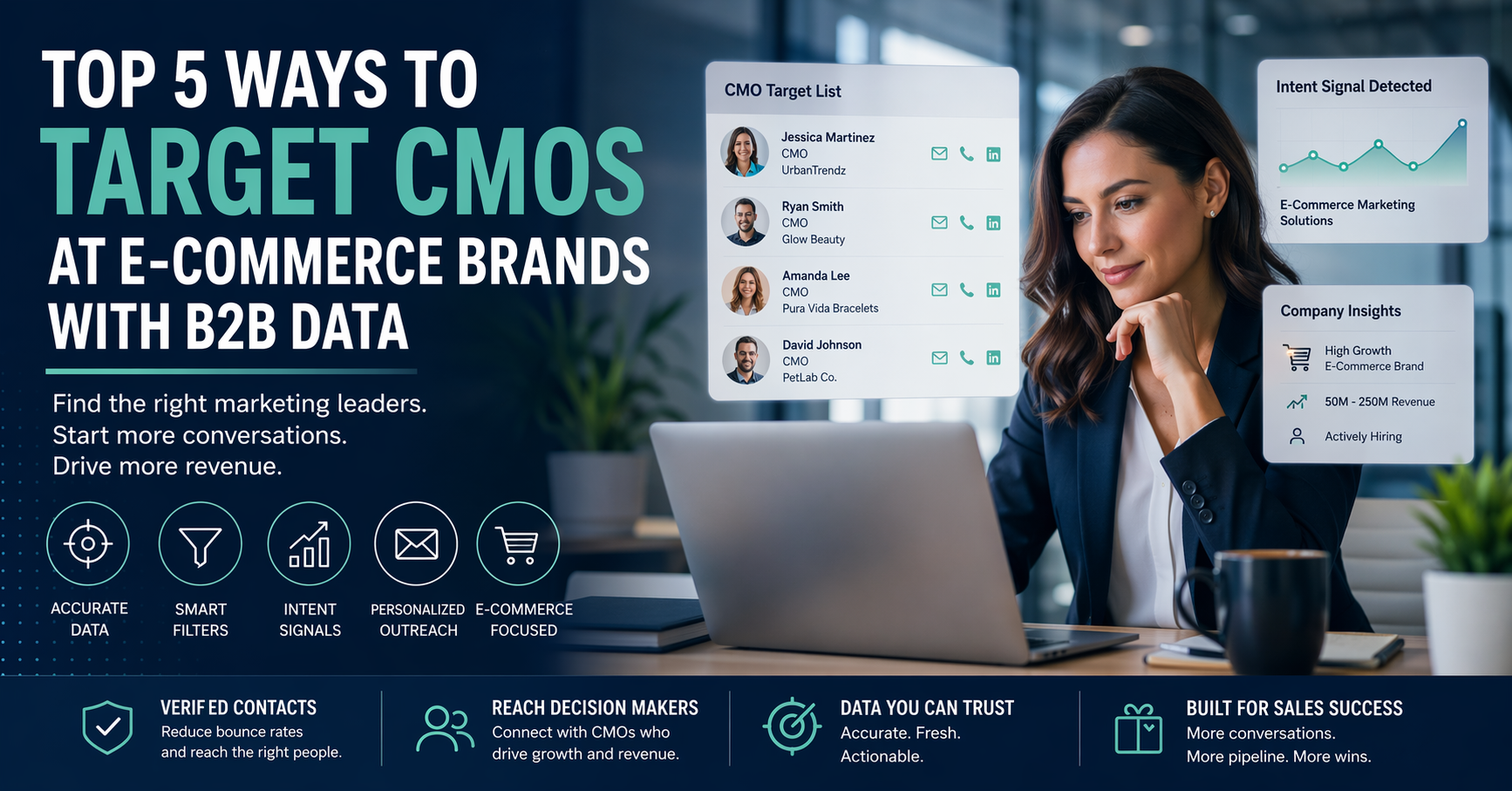
Targeting CMOs at e-commerce brands requires more than just access to contact data — it requires precision, timing, and context. The most effective B2B teams combine accurate contact data with intent signals and segmentation to identify which marketing leaders are actively evaluating solutions.
This guide covers the top 5 strategies for reaching CMOs, along with a deep comparison of the leading B2B data providers that enable high-converting outreach.
- Best overall: Lead411
- Best for enterprise: ZoomInfo
- Best all-in-one: Apollo
- Best for quick prospecting: Lusha
- Best for enrichment workflows: Clearbit
Introduction
CMOs at e-commerce brands sit at the intersection of growth, technology, and customer experience. They oversee acquisition channels, manage martech stacks, and are constantly evaluating new tools that can improve performance.
But reaching them is difficult. Their inboxes are saturated, their priorities shift quickly, and outdated data makes most outreach irrelevant. That’s why modern prospecting relies on a combination of verified contact data, intent signals, and real-time enrichment.
For more context, see this guide on B2B data providers for e-commerce companies.
Top 5 Best Ways to Target CMOs at E-Commerce Brands
1. Use Industry-Specific Filters
Generic lists dilute your targeting. The best-performing teams filter specifically for e-commerce companies using dedicated datasets.
Using e-commerce data targeting ensures your outreach focuses only on relevant brands.
2. Prioritize Intent Signals
Intent data identifies companies actively researching solutions, helping you engage CMOs at the right moment.
Platforms offering intent data provide a major competitive advantage.
3. Maintain Data Accuracy with Enrichment
CMO roles change frequently. Without enrichment, your data becomes outdated quickly.
Contact enrichment helps maintain accuracy and improve deliverability.
4. Combine Firmographic + Behavioral Data
The most effective targeting strategies combine company-level data with behavioral insights.
5. Align Messaging with CMO Priorities
CMOs care about revenue growth, CAC reduction, and marketing efficiency — your messaging should reflect that.
Top B2B Data Providers for Targeting CMOs
1. Lead411
Lead411 is designed for teams that need accurate, actionable B2B data without the high cost of enterprise platforms. It stands out particularly for targeting CMOs in e-commerce due to its strong combination of verified data and intent signals.
Core Features:
- Verified emails and direct dials
- Bombora-powered intent data
- Lead prospecting tools
- CRM integrations and enrichment capabilities
Strengths:
Lead411 excels in delivering high-quality, verified contact data combined with intent signals that help teams prioritize outreach. For e-commerce targeting, this is critical because CMOs are constantly evaluating new marketing tools. The platform also offers strong value, making it accessible to mid-market teams that need scale without enterprise pricing.
Weaknesses:
While highly effective in North America, Lead411’s international coverage is not as extensive as some enterprise-focused competitors.
Best Use Cases:
- Outbound sales targeting CMOs
- SaaS companies selling to e-commerce brands
- Agencies running multi-client campaigns
Ideal Customer Profile:
Teams of 5–100 reps targeting mid-market companies with budgets under enterprise pricing thresholds.
Pricing:
Flexible pricing with strong ROI. Start with a demo.
2. ZoomInfo
ZoomInfo is one of the most established enterprise B2B data providers, known for its massive database and advanced feature set. It is commonly used by large organizations targeting CMOs across multiple regions and industries.
Core Features:
- Extensive global contact database
- Advanced intent data and analytics
- Org charts and hierarchy mapping
- Technographic insights
Strengths:
ZoomInfo’s primary strength is scale. It offers one of the largest datasets in the market, making it ideal for global campaigns targeting CMOs at large e-commerce brands. Its advanced filtering and analytics tools also enable complex segmentation strategies.
Weaknesses:
The platform is expensive, often requiring large annual contracts. Additionally, data accuracy can vary in SMB segments, which can impact outreach effectiveness for mid-market targeting.
Best Use Cases:
- Enterprise sales organizations
- Global targeting campaigns
- Advanced ABM strategies
Ideal Customer Profile:
Large organizations with dedicated RevOps teams and significant budgets.
Pricing:
Enterprise pricing. See comparison: ZoomInfo vs Lead411.
3. Apollo
Apollo has gained popularity as an all-in-one sales platform that combines contact data with outreach capabilities. It is particularly appealing to startups and SMBs looking for a cost-effective solution.
Core Features:
- Contact database
- Email sequencing and outreach tools
- Basic intent signals
- Chrome extension
Strengths:
Apollo’s biggest advantage is its all-in-one functionality. Teams can manage prospecting and outreach within a single platform, reducing the need for additional tools. Its pricing model also makes it accessible to smaller teams.
Weaknesses:
Data accuracy can be inconsistent, especially when targeting niche roles like CMOs at specific e-commerce companies. Intent data capabilities are also less advanced compared to premium platforms.
Best Use Cases:
- Startups and early-stage companies
- Founder-led outbound efforts
- Small sales teams
Ideal Customer Profile:
Teams with limited budgets that need an all-in-one solution.
Pricing:
Freemium model. Compare: Apollo alternatives.
4. Lusha
Lusha is a lightweight B2B data provider focused on simplicity and speed. It is commonly used by individual sales reps for quick prospecting tasks.
Core Features:
- Browser extension
- Direct contact data
- Basic integrations
Strengths:
Lusha is extremely easy to use and allows reps to quickly pull contact data from LinkedIn profiles. This makes it useful for fast, manual prospecting workflows.
Weaknesses:
Its biggest limitation is lack of depth. Lusha does not provide advanced filtering, intent data, or large-scale list-building capabilities, making it less suitable for targeting CMOs across large e-commerce segments.
Best Use Cases:
- Individual contributors
- Quick prospecting
Ideal Customer Profile:
Small teams or individuals focused on speed over scale.
Pricing:
Credit-based pricing. See alternatives.
5. Clearbit
Clearbit is known for its data enrichment and API capabilities, often used by marketing and RevOps teams to enhance existing data.
Core Features:
- Data enrichment APIs
- Firmographic and technographic data
- Integration with marketing platforms
Strengths:
Clearbit excels at enriching existing datasets and providing detailed company-level insights. It is particularly useful for marketing teams that need to enhance inbound leads.
Weaknesses:
It is not designed primarily for outbound prospecting, and pricing can be high. It also lacks the same level of intent-driven targeting as some competitors.
Best Use Cases:
- Marketing enrichment workflows
- RevOps teams
Ideal Customer Profile:
Organizations focused on inbound and data enrichment.
Pricing:
Premium pricing. See alternatives.
Final Thoughts
Targeting CMOs at e-commerce brands requires precision, timing, and the right data. While multiple tools exist, platforms that combine verified data with intent signals provide the strongest results.
For teams looking to improve targeting and conversion rates, starting with a Lead411 demo is a practical next step.