
Why Companies Move On From Clay: The Hidden Cost of Chasing More Data
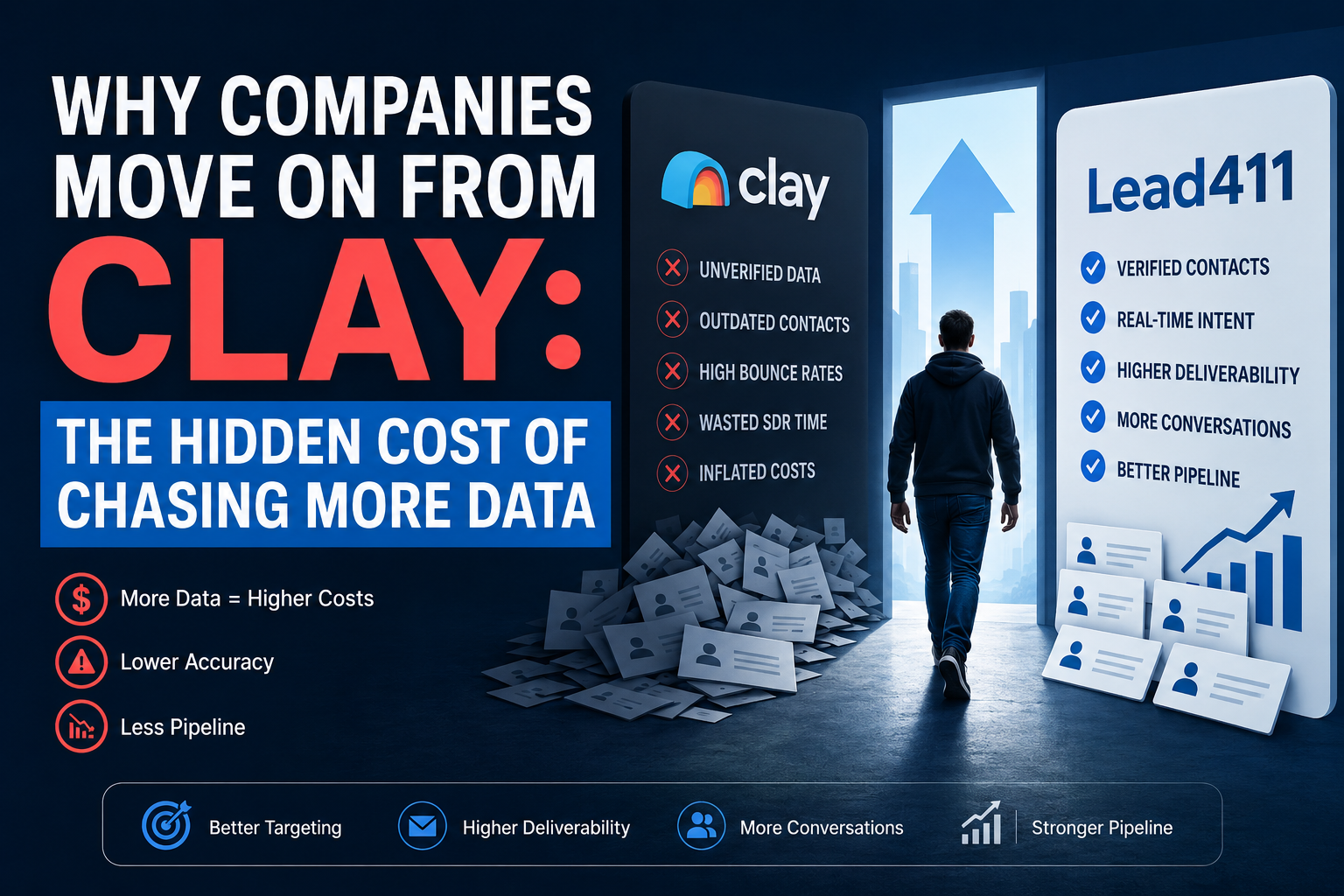
Over the past few years, few platforms have generated as much excitement in sales, RevOps, and growth circles as Clay. It has become one of the most talked-about prospecting platforms in modern outbound sales, helping teams automate research, enrich contacts, build sophisticated workflows, and orchestrate data from dozens of providers. For many startups and growth-stage companies, Clay represents a major leap forward from traditional list building.
Yet as Clay adoption has accelerated, an interesting pattern has emerged. Many organizations that initially embraced Clay eventually begin reevaluating how they approach prospecting, enrichment, and sales intelligence. Contrary to popular belief, these companies are rarely leaving because Clay failed. In fact, most continue to speak highly of the platform.
Instead, they're discovering a much larger challenge hiding beneath the surface of modern outbound sales: more data doesn't necessarily create more pipeline.
That realization is driving a broader shift across the industry. Revenue teams are beginning to prioritize data accuracy, buyer intent, deliverability, and timing over pure enrichment volume. Understanding why that shift is happening helps explain why some companies eventually move beyond waterfall-first prospecting strategies.
Table of Contents
- Why Clay Became So Popular
- What Is Waterfall Data?
- The Coverage vs Accuracy Problem
- The $100,000 SDR Problem
- Why More Data Doesn't Always Create More Pipeline
- The Rising Cost of Prospecting Data
- The Deliverability Problem Nobody Calculates
- The Industry Shift From Enrichment to Verification
- Why Buyer Signals Matter More Than Ever
- The Global Data Challenge
- What High-Performing Revenue Teams Do Differently
- The Future of Sales Intelligence
- Frequently Asked Questions
Why Clay Became So Popular
To understand why some organizations eventually move beyond Clay, it's important to understand why it became so successful in the first place.
For years, outbound prospecting was fragmented. SDRs bounced between LinkedIn, contact databases, enrichment platforms, CRM systems, email verification tools, spreadsheets, and prospecting software. Building a quality prospect list often required hours of manual work before outreach could even begin.
Clay changed that equation. Instead of forcing teams to work across multiple disconnected platforms, it created a centralized workflow layer capable of connecting dozens of enrichment providers, automating research, leveraging AI, and orchestrating prospecting tasks at scale.
For growth-focused organizations, the value proposition was compelling. More automation meant less manual work. More enrichment providers meant more contacts. More contacts meant more opportunities.
Initially, that assumption often proved true. Teams were able to generate prospect lists significantly faster than before. Workflows became more efficient. Prospecting operations became more scalable.
But as many organizations discovered, efficiency and effectiveness are not always the same thing.
What Is Waterfall Data?
Most outbound professionals have heard the term "waterfall enrichment," but surprisingly few understand how it actually works.
A waterfall model operates by querying multiple data providers in sequence. If the first provider cannot find a contact, the system moves to a second provider. If the second fails, it moves to a third. This process continues until information is found or available providers are exhausted.
On paper, this seems like an ideal solution. More providers should increase match rates. Higher match rates should improve prospecting efficiency. More completed records should lead to better outcomes.
And to a certain degree, that's true.
The challenge is that waterfall enrichment optimizes for coverage, not necessarily accuracy.
This distinction becomes increasingly important as outbound teams mature and begin measuring results rather than enrichment volume.
The Coverage vs Accuracy Problem
One of the biggest misconceptions in B2B prospecting is that more contacts automatically lead to more pipeline.
Waterfall enrichment platforms are designed to answer a specific question:
Can we find contact information?
Revenue teams are often asking a different question:
Can we trust the contact information we found?
Those questions may sound similar, but they lead to very different outcomes.
A waterfall system might successfully enrich 90% of a prospect list. Leadership sees high match rates and assumes the prospecting engine is functioning effectively. SDR teams receive thousands of additional contacts. Operations teams celebrate workflow efficiency.
Several weeks later, however, bounce rates increase. Connect rates decline. SDRs report stale records. Pipeline growth fails to match expectations.
The enrichment process worked exactly as intended.
The underlying data simply wasn't as accurate as the match rate suggested.
Coverage and accuracy are not interchangeable. One measures whether data exists. The other measures whether that data is actually useful.
The $100,000 SDR Problem
This is where many revenue teams experience their biggest "aha" moment.
Imagine a company employs ten SDRs. Between salary, benefits, management overhead, technology costs, and infrastructure, each SDR may represent an annual investment approaching $100,000.
Leadership spends heavily on enrichment tools designed to maximize contact coverage. Match rates look fantastic. Dashboards look healthy.
Yet six months later, meetings remain flat.
Why?
Because the organization optimized for finding contacts rather than creating conversations.
A 90% match rate means very little if a meaningful percentage of those contacts are outdated, inactive, or simply not involved in purchasing decisions.
The real cost isn't the software subscription.
It's the thousands of hours SDRs spend pursuing records that were never realistic opportunities to begin with.
Why More Data Doesn't Always Create More Pipeline
For years, the prevailing outbound strategy was simple: acquire more data.
If response rates declined, buy more contacts. If pipeline slowed, expand the database. If territory coverage felt weak, add another provider.
That strategy worked reasonably well when access to business data was limited.
Today's market is different.
Revenue teams have more data than ever before. Platforms such as Clay, Apollo, ZoomInfo, Cognism, Lead411, and dozens of enrichment providers have dramatically increased access to prospect information.
The problem isn't a lack of contacts.
The problem is identifying which contacts actually matter right now.
This is one reason concepts like buyer intent data and trigger-event prospecting have become increasingly important. Modern outbound success depends less on volume and more on timing.
The Rising Cost of Prospecting Data
Another challenge many organizations discover is that prospecting infrastructure becomes surprisingly expensive at scale.
A typical stack may include Clay, multiple enrichment providers, email verification platforms, CRM systems, sales engagement software, intent data vendors, and prospecting databases.
Individually, each investment appears reasonable.
Collectively, costs can escalate quickly.
This is particularly true when teams prioritize enrichment volume over outcome quality.
Many organizations eventually realize they are paying for more data every year while generating fewer meetings per SDR.
That realization often triggers a deeper evaluation of their entire prospecting strategy.
The Deliverability Problem Nobody Calculates
Deliverability may be the most overlooked consequence of poor data quality.
Most sales teams focus on generating contacts. Far fewer focus on what happens after outreach begins.
Every bounced email damages sender reputation. Every damaged sender reputation impacts inbox placement. Every inbox placement issue reduces future campaign effectiveness.
Over time, relatively small data quality issues can create significant deliverability challenges.
This is one reason organizations increasingly prioritize verified direct dials, verified emails, and data validation workflows.
The goal is no longer simply finding contact information. The goal is ensuring outreach actually reaches the intended recipient.
The Industry Shift From Enrichment to Verification
Perhaps the most important trend in sales intelligence today is the industry's gradual shift from enrichment toward verification.
Five years ago, most conversations centered around finding more contacts.
Today, the conversation increasingly centers around data accuracy.
Revenue leaders are asking different questions:
How often is the data refreshed?
How are emails verified?
How accurate are direct dials?
What happens after enrichment?
This shift explains why concepts discussed in our article about revenue infrastructure continue gaining traction across modern sales organizations.
The future belongs to teams that can combine workflow efficiency with verified data quality.
Why Buyer Signals Matter More Than Ever
Another major evolution is the growing importance of buying signals.
For years, sales teams focused primarily on identifying contacts.
Today, many of the highest-performing organizations focus on identifying timing.
A company that recently raised funding. A business hiring aggressively. An organization implementing new technology. A leadership team undergoing change.
These signals often provide stronger indicators of opportunity than thousands of additional contacts.
This explains the growing demand for buyer intent data, growth signals, hiring alerts, and technographic intelligence.
The future of prospecting isn't simply knowing who someone is.
It's understanding why now may be the right time to engage them.
The Global Data Challenge
Geography introduces another layer of complexity.
Many outbound teams now prospect across North America, Europe, the United Kingdom, Australia, and other international markets.
Data quality varies significantly by region.
A provider that performs exceptionally well in the United States may struggle elsewhere. A vendor known for strong European mobile coverage may provide weaker direct dial accuracy in North America.
This is one reason organizations often evaluate platforms such as ZoomInfo, Apollo, Cognism, and Lead411 differently depending on geographic requirements.
Global prospecting requires more than a large database. It requires regional accuracy, compliance awareness, and reliable coverage.
What High-Performing Revenue Teams Do Differently
The best outbound organizations rarely depend on a single strategy.
Instead, they combine verified data, buyer intent signals, CRM enrichment, automation, and ongoing validation.
They understand that outbound success depends on three interconnected variables:
Data quality.
Buyer timing.
Execution.
Remove any one of those variables and performance suffers.
This is one reason many teams evaluating the best B2B data provider are increasingly prioritizing accuracy, verification, and intent signals over pure database size.
The Future of Sales Intelligence
Clay helped transform modern prospecting.
There is little debate about that.
But the broader lesson many organizations eventually learn has very little to do with Clay itself.
It has to do with the evolution of outbound sales.
Three years ago, the industry was obsessed with enrichment.
Today, it is becoming obsessed with verification.
Tomorrow, it will likely become obsessed with timing.
The organizations that continue generating predictable pipeline will be those that recognize this shift early.
They will prioritize trusted data over larger databases, verified contacts over match rates, and buying signals over volume.
Because the ultimate goal is not finding more people.
The goal is finding the right people at the right time with information you can trust.
Frequently Asked Questions
What is waterfall data enrichment?
Waterfall enrichment is a process that queries multiple data providers sequentially until contact information is found. It is designed to maximize coverage rather than guarantee accuracy.
Why do companies use Clay?
Clay helps automate prospect research, enrichment, workflow building, and data orchestration across multiple providers, significantly improving prospecting efficiency.
Why do some companies leave Clay?
Most organizations do not leave because Clay is ineffective. They often reevaluate their approach when they discover that more enrichment does not automatically create more pipeline.
What is the difference between coverage and accuracy?
Coverage measures how many contacts can be found. Accuracy measures whether those contacts are correct, reachable, and relevant.
Does more data improve SDR performance?
Not necessarily. Data quality, timing, and buyer intent often have a greater impact on SDR performance than database size alone.
Recent Posts
How to Get a List of Companies That Use Salesforce? (2026 Guide)
How to Get a List of Companies That Use Salesforce (2026 Guide) Quick Summary The fastest way to get a list of companies that use Salesforce is to use a B2B data provider with technographic filtering. Technographic data identifies which software companies use,...

How to Find Executive Phone Numbers (2026 Guide)
How to Find Executive Phone Numbers (Step-by-Step Guide for 2026) Quick Summary The fastest way to find executive phone numbers is to use a verified B2B data provider that includes direct dials, real-time validation, and intent-based targeting. Manual research methods...
Why SDRs Are More Frustrated Than Ever in 2026 (And Why Most Teams Are Getting It Wrong)
Why SDRs Are More Frustrated Than Ever in 2026 (And Why Most Teams Are Getting It Wrong) Quick Summary SDRs are more frustrated than ever because outbound systems are broken—not because of lack of effort. The core issues are poor data quality, outdated contacts, weak...

- Sales Services
- Cybersecurity
- SaaS/Technology
- Energy / CleanTech
- Manufacturing
- Hospitality / Travel / Tourism
- Financial / FinTech
- Healthcare / MedTech
- Logistics / Transportation
- Account Based Marketing
- Recruiting
- Real Estate & Construction
- Professional Services & Consulting
- SLED Data Solutions
- Retail / E-Commerce
- Legal Services
resources
Zoominfo Intent vs Bombora Intent in 2026 | Top 3 B2b Buyer Intent Providers in 2026 | Zoominfo Pricing in 2026 | Linkedin Sales Navigator Competitors (2026) | Clearbit Pricing (2026) | Hubspot Pricing Review (2026) | Lead411 Competitors in 2026| Top 5 Linkedin Email Finders for 2026 | How to Find Someone's Phone Number in 2026 | Apollo.io vs. Lead411 Chrome Extension in 2026 | Apollo.io vs. Zoominfo in 2026 | Top 10 B2B Data Resellers in 2026 | Zoominfo API | Seamless.ai vs. Zoominfo in 2026 | 10 Best Clay Competitors for 2026 | What Does Lead Generation Look Like in 2026? | Zoominfo MCP Server |
7 Best B2B Data Providers for 2026 | 15 Best Sales Lead Databases for B2B in 2026 | Apollo.io MCP Server | Questions About Zoominfo
© 2026 Lead411 All Rights Reserved | Your Privacy Choices | Privacy Policy | Do Not Sell | CCPA | Terms Of Use | Lead411 is a registered data broker under applicable state laws, including under Texas law. To conduct business in Texas, a data broker must register with the Texas Secretary of State (Texas SOS). Information about data broker registrants is available on the Texas SOS website.
- Sales Services
- Cybersecurity
- SaaS/Technology
- Energy / CleanTech
- Manufacturing
- Hospitality / Travel / Tourism
- Financial / FinTech
- Healthcare / MedTech
- Logistics / Transportation
- Account Based Marketing
- Recruiting
- Real Estate & Construction
- Professional Services & Consulting
- SLED Data Solutions
- Retail / E-Commerce
- Legal Services
resources
Zoominfo Intent vs Bombora Intent in 2026 | Top 3 B2b Buyer Intent Providers in 2026 | Zoominfo Pricing in 2026 | Linkedin Sales Navigator Competitors (2026) | Clearbit Pricing (2026) | Hubspot Pricing Review (2026) | Lead411 Competitors in 2026| Top 5 Linkedin Email Finders for 2026 | How to Find Someone's Phone Number in 2026 | Apollo.io vs. Lead411 Chrome Extension in 2026 | Apollo.io vs. Zoominfo in 2026 | Top 10 B2B Data Resellers in 2026 | Zoominfo API | Seamless.ai vs. Zoominfo in 2026 | 10 Best Clay Competitors for 2026 | What Does Lead Generation Look Like in 2026? | Zoominfo MCP Server |
7 Best B2B Data Providers for 2026 | 15 Best Sales Lead Databases for B2B in 2026 | Apollo.io MCP Server | Questions About Zoominfo