
Why Hundreds of Companies Are Leaving ZoomInfo for Lead411 in 2026
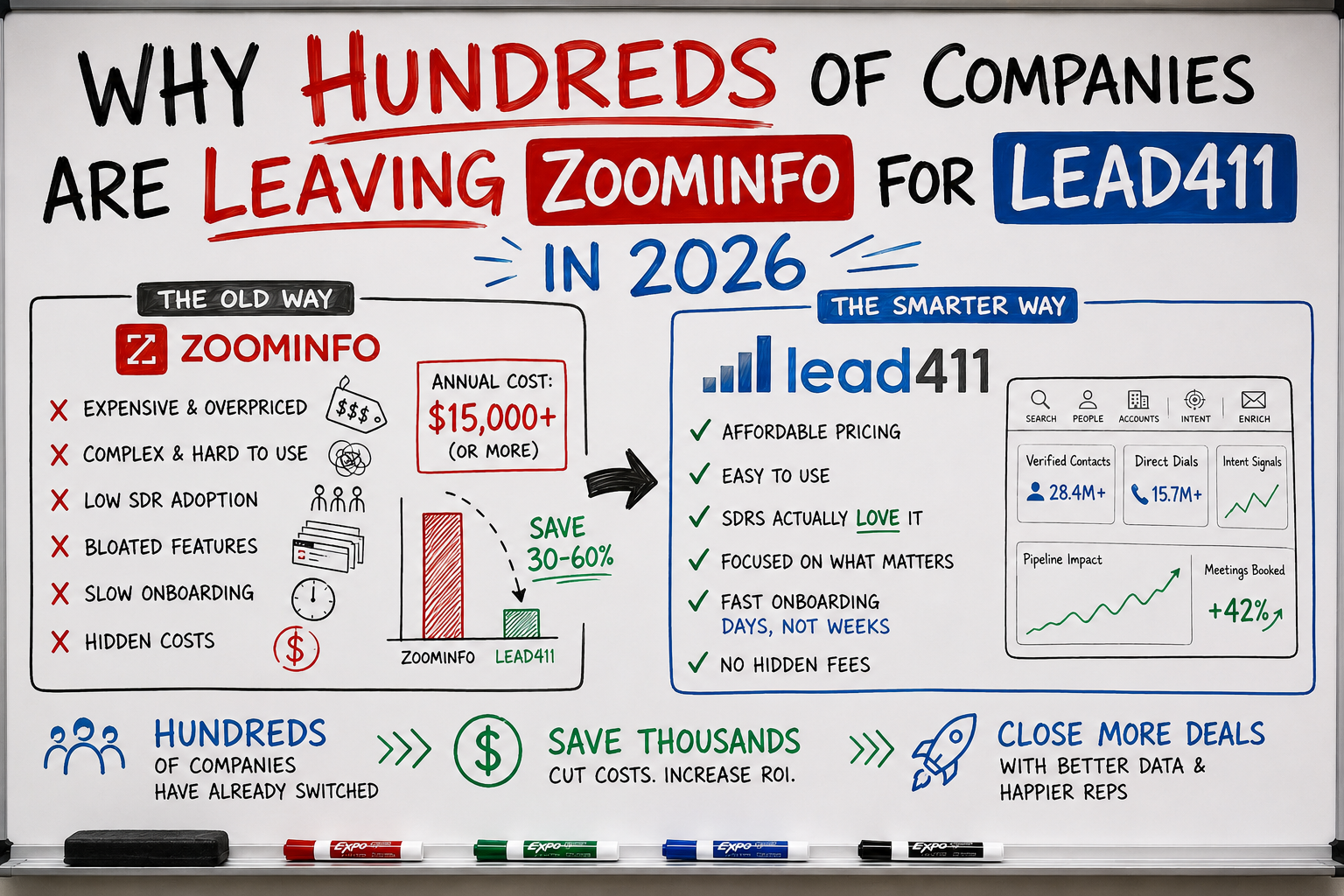
Why Hundreds of Companies Are Leaving ZoomInfo for Lead411 in 2026
For nearly a decade, ZoomInfo became synonymous with B2B sales intelligence.
If a company needed direct dials, contact enrichment, buyer intent data, or outbound prospecting infrastructure, ZoomInfo was often the automatic recommendation.
But the market changed.
And it changed faster than most enterprise software companies expected.
Today’s revenue organizations are no longer optimizing for software expansion alone. They are optimizing for:
- revenue efficiency
- rep productivity
- pipeline velocity
- operational simplicity
- software ROI
That shift is one of the biggest reasons hundreds of sales teams are transitioning from ZoomInfo to Lead411.
Quick Summary
Modern B2B sales teams are increasingly moving away from bloated enterprise software ecosystems toward leaner, execution-focused platforms. While ZoomInfo remains powerful for large enterprise organizations, many SMB and mid-market companies are transitioning to Lead411 because of lower costs, easier onboarding, simpler workflows, improved SDR adoption, and stronger outbound ROI.
The companies winning in outbound today are often the companies with the simplest operational systems — not necessarily the companies with the largest software stacks.
Table of Contents
Why the B2B Sales Intelligence Market Changed So Fast
The sales technology market of 2021 and the sales technology market of 2026 are dramatically different.
During the SaaS growth boom, software spending exploded across nearly every category. Companies aggressively purchased:
- sales engagement tools
- intent data providers
- conversation intelligence platforms
- CRM enrichment systems
- ABM software
- prospecting databases
At the time, leadership teams believed larger software ecosystems would naturally create more pipeline.
But eventually, many organizations realized something uncomfortable:
More software did not always produce better outbound execution.
Instead, many companies became buried under:
- low SDR adoption
- workflow complexity
- rising renewal costs
- duplicated functionality
- operational inefficiency
This shift heavily impacted enterprise-first software providers.
Today’s sales organizations increasingly prioritize usability over complexity.
That is precisely where Lead411 has gained enormous traction.
Many outbound teams now prefer tools that:
- work immediately
- require less onboarding
- improve SDR productivity faster
- reduce operational overhead
- deliver measurable ROI quickly
This broader market movement is why searches for:
- “best ZoomInfo alternative”
- “Lead411 vs ZoomInfo”
- “how to replace ZoomInfo”
- “best B2B contact database for SMB”
have increased substantially over the last two years.
What Companies Commonly Experience Before Leaving ZoomInfo
One of the biggest misconceptions in the sales intelligence market is that companies leave ZoomInfo because the platform suddenly becomes ineffective.
That is rarely the actual reason.
Most companies transition away because the operational economics stop making sense relative to daily usage.
The Renewal Cost Problem
Many companies initially enter ZoomInfo agreements at manageable pricing levels.
But over time, costs expand significantly.
Additional seats, intent packages, enrichment credits, workflow add-ons, and layered integrations can dramatically increase annual spend.
One cybersecurity SaaS company described their situation this way:
“We started with a reasonable outbound budget. Within two renewal cycles, our sales intelligence stack exceeded six figures annually, yet our SDRs were still mainly using contact search and direct dial exports.”
This experience is becoming increasingly common among mid-market organizations.
Many leadership teams eventually begin questioning whether enterprise-scale software costs align with actual workflow usage.
SDR Adoption Quietly Declines
One of the least discussed issues in outbound sales technology is software adoption fatigue.
The more operationally complicated a system becomes, the less consistently reps tend to use it.
Across many outbound audits, companies discover SDRs gradually revert back toward:
- manual prospecting
- spreadsheet workflows
- LinkedIn searching
- partial platform usage
This creates a dangerous problem because software ROI is ultimately driven by consistent rep execution.
If adoption falls, outbound efficiency usually falls alongside it.
Operational Burden Expands Rapidly
Enterprise-heavy sales intelligence systems often create significant RevOps overhead.
Teams become responsible for:
- CRM governance
- duplicate cleanup
- workflow maintenance
- integration troubleshooting
- seat management
- enrichment controls
Several former ZoomInfo customers described spending more time managing workflows than improving outbound performance itself.
That becomes especially difficult for lean GTM organizations trying to move quickly.
This is one reason many teams begin evaluating simpler alternatives like Lead411’s B2B data solutions.
Why Lead411 Started Gaining Momentum
Lead411 approached the market differently from most enterprise-first competitors.
Instead of attempting to become an enormous operational ecosystem, the platform focused heavily on practical outbound usability.
That positioning became increasingly valuable as SaaS organizations shifted toward leaner revenue operations.
Modern sales teams care deeply about:
- fast onboarding
- workflow simplicity
- verified contact accuracy
- rep usability
- speed-to-pipeline
In many ways, Lead411’s growth reflects a broader trend happening across SaaS:
Companies are prioritizing operational efficiency over feature overload.
This is especially true among:
- SaaS startups
- growth-stage companies
- recruiting firms
- agencies
- outsourced SDR organizations
These teams often need enterprise-grade outbound execution without enterprise-level operational friction.
That is where Lead411 competitor comparisons have gained major attention in search.
Real-World Cost Savings Examples
Example #1: HR Tech SaaS Company
A mid-market HR technology company employing:
- 12 SDRs
- 5 Account Executives
- 2 RevOps specialists
was spending roughly $94,000 annually across:
- ZoomInfo licenses
- intent packages
- enrichment tools
- additional prospecting software
After conducting a software utilization audit, leadership realized:
- less than half the platform functionality was actively used
- SDRs mainly relied on contact exports
- rep onboarding averaged nearly three weeks
- RevOps spent excessive time maintaining workflows
After transitioning to Lead411:
- annual spend fell below $40,000
- SDR onboarding dropped to 5 business days
- workflow adoption improved dramatically
- RevOps maintenance time decreased significantly
But leadership said the biggest improvement was consistency.
“The simpler workflow created more predictable outbound execution.”
Example #2: Outsourced SDR Agency
An outsourced SDR agency managing prospecting campaigns for multiple B2B clients experienced a different challenge.
Their problem was not just software cost — it was scalability.
Every new client required:
- new workflows
- new onboarding
- new enrichment management
- new prospecting structures
The agency found enterprise-heavy systems increasingly difficult to operationalize across dozens of client campaigns simultaneously.
After migrating to Lead411’s sales prospecting platform, they reported:
- faster campaign deployment
- simpler SDR training
- improved workflow standardization
- lower operational overhead
The Step-by-Step Process Companies Use to Transition from ZoomInfo to Lead411
One of the biggest fears companies have before migrating sales intelligence platforms is disruption.
Ironically, most organizations discover the transition process is much easier than expected.
Step 1: Audit Actual Platform Usage
Companies first evaluate:
- seat utilization
- workflow adoption
- prospecting behavior
- rep engagement
- integration usage
This stage often exposes substantial inefficiencies.
Step 2: Export Existing Prospecting Infrastructure
Teams usually export:
- saved searches
- ICP filters
- account lists
- buyer personas
- CRM mappings
This process frequently becomes an opportunity for broader CRM cleanup as well.
Many organizations discover years of duplicate enrichment and outdated records during migration preparation.
Step 3: Rebuild Leaner Workflows Inside Lead411
This is often where companies notice immediate improvements.
Because Lead411’s workflow structure is intentionally designed around outbound usability, SDRs typically adapt much faster.
Several companies reported:
- faster SDR ramp-up
- improved onboarding consistency
- cleaner prospecting workflows
- reduced administrative overhead
Step 4: Connect CRM and Sales Engagement Platforms
Most organizations integrate Lead411 with:
- Salesforce
- HubSpot
- Outreach
- Salesloft
Unlike many enterprise-heavy systems, implementation is often described as significantly lighter operationally.
Step 5: Benchmark Outbound Performance
Successful migrations usually track:
- connect rates
- reply rates
- meetings booked
- cost-per-opportunity
- SDR ramp speed
Many organizations discover outbound performance improves primarily because workflows become easier for reps to execute consistently.
Why Mid-Market Teams Prefer Lead411
The mid-market has become one of the most competitive environments in SaaS.
These companies must:
- grow quickly
- maximize SDR productivity
- control software spend
- reduce operational friction
- improve revenue efficiency
That environment strongly favors platforms that balance:
- functionality
- simplicity
- speed
- adoption
- ROI
Many outbound leaders increasingly believe enterprise-scale complexity simply is not necessary for high-performing SDR organizations.
This is one reason pages like Lead411’s sales and marketing blog continue gaining visibility among companies researching:
- best B2B contact databases
- ZoomInfo alternatives
- sales intelligence ROI
- outbound optimization strategies
The Future of B2B Sales Intelligence
The next era of B2B sales software will likely reward companies that prioritize:
- execution speed
- rep usability
- workflow simplicity
- clear ROI visibility
- operational efficiency
This broader SaaS shift is already happening across:
- CRM systems
- sales engagement platforms
- marketing automation tools
- RevOps infrastructure
- sales intelligence providers
Modern buyers increasingly prefer:
Tools that help teams execute faster — not platforms that create more operational complexity.
That trend strongly benefits companies like Lead411 that emphasize usability and outbound practicality.
Final Thoughts
ZoomInfo remains a major player in the enterprise sales intelligence market.
For very large organizations with highly complex GTM ecosystems, the platform can still provide substantial value.
But the broader market is changing rapidly.
Modern revenue organizations increasingly prioritize:
- faster onboarding
- simpler workflows
- better SDR adoption
- lower operational overhead
- stronger outbound ROI
That is exactly why more companies are transitioning to Lead411.
Not because enterprise sales intelligence disappeared.
But because many outbound teams are realizing something important:
The best sales platform is not the platform with the most features.
It is the platform that helps reps consistently generate pipeline with the least amount of friction.
Explore Lead411
If your organization is reevaluating outbound efficiency, SDR productivity, or sales software costs, explore: