Why Industry + Company Keywords Outperform NAICS or SIC Codes in B2B Database Searches

Traditionally, businesses have relied on NAICS (North American Industry Classification System) or SIC (Standard Industrial Classification) codes to categorize and search for potential leads. However, these methods often lack precision, leading to missed opportunities and wasted efforts. A more effective approach is to use a combination of industry and company keywords in your B2B database searches. Here’s why this method is superior:
1. Greater Precision
NAICS and SIC codes group companies into broad categories, which can be too general to capture the nuances of specific businesses. For example, the NAICS code for “Custom Computer Programming Services” lumps together everything from small software firms to large IT consultancies. By using industry and company keywords, you can target specific niches, like “AI-powered SaaS solutions,” ensuring your outreach is more relevant and precise.
2. Real-Time Relevance
NAICS and SIC codes are static and don’t always keep up with rapidly evolving industries. Keywords, on the other hand, can be updated in real-time to reflect the latest trends. This means you can target businesses that are actively engaging in new developments, staying ahead of industry shifts.
3. Flexibility in Targeting
NAICS and SIC codes can be restrictive, especially when companies operate across multiple industries or offer unique products that don’t fit neatly into one category. Keywords provide flexibility, allowing you to combine multiple search terms to pinpoint companies that operate at the intersection of different sectors.
4. Insight into Company Focus
Keywords reveal a company’s current focus and intent, something static codes can’t provide. For instance, a company under a general “Retail” NAICS code might be specifically focused on “sustainable fashion” or “luxury home goods.” Using these specific keywords helps you tailor your outreach to align with the company’s priorities.
5. Improved Data Accuracy
NAICS and SIC codes are often self-selected by companies, leading to potential misclassifications. Keyword searches, however, are based on how companies describe themselves, resulting in more accurate and relevant matches.
6. Enhanced Competitive Intelligence
Keywords allow for more nuanced competitive analysis. You can track competitors more effectively by searching for specific terms related to their market positioning or unique offerings—something that broad industry codes can’t match.
7. Seamless Integration with Modern Tools
Modern B2B tools are designed for complex, multi-layered searches, and keywords integrate seamlessly with these platforms. This allows for highly targeted searches that can be combined with other filters, such as location or company size. NAICS and SIC codes, in contrast, are less adaptable to these advanced search capabilities.
While NAICS and SIC codes have been the traditional go-to for B2B searches, they fall short in today’s fast-paced business environment. Industry and company keywords offer greater precision, relevance, and flexibility, making them a superior choice for modern B2B prospecting. By leveraging industry + company keywords, you’ll not only improve the accuracy of your searches but also enhance the effectiveness of your marketing and sales efforts—leading to better results and a higher return on investment. Try it in the Lead411 platform today!
Recent Posts
Signal-Based Prospecting: The New Outbound Playbook
Signal-Based Prospecting: The New Outbound Playbook Outbound sales changed quietly. Most companies just have not fully realized it yet. For years, the dominant outbound model was simple: build a giant list, load a sequence, send enough emails, and let volume do the...
How do I Find Companies Using HubSpot? (Complete B2B Prospecting Guide)
How to Find Companies Using HubSpot (Complete B2B Prospecting Guide) If you work in B2B sales, one of the highest-leverage prospecting strategies today is targeting companies based on the software they already use. This is known as technographic prospecting. And among...
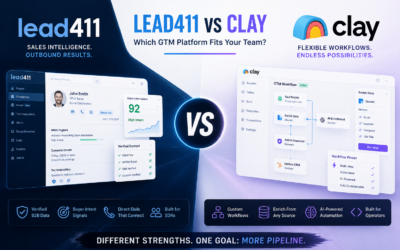
Lead411 vs Clay: Which GTM Platform Fits Your Team in 2026?
Lead411 vs Clay: Which GTM Platform Fits Your Team in 2026? Modern GTM teams are overwhelmed with tooling decisions. Between AI agents, enrichment workflows, intent platforms, outbound automation, and SDR infrastructure, the average sales stack is more...