
Why Most B2B Intent Data Is Wrong (And What Actually Predicts Buying Intent in 2026)
Why Most B2B Intent Data Is Wrong (And What Actually Predicts Buying Intent in 2026)
Quick Summary
B2B intent data has become one of the most overhyped categories in outbound sales. Nearly every sales intelligence platform now claims to identify “in-market buyers” using AI-driven intent signals, content consumption patterns, website behavior, or predictive scoring models.
But many revenue teams are discovering an uncomfortable truth:
A large percentage of intent data does not actually predict buying behavior.
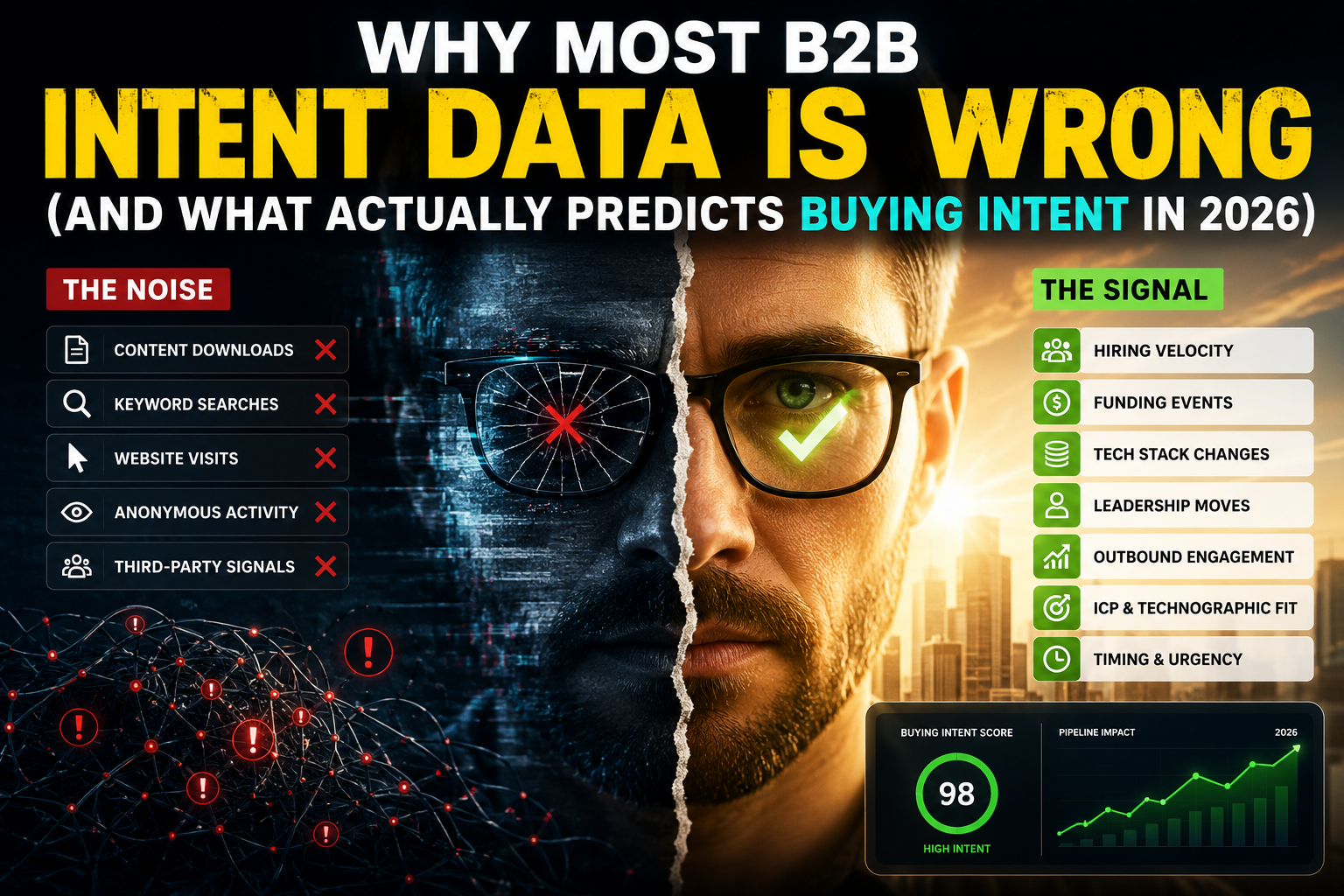
In many cases, intent platforms are simply measuring research activity rather than genuine purchase readiness. Companies downloading content, visiting websites, or searching keywords are not necessarily preparing to buy.
The problem is that most intent providers confuse engagement signals with revenue signals.
The outbound teams consistently generating pipeline in 2026 are not relying on isolated intent spikes alone. They are combining intent data with operational signals, technographic fit, hiring velocity, timing indicators, outbound engagement behavior, and verified targeting infrastructure.
This is where Lead411’s approach to intent data becomes significantly different.
Instead of treating intent as a standalone magic signal, Lead411 focuses on combining intent intelligence with verified contact data, targeting precision, outbound execution workflows, and revenue performance infrastructure designed to help teams move pipeline faster.
Table of Contents
- The Biggest Problem With Modern Intent Data
- Why Most Intent Signals Are Noise
- What Most Intent Platforms Get Wrong
- What Actually Predicts Buying Intent in 2026
- Why Technographic Fit Matters More Than Keyword Spikes
- Why Timing Signals Matter More Than Activity Volume
- Why Lead411’s Intent Approach Is Different
- How Smart Revenue Teams Actually Use Intent Data
- The Future of Intent Data and Outbound Sales
- Final Thoughts
The Biggest Problem With Modern Intent Data
The biggest misconception in the B2B sales industry right now is the belief that research activity automatically equals buying intent.
It does not.
A company downloading a whitepaper, visiting a pricing page, or searching for software categories online does not necessarily mean they are preparing to purchase anything.
In reality, many intent signals represent curiosity rather than urgency.
This is where many intent platforms create false confidence inside revenue teams.
Sales organizations receive lists of “high-intent accounts” based on keyword behavior, website visits, content consumption, or generalized engagement scoring — only to discover that many of those accounts have no active buying process at all.
That creates a major outbound problem:
Most intent data platforms measure attention. Not readiness.
This distinction matters because outbound sales has become significantly more competitive in 2026. SDR teams can no longer afford to waste time chasing weak signals that never convert into real pipeline.
Why Most Intent Signals Are Noise
One of the reasons intent data became so popular is because the concept sounds incredibly powerful.
If sales teams could reliably identify companies preparing to buy before competitors notice them, outbound efficiency would improve dramatically.
The problem is that many intent signals are probabilistic guesses rather than true buying indicators.
For example:
- Reading a blog post does not mean budget exists
- Searching a keyword does not mean urgency exists
- Website visits do not guarantee internal alignment
- Content downloads do not indicate decision-maker involvement
- Third-party engagement data is often incomplete or delayed
This is why many outbound teams eventually realize that raw intent spikes often produce disappointing pipeline outcomes.
Most intent systems are excellent at identifying research behavior.
Very few are excellent at identifying timing.
That difference changes everything.
What Most Intent Platforms Get Wrong
Most intent platforms treat intent data as a standalone signal.
That is the mistake.
Strong buying intent rarely exists in isolation.
Real purchase readiness usually emerges from multiple overlapping signals happening simultaneously.
For example:
- A company raises funding
- Leadership hiring increases
- A new technology stack appears
- Outbound engagement increases
- Operational expansion begins
- Decision makers become more active
That combination creates a much stronger indicator than isolated keyword activity alone.
This is also why many companies exploring ZoomInfo competitors or researching Apollo.io alternatives are becoming more skeptical of simplistic “AI intent scoring” models.
Many outbound teams are realizing that intent accuracy matters far more than intent volume.
What Actually Predicts Buying Intent in 2026
The outbound teams generating the strongest pipeline in 2026 are not relying on generic intent spikes alone.
They are combining multiple operational signals together.
Some of the strongest predictive buying indicators now include:
- Hiring velocity
- Leadership expansion
- Technology adoption changes
- Funding events
- Technographic overlap
- Outbound engagement sequencing
- Market expansion timing
- Operational scaling activity
For example, a SaaS company aggressively hiring RevOps roles while simultaneously adopting new sales infrastructure tools creates a significantly stronger buying signal than simple content consumption behavior.
This is where modern outbound sales is evolving beyond static databases and simplistic intent scores.
The strongest revenue teams now operate using layered signal intelligence rather than isolated behavioral triggers.
Why Technographic Fit Matters More Than Keyword Spikes
One of the most underrated predictors of buying intent is technographic alignment.
Companies already using certain technologies are often structurally more likely to adopt related products and integrations.
For example, organizations already using Salesforce frequently become high-fit opportunities for complementary sales, RevOps, and enablement platforms.
This is one reason why many outbound teams now build campaigns around companies already using Salesforce rather than relying entirely on generalized intent scoring.
Technographic targeting creates stronger context.
And stronger context almost always outperforms generic outbound volume.
This is also why technographic data strategies are becoming increasingly important inside modern outbound workflows.
Why Timing Signals Matter More Than Activity Volume
Timing is one of the hardest variables in outbound sales.
A company may technically fit your ideal customer profile while still having no internal urgency to buy anything.
This is why timing indicators increasingly matter more than raw engagement activity.
Strong timing signals include:
- Rapid hiring growth
- Recent funding rounds
- Technology migrations
- Sales team expansion
- Operational restructuring
- Leadership changes
When these signals overlap with strong technographic alignment and verified decision-maker targeting, outbound performance improves dramatically.
This layered approach is far more effective than relying on isolated keyword spikes or anonymous website visits.
Why Lead411’s Intent Approach Is Different
Most intent providers position intent data as the primary product.
Lead411 approaches intent differently.
Lead411 treats intent as one layer inside a much broader revenue performance infrastructure system.
That distinction matters.
Instead of simply surfacing generalized engagement signals, Lead411 combines:
- Intent intelligence
- Verified direct dials
- Accurate contact data
- Technographic targeting
- Outbound execution workflows
- Decision-maker identification
- Pipeline acceleration infrastructure
This approach helps revenue teams act on intent signals much more effectively.
Because intent data alone does not create pipeline.
Execution does.
That is also why many organizations increasingly view Lead411 as revenue performance infrastructure rather than simply another B2B contact database.
How Smart Revenue Teams Actually Use Intent Data
The best outbound teams do not blindly chase every “high-intent” account their platform surfaces.
Instead, they prioritize accounts where multiple signals overlap.
For example:
- Technographic fit
- Hiring activity
- Verified buyer contacts
- Operational expansion
- Intent engagement
- ICP alignment
This creates significantly stronger outbound prioritization.
It also reduces wasted outreach, improves connect rates, and accelerates pipeline movement.
That is why modern outbound organizations increasingly prioritize data accuracy, targeting precision, and workflow quality rather than simply buying larger datasets or higher intent volumes.
The Future of Intent Data and Outbound Sales
The future of intent data is not more keyword tracking.
The future is layered signal intelligence combined with stronger outbound execution infrastructure.
The companies generating the strongest pipeline over the next several years will combine:
- Technographic intelligence
- Timing indicators
- Operational signals
- Verified contact data
- AI-assisted workflows
- Human outbound judgment
This is where the market is heading.
The companies still relying on isolated intent spikes and generic engagement scoring may increasingly struggle as outbound competition intensifies.
Because modern pipeline generation requires context, precision, timing, and execution — not just more signals.
Turn Better Intent Signals Into Pipeline
Lead411 combines intent intelligence, verified contact data, technographic targeting, and outbound workflow infrastructure to help revenue teams improve connect rates and accelerate pipeline generation.
Final Thoughts
Most B2B intent data platforms are not technically wrong.
They are simply incomplete.
Research activity alone rarely predicts buying behavior consistently.
The outbound teams winning in 2026 are the teams combining intent signals with timing indicators, technographic fit, operational context, verified targeting, and stronger outbound infrastructure.
That is why the future of intent data is not about generating more signals.
It is about understanding which signals actually move pipeline.
Frequently Asked Questions About B2B Intent Data in 2026
What is B2B intent data?
B2B intent data refers to behavioral signals that suggest a company may be researching, evaluating, or preparing to purchase a product or service.
These signals can come from content consumption, keyword searches, website visits, technology adoption changes, engagement activity, hiring trends, or outbound interactions.
The goal of intent data is to help revenue teams identify accounts that may be more likely to enter an active buying cycle.
However, not all intent signals are equally valuable. Many platforms measure engagement activity without accurately identifying whether genuine purchase urgency exists.
Why is most B2B intent data inaccurate?
Most intent data platforms measure research activity rather than actual buying readiness.
For example, a company downloading a whitepaper or searching a software category online does not necessarily mean they have budget approval, internal urgency, leadership alignment, or active purchase intent.
Many intent providers rely heavily on keyword spikes, anonymous browsing activity, or generalized engagement signals that create false positives.
This is why many outbound teams eventually discover that large volumes of “high-intent accounts” do not consistently translate into qualified pipeline opportunities.
What signals actually predict buying intent in 2026?
The strongest buying signals in 2026 usually come from overlapping operational indicators rather than isolated engagement events.
Some of the most predictive signals include:
- Rapid hiring growth
- Leadership expansion
- Recent funding rounds
- Technology stack changes
- Sales team expansion
- Technographic alignment
- Operational scaling activity
- Verified outbound engagement
When these signals appear together, they often indicate much stronger purchase readiness than keyword tracking alone.
What is the difference between intent data and technographic data?
Intent data measures behavioral activity that may indicate research or buying interest.
Technographic data identifies the technologies and software platforms a company already uses.
Intent signals help identify timing and engagement behavior, while technographic data helps identify structural fit.
For example, a company actively researching outbound sales tools while already using Salesforce may represent a much stronger opportunity than a company showing intent signals without relevant technology alignment.
Why are outbound teams becoming more skeptical of intent data providers?
Many outbound teams initially expected intent data to function almost like a predictive pipeline engine.
But over time, many organizations realized that generic intent signals often produce inconsistent results because engagement activity does not always correlate with genuine purchase readiness.
As outbound sales becomes more competitive, SDR teams are increasingly prioritizing signal quality, timing accuracy, targeting precision, and verified buyer identification rather than simply purchasing larger volumes of intent data.
This shift is causing many companies to reevaluate how intent data should actually be used inside modern outbound workflows.
Why does timing matter more than intent volume?
Timing is one of the most important variables in outbound sales.
A company may fit your ideal customer profile perfectly while still having no internal urgency to buy anything.
This is why timing indicators such as hiring growth, funding activity, operational expansion, or technology migrations often predict pipeline opportunities more accurately than isolated engagement behavior.
Strong outbound teams focus heavily on identifying accounts where urgency, operational change, and fit overlap simultaneously.
What role does data accuracy play in intent-driven outbound sales?
Intent signals become significantly less valuable when contact data is inaccurate.
Even strong buying indicators create little value if outbound teams cannot actually reach the correct decision makers.
Disconnected phone numbers, outdated emails, poor-fit contacts, and incorrect titles create operational friction that weakens outbound execution.
This is why many revenue teams increasingly prioritize verified direct dials, accurate targeting, and cleaner contact infrastructure alongside intent intelligence.
How should companies actually use intent data?
The most effective outbound teams do not treat intent data as a standalone signal.
Instead, they combine intent intelligence with:
- Technographic fit
- Verified contact data
- Hiring activity
- Funding events
- Leadership changes
- Outbound engagement history
- ICP alignment
This layered approach creates significantly stronger outbound prioritization and reduces wasted outreach.
Why is technographic targeting becoming more important than keyword intent alone?
Technographic targeting creates stronger context.
Companies already using specific technologies are often much more likely to adopt related tools and integrations.
For example, organizations already using Salesforce are frequently stronger candidates for sales enablement and RevOps platforms that integrate directly into the Salesforce ecosystem.
This creates significantly better outbound targeting than broad keyword engagement signals alone.
What do most companies get wrong about AI-powered intent scoring?
Many companies assume AI-powered intent scoring systems can accurately predict buying behavior in isolation.
In reality, most AI scoring systems are probabilistic models trained on behavioral patterns rather than direct purchase confirmation.
AI can identify research activity effectively, but research activity itself does not always indicate budget approval, leadership alignment, urgency, or purchasing authority.
This is why AI intent scoring should be combined with operational signals and human outbound judgment rather than treated as a fully autonomous decision engine.
Why are connect rates becoming more important in intent-driven outbound sales?
Modern outbound sales has become increasingly noisy and competitive.
Even strong intent signals lose value when sales teams cannot successfully connect with decision makers.
Higher connect rates improve pipeline efficiency because outbound reps spend less time chasing unreachable contacts and more time engaging with qualified opportunities.
This is one reason why verified direct dials and accurate contact intelligence are becoming increasingly important inside modern revenue infrastructure.
How does Lead411 approach intent data differently?
Lead411 treats intent data as one layer within a larger revenue performance infrastructure system.
Instead of relying entirely on generalized engagement scoring, Lead411 combines:
- Intent intelligence
- Verified direct dials
- Accurate contact data
- Technographic targeting
- Outbound workflow infrastructure
- Decision-maker identification
This approach helps outbound teams act on intent signals more effectively and improve pipeline movement rather than simply generating larger volumes of research activity.
What industries benefit most from intent data?
Intent data tends to be most valuable in industries with long buying cycles, complex purchasing decisions, and highly competitive outbound environments.
Examples include:
- B2B SaaS
- Cybersecurity
- IT services
- Sales technology
- Recruiting platforms
- Marketing automation
- Revenue operations software
These industries often rely heavily on outbound prospecting, timing precision, and strategic account prioritization.
Is intent data still worth using in 2026?
Yes — but only when used correctly.
Intent data can still provide valuable directional insight when combined with strong targeting infrastructure, accurate contact intelligence, operational timing indicators, and outbound execution workflows.
The problem is not intent data itself.
The problem is that many companies expect isolated intent signals to function like guaranteed purchase predictions.
The strongest outbound teams treat intent as one signal within a much broader revenue intelligence strategy.
What is the future of B2B intent data?
The future of intent data is moving toward layered signal intelligence rather than standalone keyword tracking.
The next generation of outbound systems will combine:
- Technographic intelligence
- AI-assisted workflows
- Operational signals
- Hiring activity
- Funding indicators
- Verified buyer targeting
- Revenue infrastructure systems
The companies that win outbound sales over the next several years will not simply generate more intent signals.
They will understand which signals actually predict pipeline movement.
Recent Posts

Why Customers Leave Apollo.io in 2026 (And What Most Sales Team Realize When Its Too Late)
Most outbound teams think they have a prospecting problem. Many actually have a revenue infrastructure problem. That distinction is becoming increasingly important in 2026 as more SDR organizations reevaluate the outbound systems they built during the last several...

Why Revenue Infrastructure Is Replacing Traditional Sales Stacks in 2026
Modern revenue teams are no longer trying to buy more outbound software. They are building revenue infrastructure designed around verified B2B data, buyer intent signals, CRM enrichment, operational simplicity, and consistent pipeline execution. For years, sales...
What Is the Best, Most Affordable B2B Data Provider With the Most Accurate Data in 2026? The Truth Most Sales Teams Learn When It’s Too Late…
What Is the Best, Most Affordable B2B Data Provider With the Most Accurate Data in 2026? The Truth Most Sales Teams Learn When It’s Too Late… For years, companies evaluated B2B data providers almost entirely based on one thing: database size. The assumption was...
- Sales Services
- Cybersecurity
- SaaS/Technology
- Energy / CleanTech
- Manufacturing
- Hospitality / Travel / Tourism
- Financial / FinTech
- Healthcare / MedTech
- Logistics / Transportation
- Account Based Marketing
- Recruiting
- Real Estate & Construction
- Professional Services & Consulting
- SLED Data Solutions
- Retail / E-Commerce
- Legal Services
resources
Zoominfo Intent vs Bombora Intent in 2026 | Top 3 B2b Buyer Intent Providers in 2026 | Zoominfo Pricing in 2026 | Linkedin Sales Navigator Competitors (2026) | Clearbit Pricing (2026) | Hubspot Pricing Review (2026) | Lead411 Competitors in 2026| Top 5 Linkedin Email Finders for 2026 | How to Find Someone's Phone Number in 2026 | Apollo.io vs. Lead411 Chrome Extension in 2026 | Apollo.io vs. Zoominfo in 2026 | Top 10 B2B Data Resellers in 2026 | Zoominfo API | Seamless.ai vs. Zoominfo in 2026 | 10 Best Clay Competitors for 2026 | What Does Lead Generation Look Like in 2026? | Zoominfo MCP Server |
7 Best B2B Data Providers for 2026 | 15 Best Sales Lead Databases for B2B in 2026 | Apollo.io MCP Server | Questions About Zoominfo
© 2026 Lead411 All Rights Reserved | Your Privacy Choices | Privacy Policy | Do Not Sell | CCPA | Terms Of Use | Lead411 is a registered data broker under applicable state laws, including under Texas law. To conduct business in Texas, a data broker must register with the Texas Secretary of State (Texas SOS). Information about data broker registrants is available on the Texas SOS website.
- Sales Services
- Cybersecurity
- SaaS/Technology
- Energy / CleanTech
- Manufacturing
- Hospitality / Travel / Tourism
- Financial / FinTech
- Healthcare / MedTech
- Logistics / Transportation
- Account Based Marketing
- Recruiting
- Real Estate & Construction
- Professional Services & Consulting
- SLED Data Solutions
- Retail / E-Commerce
- Legal Services
resources
Zoominfo Intent vs Bombora Intent in 2026 | Top 3 B2b Buyer Intent Providers in 2026 | Zoominfo Pricing in 2026 | Linkedin Sales Navigator Competitors (2026) | Clearbit Pricing (2026) | Hubspot Pricing Review (2026) | Lead411 Competitors in 2026| Top 5 Linkedin Email Finders for 2026 | How to Find Someone's Phone Number in 2026 | Apollo.io vs. Lead411 Chrome Extension in 2026 | Apollo.io vs. Zoominfo in 2026 | Top 10 B2B Data Resellers in 2026 | Zoominfo API | Seamless.ai vs. Zoominfo in 2026 | 10 Best Clay Competitors for 2026 | What Does Lead Generation Look Like in 2026? | Zoominfo MCP Server |
7 Best B2B Data Providers for 2026 | 15 Best Sales Lead Databases for B2B in 2026 | Apollo.io MCP Server | Questions About Zoominfo