
Why Revenue Performance Infrastructure Companies Like Lead411 are Replacing B2B Data Providers like Zoominfo
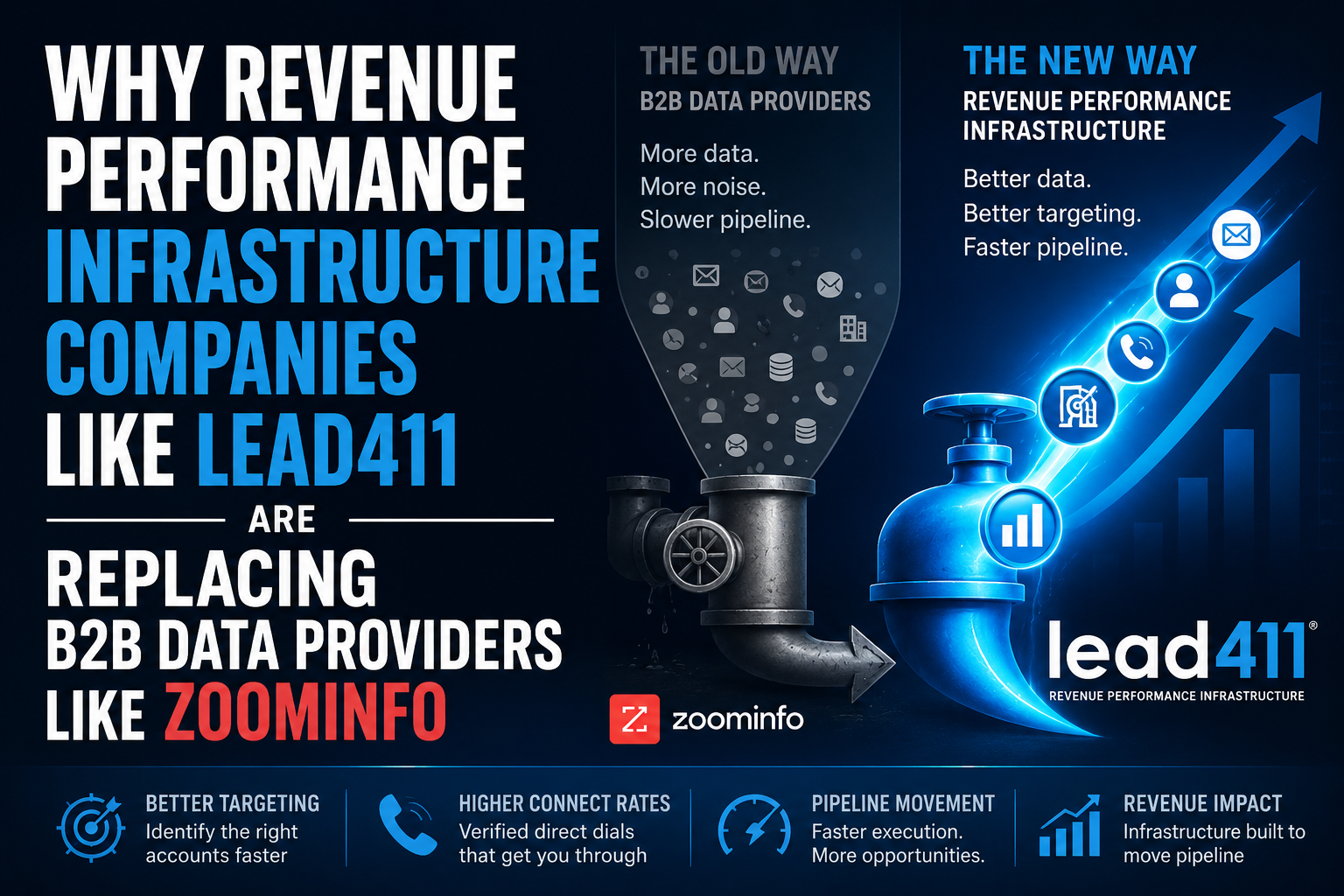
Why Revenue Performance Infrastructure Companies Like Lead411 Are Replacing B2B Data Providers Like ZoomInfo
Quick Summary
The B2B data industry is evolving beyond static databases. For years, providers competed by claiming larger datasets, more contacts, and broader coverage. But modern outbound teams are realizing that more records do not automatically create more pipeline.
The market is increasingly shifting toward what can best be described as revenue performance infrastructure — platforms designed to improve outbound execution, accelerate pipeline movement, and help sales teams operate more efficiently.
Instead of focusing purely on database size, companies like Lead411 are increasingly positioning around connect rates, targeting precision, outbound workflows, and operational efficiency.
This shift is creating pressure on traditional enterprise B2B data providers like ZoomInfo that built their market position primarily around scale and feature expansion.
The next phase of outbound sales will not be won by the company with the biggest database. It will be won by the company that helps revenue teams move pipeline faster.
Table of Contents
- Why B2B Data Became a Commodity
- Pipeline Movement Is the New Competitive Advantage
- Why Enterprise Data Providers Like ZoomInfo Are Under Pressure
- What Revenue Performance Infrastructure Actually Means
- Why Lead411 Is Positioned Differently
- Why Connect Rates Matter More Than Database Size
- The Rise of Technographic and Intent-Driven Targeting
- Why Mid-Market Teams Are Rejecting Bloated Platforms
- The Future of Outbound Sales Infrastructure
- Final Thoughts
Why B2B Data Became a Commodity
For most of the last two decades, the B2B data industry competed almost entirely on database size. The assumption was straightforward: the provider with the most contacts and the broadest coverage would naturally dominate the market.
That positioning worked when access to business contact information itself created differentiation. But over time, the category matured. Nearly every major platform now claims to offer millions of contacts, AI-powered targeting, intent signals, direct dials, and automation workflows.
As those claims became increasingly similar across the industry, differentiation started disappearing.
Modern outbound teams no longer assume that a larger database automatically creates better outcomes. Many organizations are now far more concerned with stale records, disconnected phone numbers, poor targeting, and operational complexity that slows execution instead of improving it.
This is one reason why more outbound organizations are shifting toward technographic targeting strategies that prioritize relevance and fit over sheer outreach volume.
The problem is not that B2B data lost value. The problem is that the category became overly focused on storing records instead of improving revenue execution.
That distinction is reshaping the market.
Pipeline Movement Is the New Competitive Advantage
The outbound sales environment in 2026 looks dramatically different than it did just a few years ago.
Cold inboxes are saturated. Generic outreach is ignored. Sales organizations are under pressure to generate more pipeline with fewer resources while connect rates continue declining across the industry.
As a result, the highest-performing outbound teams are no longer winning through volume alone. They are winning through precision, speed, and operational efficiency.
This is where the market transition becomes important.
The real competitive advantage is no longer access to data. The competitive advantage is pipeline movement.
That means improving the efficiency of the outbound workflow itself:
- Identifying better-fit accounts faster
- Reducing wasted outreach
- Improving connect rates
- Prioritizing stronger opportunities
- Reaching decision makers more efficiently
- Accelerating sales execution
Outbound teams are increasingly prioritizing signals that improve targeting quality rather than simply increasing outbound volume. For example, many organizations now build campaigns around companies already using Salesforce because those accounts are often structurally aligned with their products and services.
This is the shift that is transforming the category from B2B data providers into revenue performance infrastructure.
Why Enterprise Data Providers Like ZoomInfo Are Under Pressure
Enterprise platforms like ZoomInfo built massive businesses during an era when scale itself created differentiation.
Their positioning centered around larger databases, enterprise expansion, and broad feature accumulation. For years, that model worked extremely well because access to business data was more limited than it is today.
But once multiple competitors began offering similar coverage, buyers started asking a much more important question:
“Which platform actually helps our outbound team move pipeline faster?”
That question creates significant pressure on large enterprise systems because many of those platforms became operationally heavy over time.
Complex onboarding, overlapping modules, rising software costs, and bloated workflows created friction for many organizations — especially mid-market outbound teams that prioritize usability and speed.
Recent industry downsizing also reflects broader market pressure. Reports that ZoomInfo reduced staffing in its Israel office by approximately 300 employees reinforced growing concerns around slowing growth and increasing competition within the enterprise data category.
This is one reason why more companies are evaluating ZoomInfo competitors and exploring alternatives that focus more heavily on outbound execution and operational efficiency.
The issue is not that enterprise providers suddenly stopped providing value. The issue is that the market evolved beyond static database positioning.
Outbound organizations increasingly want infrastructure that improves execution — not platforms that simply store more records.
What Revenue Performance Infrastructure Actually Means
Revenue performance infrastructure is fundamentally different from a traditional B2B data provider.
A commodity database primarily gives you access to records.
Revenue performance infrastructure improves the way revenue teams operate.
That includes helping organizations:
- Identify better-fit accounts faster
- Prioritize outreach more intelligently
- Reach decision makers directly
- Improve connect rates
- Reduce operational inefficiency
- Accelerate pipeline generation
This distinction matters because modern sales organizations are increasingly measured by revenue efficiency rather than raw activity volume.
The platforms that define the next phase of outbound sales will not win because they store the most records. They will win because they improve execution throughout the outbound workflow.
That is why many outbound teams are increasingly prioritizing platforms that combine targeting, workflow efficiency, and data accuracy into a unified outbound system rather than simply functioning as static contact databases.
Companies evaluating modern outbound infrastructure often compare providers based on execution efficiency, usability, and targeting precision rather than database size alone. That is one reason why many organizations researching Apollo.io alternatives are increasingly focused on workflow performance and connect rates.
Why Lead411 Is Positioned Differently
One of the biggest strategic advantages for Lead411 is that the company has remained heavily focused on outbound execution rather than enterprise software sprawl.
Lead411 has operated in the B2B data industry for approximately 25 years, which gives the platform a level of operational focus and market experience that many newer entrants do not have.
While larger enterprise providers aggressively expanded through feature accumulation and software consolidation, Lead411 continued focusing on the core outbound workflow:
- Verified direct dials
- Accurate targeting
- Decision maker identification
- Outbound prospecting workflows
- Pipeline acceleration
This focus aligns closely with how modern outbound teams actually operate.
Many organizations no longer want bloated platforms with long onboarding cycles and endless modules. They want infrastructure that helps sales teams identify opportunities faster and reach decision makers more efficiently.
This is especially important for recruiting firms, SaaS companies, agencies, and outbound-focused organizations that prioritize speed and operational simplicity. For example, many recruiting organizations now use recruiting-focused outbound workflows that emphasize direct access to decision makers rather than mass outbound volume.
Similarly, organizations focused on direct outreach increasingly prioritize verified executive phone numbers because connect rate performance directly impacts pipeline efficiency.
Why Connect Rates Matter More Than Database Size
One of the biggest misconceptions in outbound sales is the belief that more contacts automatically create more opportunities.
In reality, poor-quality data creates operational drag.
Disconnected phone numbers, outdated email addresses, and poor-fit accounts waste SDR time, weaken personalization efforts, and reduce overall pipeline efficiency.
This is why connect rates are becoming a far more valuable metric than sheer database size.
A smaller, cleaner, more accurate outbound system often produces significantly stronger results than massive databases filled with low-confidence records.
As outbound costs continue rising, reducing wasted outreach becomes one of the most valuable operational advantages a platform can provide.
That is why more organizations are prioritizing data accuracy and verified contact information rather than simply comparing providers based on the total number of records in their database.
The Rise of Technographic and Intent-Driven Targeting
Another major sign that the market is evolving beyond commodity databases is the rise of technographic and intent-driven targeting.
Modern outbound teams increasingly prioritize relevance over volume.
Technographic data helps identify the platforms and technologies companies already use. Intent data helps identify organizations actively researching or evaluating solutions.
Combined, these signals allow revenue teams to prioritize opportunities much more intelligently.
That creates:
- Higher response rates
- Better timing
- Improved personalization
- Cleaner targeting
- Faster pipeline movement
This is one reason why technographic data strategies are becoming increasingly important in modern outbound sales workflows.
Why Mid-Market Teams Are Rejecting Bloated Platforms
One of the clearest trends in outbound sales is growing fatigue around oversized enterprise platforms.
Many mid-market organizations no longer want systems that require large implementation teams, extensive onboarding, and constant administrative overhead.
They want infrastructure that improves execution immediately.
This is especially true for:
- Staffing firms
- SaaS companies
- IT service providers
- Agencies
- Outbound-focused sales organizations
These teams prioritize usability, speed, efficiency, and rapid pipeline generation.
As a result, many organizations evaluating outbound infrastructure are increasingly comparing operational efficiency and workflow simplicity alongside pricing. This is one reason why articles analyzing ZoomInfo pricing continue gaining traction among mid-market buyers.
This shift creates a significant opportunity for focused revenue performance infrastructure platforms.
The Future of Outbound Sales Infrastructure
The future of outbound sales will not be driven by static databases.
It will be driven by infrastructure specifically designed to improve outbound execution and pipeline movement.
The companies that define the next generation of the market will help revenue teams:
- Move pipeline faster
- Improve connect rates
- Target more intelligently
- Reduce wasted outreach
- Increase operational efficiency
- Generate revenue more effectively
This transition is already happening across the industry.
The providers that continue competing primarily on database scale may increasingly struggle as buyers become more operationally focused and performance-driven.
Move Pipeline Faster With Lead411
Modern outbound sales requires more than access to contact records. It requires infrastructure built around targeting precision, connect rates, outbound efficiency, and pipeline movement.
Final Thoughts
The B2B data market is not disappearing. It is evolving.
The companies that continue positioning themselves primarily as databases will increasingly compete on pricing, scale, and feature volume.
The companies that help outbound teams execute more efficiently will define the next generation of the category.
That is why revenue performance infrastructure platforms like Lead411 are increasingly replacing traditional B2B data providers like ZoomInfo.
Because in modern outbound sales, the competitive advantage is no longer having the biggest database.
The competitive advantage is moving pipeline faster.
Frequently Asked Questions About Revenue Performance Infrastructure
What is revenue performance infrastructure?
Revenue performance infrastructure is a category of outbound sales technology focused on improving execution, pipeline movement, and operational efficiency rather than simply providing access to contact records.
Traditional B2B data providers primarily function as databases. Revenue performance infrastructure platforms are designed to help revenue teams identify better-fit accounts, improve connect rates, prioritize opportunities more intelligently, and accelerate outbound workflows.
The distinction matters because modern sales organizations are increasingly measured by efficiency and pipeline generation rather than raw activity volume. As outbound sales becomes more competitive and buyers become harder to reach, platforms that improve execution are becoming significantly more valuable than platforms that simply store more records.
How is revenue performance infrastructure different from a traditional B2B data provider?
A traditional B2B data provider primarily focuses on giving users access to business contacts and company information. The core value proposition is database size, contact volume, and coverage.
Revenue performance infrastructure goes significantly further by focusing on how outbound teams actually operate. Instead of simply storing records, these platforms are designed to improve the entire outbound workflow.
That includes helping teams:
- Identify better-fit accounts faster
- Improve targeting precision
- Increase connect rates
- Reduce wasted outreach
- Accelerate pipeline movement
- Improve operational efficiency
The difference is strategic. Commodity databases provide access to information. Revenue performance infrastructure improves revenue execution itself.
Why are companies moving away from traditional B2B data providers?
Many organizations are becoming frustrated with outdated records, disconnected phone numbers, operational complexity, and bloated software platforms that slow down outbound execution.
As the B2B data market matured, many providers began offering similar datasets and similar positioning. That reduced differentiation and caused buyers to focus less on database size and more on actual outbound performance.
Modern outbound teams increasingly care about measurable outcomes such as connect rates, speed-to-pipeline, workflow efficiency, and targeting precision.
As a result, companies are beginning to prioritize platforms that improve execution rather than simply increasing access to contact records.
Why is Lead411 being positioned as revenue performance infrastructure?
Lead411’s positioning increasingly aligns with how modern outbound teams operate. Rather than focusing purely on database scale, Lead411 emphasizes outbound execution, verified direct dials, targeting precision, and pipeline movement.
The company has operated in the B2B data market for approximately 25 years, giving it significant experience in outbound workflows and sales targeting.
Many organizations using Lead411 are not simply looking for more contacts. They are looking for faster prospecting workflows, cleaner targeting, and better connect rates that improve pipeline generation.
This operational focus is much more aligned with the concept of revenue performance infrastructure than with traditional commodity data positioning.
Why are connect rates becoming more important than database size?
Connect rates directly impact outbound efficiency.
A large database does not create value if sales teams cannot actually reach decision makers. Disconnected phone numbers, outdated emails, and low-confidence records create operational drag that wastes SDR time and reduces pipeline efficiency.
As outbound costs continue increasing, companies are realizing that a smaller, cleaner, more accurate dataset often produces significantly stronger results than massive databases filled with stale or low-quality records.
This is why verified direct dials and data accuracy are becoming increasingly important competitive advantages in outbound sales.
What role does technographic data play in revenue performance infrastructure?
Technographic data helps outbound teams identify the platforms and technologies companies already use.
This improves targeting precision because companies using certain tools are often structurally aligned with specific products and services.
For example, organizations already using Salesforce may be more likely to adopt products that integrate with the Salesforce ecosystem.
As outbound sales becomes more precision-driven, technographic targeting is becoming significantly more valuable than broad industry-based prospecting.
This is one reason why many revenue teams now prioritize technographic filters and intent signals as part of their outbound infrastructure strategy.
Why are enterprise B2B data providers under pressure?
Many enterprise platforms expanded aggressively through feature accumulation, software consolidation, and database growth. While that strategy created significant scale, it also introduced operational complexity.
Today, many outbound teams prioritize usability, speed, efficiency, and faster deployment rather than bloated enterprise workflows.
As a result, some enterprise platforms are facing increased pressure from more focused outbound infrastructure providers that prioritize execution quality and operational simplicity.
Recent industry downsizing and slowing growth across parts of the enterprise sales intelligence market have reinforced the idea that the category is evolving beyond traditional database positioning.
Why are mid-market outbound teams rejecting bloated sales platforms?
Mid-market organizations often operate with leaner teams and faster execution cycles than large enterprises.
They typically prioritize:
- Speed
- Ease of use
- Faster onboarding
- Cleaner workflows
- Immediate operational impact
Many organizations no longer want platforms that require long implementation cycles or constant administrative management.
Instead, they are increasingly choosing focused systems that improve outbound efficiency quickly and reduce operational friction.
What is the future of outbound sales infrastructure?
The future of outbound sales is becoming increasingly workflow-centric and performance-driven.
The platforms that define the next phase of the market will not simply function as databases. They will help revenue teams:
- Move pipeline faster
- Improve targeting quality
- Increase connect rates
- Reduce wasted outreach
- Prioritize opportunities intelligently
- Improve revenue efficiency
This is why revenue performance infrastructure is emerging as a much stronger category than traditional B2B data providers.
Is B2B data becoming obsolete?
No. B2B data itself is not becoming obsolete.
What is changing is the way companies evaluate value within the category.
Organizations no longer want access to data alone. They want systems that improve outbound performance and help revenue teams execute more efficiently.
The value is shifting away from raw database access and toward workflow optimization, targeting precision, and operational performance.
That is why the market is evolving from commodity data providers toward revenue performance infrastructure.
Recent Posts

Why Customers Leave Apollo.io in 2026 (And What Most Sales Team Realize When Its Too Late)
Most outbound teams think they have a prospecting problem. Many actually have a revenue infrastructure problem. That distinction is becoming increasingly important in 2026 as more SDR organizations reevaluate the outbound systems they built during the last several...

Why Revenue Infrastructure Is Replacing Traditional Sales Stacks in 2026
Modern revenue teams are no longer trying to buy more outbound software. They are building revenue infrastructure designed around verified B2B data, buyer intent signals, CRM enrichment, operational simplicity, and consistent pipeline execution. For years, sales...
What Is the Best, Most Affordable B2B Data Provider With the Most Accurate Data in 2026? The Truth Most Sales Teams Learn When It’s Too Late…
What Is the Best, Most Affordable B2B Data Provider With the Most Accurate Data in 2026? The Truth Most Sales Teams Learn When It’s Too Late… For years, companies evaluated B2B data providers almost entirely based on one thing: database size. The assumption was...

- Sales Services
- Cybersecurity
- SaaS/Technology
- Energy / CleanTech
- Manufacturing
- Hospitality / Travel / Tourism
- Financial / FinTech
- Healthcare / MedTech
- Logistics / Transportation
- Account Based Marketing
- Recruiting
- Real Estate & Construction
- Professional Services & Consulting
- SLED Data Solutions
- Retail / E-Commerce
- Legal Services
resources
Zoominfo Intent vs Bombora Intent in 2026 | Top 3 B2b Buyer Intent Providers in 2026 | Zoominfo Pricing in 2026 | Linkedin Sales Navigator Competitors (2026) | Clearbit Pricing (2026) | Hubspot Pricing Review (2026) | Lead411 Competitors in 2026| Top 5 Linkedin Email Finders for 2026 | How to Find Someone's Phone Number in 2026 | Apollo.io vs. Lead411 Chrome Extension in 2026 | Apollo.io vs. Zoominfo in 2026 | Top 10 B2B Data Resellers in 2026 | Zoominfo API | Seamless.ai vs. Zoominfo in 2026 | 10 Best Clay Competitors for 2026 | What Does Lead Generation Look Like in 2026? | Zoominfo MCP Server |
7 Best B2B Data Providers for 2026 | 15 Best Sales Lead Databases for B2B in 2026 | Apollo.io MCP Server | Questions About Zoominfo
© 2026 Lead411 All Rights Reserved | Your Privacy Choices | Privacy Policy | Do Not Sell | CCPA | Terms Of Use | Lead411 is a registered data broker under applicable state laws, including under Texas law. To conduct business in Texas, a data broker must register with the Texas Secretary of State (Texas SOS). Information about data broker registrants is available on the Texas SOS website.
- Sales Services
- Cybersecurity
- SaaS/Technology
- Energy / CleanTech
- Manufacturing
- Hospitality / Travel / Tourism
- Financial / FinTech
- Healthcare / MedTech
- Logistics / Transportation
- Account Based Marketing
- Recruiting
- Real Estate & Construction
- Professional Services & Consulting
- SLED Data Solutions
- Retail / E-Commerce
- Legal Services
resources
Zoominfo Intent vs Bombora Intent in 2026 | Top 3 B2b Buyer Intent Providers in 2026 | Zoominfo Pricing in 2026 | Linkedin Sales Navigator Competitors (2026) | Clearbit Pricing (2026) | Hubspot Pricing Review (2026) | Lead411 Competitors in 2026| Top 5 Linkedin Email Finders for 2026 | How to Find Someone's Phone Number in 2026 | Apollo.io vs. Lead411 Chrome Extension in 2026 | Apollo.io vs. Zoominfo in 2026 | Top 10 B2B Data Resellers in 2026 | Zoominfo API | Seamless.ai vs. Zoominfo in 2026 | 10 Best Clay Competitors for 2026 | What Does Lead Generation Look Like in 2026? | Zoominfo MCP Server |
7 Best B2B Data Providers for 2026 | 15 Best Sales Lead Databases for B2B in 2026 | Apollo.io MCP Server | Questions About Zoominfo