
Our Data Sucks: Why Your B2B Data Is Failing (And How to Fix It)
Quick Summary:
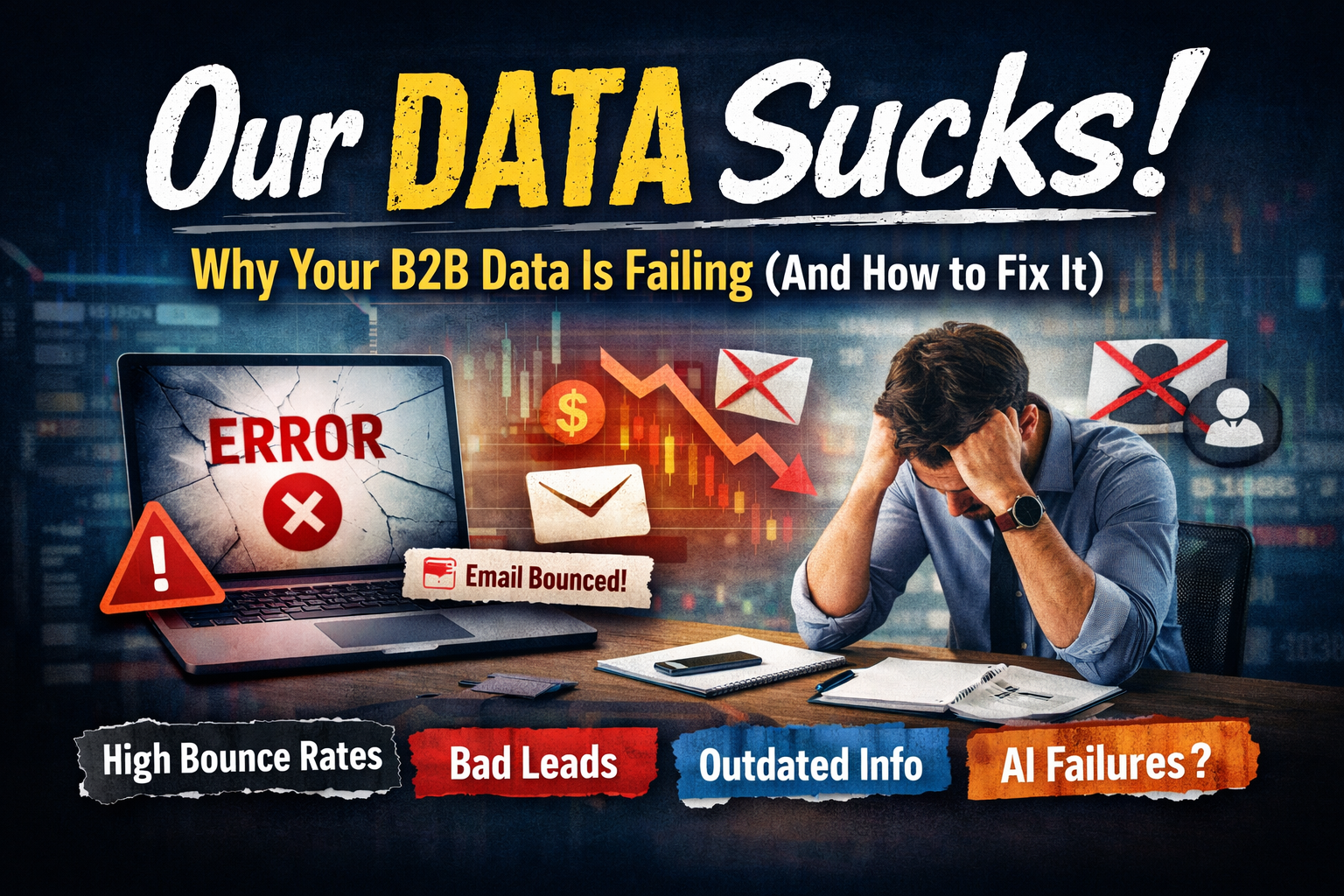
If you’ve ever said “our data sucks,” you’re not alone. Bad B2B data kills reply rates, increases bounce rates, frustrates SDRs, and wastes thousands in software spend. Most companies don’t have a lead problem — they have a data quality problem. In this guide, we’ll break down why your CRM data goes stale, how often contact data decays, why AI-generated data can make things worse, and which B2B data providers actually keep their records fresh — including why Lead411’s real-time verification model stands out.
Table of Contents
- Why B2B Data Goes Bad So Fast
- The Hidden Cost of Bad Sales Data
- Why AI-Generated Data Isn’t the Magic Fix
- What “Good Data” Actually Looks Like
- Re-Verification Schedules: The Most Important Factor Nobody Talks About
- The Best B2B Data Providers (And How They Compare)
- How to Fix Your Data Problem for Good
Why B2B Data Goes Bad So Fast
Here’s the uncomfortable truth:
- Up to 30% of B2B contact data decays every year
- Employees change roles every 2–4 years on average
- Companies restructure, relocate, and rebrand constantly
That means the contact you verified six months ago could already be wrong.
Common issues you’re probably seeing:
- High email bounce rates
- Phone numbers that don’t connect
- Outdated job titles
- Contacts who no longer work at the company
- SDRs saying, “This list is trash.”
This isn’t your team’s fault. It’s how fast business changes. If your B2B data provider isn’t constantly re-verifying records, your database starts rotting the moment you export it.
The Hidden Cost of Bad Sales Data
Most companies calculate software cost. Few calculate bad data cost.
Here’s what bad CRM data actually does:
- Lowers reply rates
- Damages domain reputation
- Increases spam complaints
- Inflates customer acquisition cost (CAC)
- Burns out sales reps
- Creates misleading pipeline metrics
If 25–40% of your B2B contact data is wrong, nearly half your outbound effort is wasted before the first email is sent. And when that happens, leadership starts thinking outbound marketing doesn’t work.
Why AI-Generated Data Isn’t the Magic Fix
AI has changed prospecting — but it’s also introduced a new issue: synthetic confidence.
Many platforms now promise they can “find leads with AI” or “predict verified emails using machine learning.” Here’s where that breaks down:
1. AI Often Predicts, Not Verifies
AI can guess common email formats (like first.last@company.com), but guessing isn’t validating. If the email server blocks unknown addresses, you bounce.
2. Scraped + Modeled Data Ages Faster
AI-driven tools frequently rely on scraped web data, enrichment guesses, or inferred job changes. Without true verification cycles, you’re working with probabilities — not confirmed contact data.
3. AI Doesn’t Know Employment Status in Real Time
Someone updates LinkedIn? That’s visible. Someone quietly leaves a role without updating anything? AI won’t catch it until a public signal appears — and sometimes that never happens.
4. Confidence Scores Don’t Equal Accuracy
A “92% confidence” score still means 8 out of 100 contacts may be wrong — and that’s before natural data decay kicks in.
AI is excellent for:
- Data enrichment
- Intent signals
- Prospect scoring
- Pattern detection
But AI cannot replace real-time email verification infrastructure. If your data provider relies heavily on AI inference without active verification, you’ll see it reflected in your bounce rate.
What “Good Data” Actually Looks Like
Good B2B data isn’t just a massive database.
It includes:
- Real-time or near real-time email verification
- Human + automated validation layers
- Transparent re-verification schedules
- Clear bounce policies
- Strong direct-dial accuracy
- Compliance safeguards
The key question to ask any data vendor:
“How often is your data re-verified?”
If they can’t answer that clearly, that’s your red flag.
Re-Verification Schedules: The Most Important Factor Nobody Talks About
Most data providers talk about database size, AI capabilities, or intent integrations. Few talk about how often they re-verify contact records.
There are typically three models:
Static Database Model
Data is collected, refreshed in batches, and sold via subscription. Records may sit untouched for months.
Scrape + Refresh Model
Data is scraped from public sources and refreshed when signals appear. This improves scale but leaves gaps between updates.
Real-Time Verification Model
Contacts are verified at the point of access or continuously re-validated through automated systems. This significantly reduces bounce rates and improves deliverability.
This third model is where Lead411 differentiates itself.
The Best B2B Data Providers (And How They Compare)
Not all B2B data providers are bad. The real difference is how they handle data freshness and verification.
Lead411
Lead411 emphasizes real-time verified emails and continuous data validation.
Strengths:
- Real-time email verification
- High direct-dial accuracy
- Transparent refresh approach
- Intent-driven targeting
- Unlimited search model (no restrictive credit throttling)
Because emails are verified at the point of access, bounce rates tend to remain lower than static database systems. This protects domain reputation and improves outbound performance.
ZoomInfo
ZoomInfo offers massive coverage and enterprise integrations.
Strengths:
- Large contact database
- Org charts
- Strong enterprise integrations
Drawbacks:
- Higher pricing
- Re-verification transparency varies
- Rigid contracts
Apollo.io
Apollo combines prospecting data with sequencing tools.
Strengths:
- Affordable entry point
- All-in-one outbound platform
Drawbacks:
- Credit-based data pulls
- Heavier AI inference usage
- Data freshness can vary by segment
Seamless.AI
Seamless focuses heavily on AI-powered contact discovery.
Strengths:
- Large contact pool
- Browser extension
Drawbacks:
- Predictive email generation reliance
- Verification consistency varies
- Daily export limits
RocketReach / Lusha
Useful for individual lookups and quick enrichment, but not typically built for large-scale outbound optimization.
How to Fix Your Data Problem for Good
1. Audit Your Bounce Rate
If it’s above 5%, you likely have a data quality issue.
2. Review Data Age
When was your contact data last verified?
3. Don’t Rely on AI Alone
Use AI for enrichment and scoring — not unverified contact generation.
4. Switch to Real-Time Verified Data
This is the biggest performance lever for outbound success.
5. Monitor Data Performance Monthly
Treat your B2B database as infrastructure, not a one-time purchase.
Final Thoughts
Most outbound doesn’t fail because messaging is bad. It fails because:
- Emails are incorrect
- Contacts are outdated
- Titles are inaccurate
- Data wasn’t re-verified
If your team keeps saying, “our data sucks”, that’s not a sales problem — it’s a data quality problem.
The solution isn’t more volume or more AI. It’s better verification.
Lead411’s real-time verified data model was built specifically to reduce decay, protect deliverability, and stabilize outbound performance over time.
Because in B2B sales, your data isn’t just a tool.
It’s your foundation.
Frequently Asked Questions About Bad B2B Data
1. Why does B2B data go bad so quickly?
B2B contact data decays because employees change jobs, get promoted, switch departments, or companies restructure. On average, 25–35% of B2B data becomes outdated every year. If your data provider does not frequently re-verify contacts, your CRM will naturally degrade over time.
2. What is an acceptable email bounce rate for outbound sales?
Most deliverability experts recommend keeping bounce rates under 3–5%. Anything higher usually signals poor data quality, outdated contact information, or unverified email addresses. High bounce rates can also damage your sender reputation.
3. How often should B2B contact data be re-verified?
Ideally, contact data should be verified in real time or at least every 30–90 days. Providers that rely on static databases or annual refresh cycles tend to experience higher data decay and increased inaccuracies.
4. Why are our SDRs complaining about lead quality?
When SDRs complain about lead quality, it often comes down to bad data. Common issues include contacts no longer working at the company, incorrect job titles, bounced emails, and outdated phone numbers. Poor data quality directly impacts morale and outbound performance.
5. Does AI-generated prospect data reduce bounce rates?
Not necessarily. AI can predict or infer email formats, but prediction is not the same as verification. Without real-time validation, AI-generated contact data can still result in high bounce rates and deliverability issues.
6. Which industries struggle most with bad B2B data?
Industries with high employee turnover or rapid growth typically experience faster data decay. These include technology startups, healthcare organizations, financial services, manufacturing, and agencies. Fast-moving sectors require more frequent data re-verification.
7. Is data quality worse in certain geographic regions?
Yes. International data, especially outside the United States, can vary in accuracy due to privacy regulations, reporting standards, and limited public data availability. Targeting EMEA, APAC, or LATAM markets often requires stronger verification processes.
8. How much should a company budget for clean B2B data?
Budgets vary depending on team size and outbound volume, but companies should treat data as infrastructure rather than a one-time purchase. Investing in continuously verified data often reduces wasted ad spend, outbound effort, and deliverability damage, making it more cost-effective in the long run.
9. How do I audit my CRM for bad data?
Start by reviewing your email bounce rates, duplicate contacts, missing job titles, outdated company information, and overall reply rates. Running a re-verification test on a sample of your database can also help measure accuracy levels.
10. What’s the best way to fix a bad B2B database?
The most effective approach includes removing unverified contacts, implementing real-time email verification, choosing a provider with transparent re-verification schedules, monitoring bounce rates monthly, and avoiding reliance on AI-predicted contacts alone. Moving to continuously verified data significantly reduces long-term decay.
Recent Posts

How to Find Decision Makers at Any Company (Complete Guide for B2B Sales)
Quick Summary Finding the right decision maker is one of the most important steps in B2B sales and lead generation.Decision makers are the people inside a company who have the authority to approve budgets, evaluate vendors, and make purchasing decisions. To find...

The Ultimate Guide to Cold Outreach That Avoids the Spam Folder (2026)
Quick Summary Cold outreach remains one of the most powerful B2B growth channels, but modern spam filters have become significantly more advanced. Email providers now analyze domain authentication, sender reputation, bounce rates, engagement signals, sending...
The B2B Lead Provider Monopoly Board: Every Space Explained
Quick Summary The B2B lead provider industry can feel like playing Monopoly. Each square represents a platform competing for your sales team’s attention, time, and budget. Some tools are cheap entry points, others promise shortcuts that don’t always work, and a few...