
Why Apollo.io Doesn’t Fix Your Pipeline (And What Actually Does)
Why Apollo.io Doesn’t Fix Your Pipeline (And What Actually Does)
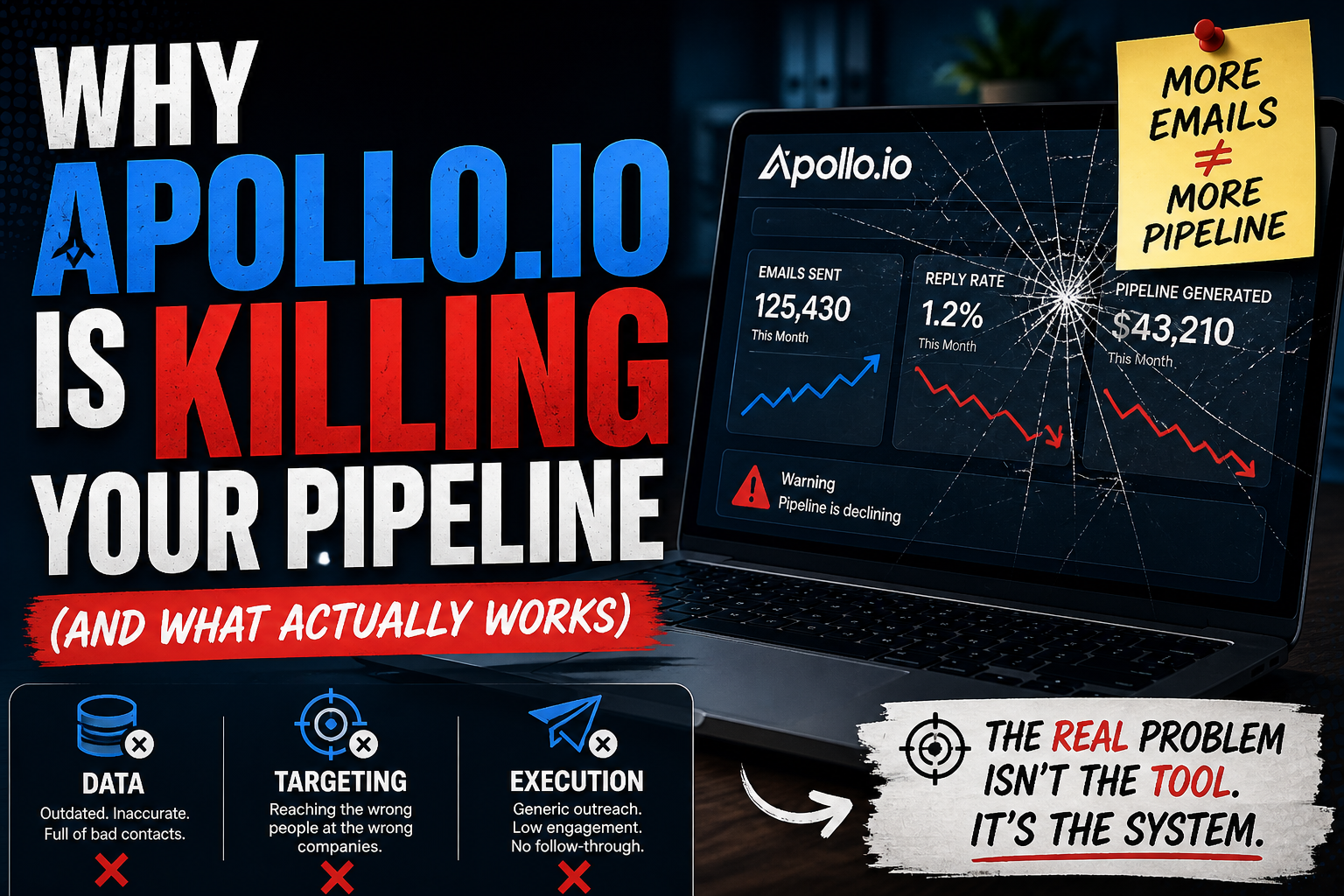
Quick Answer: Apollo.io doesn’t fail because it’s a bad tool. It fails because most teams expect a tool to fix a system problem.
That system problem usually comes down to three things: data quality, targeting, and execution. Until those are fixed, no outbound platform will consistently generate pipeline.
If you’re using Apollo and not seeing results, you’re not alone. Many teams hit the same ceiling—and it has very little to do with features.
---
Table of Contents
- The Real Problem with Outbound
- Why Apollo.io Feels Like It’s Not Working
- The Activity Trap
- The Data Quality Problem
- The Execution Problem
- The Targeting Problem
- What Actually Drives Pipeline
- FAQ
- Final Takeaway
---
The Real Problem with Outbound
Most teams think outbound is about tools. It’s not.
Outbound is about reaching the right person at the right time with the right message.
Tools like Apollo help with execution—but they don’t fix underlying issues like poor targeting or outdated data.
This is why many teams still struggle even after adopting new platforms. As explained in why outbound fails, the problem is rarely the tool—it’s the system behind it.
---
Why Apollo.io Feels Like It’s Not Working
Apollo doesn’t fail in obvious ways. It fails quietly.
At first, everything looks fine:
- Sequences are running
- Emails are sending
- Activity is high
But underneath that activity, performance is slipping:
- Reply rates drop from 8% → 2%
- Meetings become inconsistent
- Pipeline slows down
This is where most teams get stuck.
They assume the problem is messaging, so they rewrite emails.
But the real issue is earlier in the process.
Your outbound isn’t failing because you’re not sending enough emails—it’s failing because the wrong people are receiving them.
---
The Activity Trap
Apollo makes it easy to do more.
More emails. More sequences. More contacts.
And that’s exactly where most teams go wrong.
They optimize for activity instead of outcomes.
This leads to a dangerous pattern:
- Low reply rates → send more emails
- No meetings → increase volume
- Poor pipeline → expand targeting
The more you scale a broken system, the worse it performs.
---
The Data Quality Problem
Most teams don’t realize their data is the problem until it’s too late.
Here’s what it actually looks like:
- You email someone who left the company months ago
- You call numbers that don’t connect to decision-makers
- You target accounts that aren’t actively buying
At scale, this destroys performance.
Out of 1,000 contacts, a significant portion may already be outdated or irrelevant. That means your real reachable audience is far smaller than you think.
This is the reality of data decay.
You don’t have a messaging problem—you have a reachability problem.
---
The Execution Problem
Even with good data, execution matters.
Most teams:
- send generic outreach
- fail to personalize
- don’t follow up effectively
These small issues compound into low engagement.
Improving execution requires better targeting and personalization, like those outlined in this guide to cold outreach personalization.
---
The Targeting Problem
If you’re targeting the wrong accounts, nothing else matters.
Top teams don’t just build lists—they prioritize timing and intent.
For example, identifying companies hiring IT teams can signal immediate buying opportunities.
This level of precision is what separates high-performing outbound from average campaigns.
---
What Actually Drives Pipeline
The difference between average teams and top-performing teams isn’t tools—it’s how they use them.
Average teams:
- prioritize volume
- use static lists
- react after performance drops
Top-performing teams:
- prioritize connection rate
- use continuously refreshed data
- target based on real-time signals
This is why learning how to build a high-converting prospect list has a bigger impact than switching tools.
The goal isn’t more outreach—it’s more conversations.
---
Frequently Asked Questions
Why isn’t Apollo generating leads?
In most cases, the issue isn’t Apollo—it’s outdated data, poor targeting, or weak execution. Increasing volume won’t fix these underlying problems.
Is Apollo good for outbound sales?
Apollo is effective for scaling outreach and managing sequences, but performance depends heavily on data quality and targeting accuracy.
Does Apollo provide accurate data?
Data accuracy varies. Like all platforms, it is affected by data decay, meaning contacts can become outdated over time.
Why are my reply rates dropping?
Declining reply rates are usually caused by outdated contacts, poor targeting, or lack of personalization—not just messaging issues.
Can tools fix outbound performance?
No tool can fix a broken system. Performance depends on data quality, targeting, and execution working together.
What matters more: volume or accuracy?
Accuracy matters more. Reaching the right person is far more valuable than sending more emails.
How do I improve outbound results?
Focus on better data, stronger targeting, and more relevant messaging instead of increasing activity.
---
Final Takeaway
Apollo.io isn’t broken.
But it doesn’t fix what’s actually broken.
Most outbound systems fail before the first email is ever sent.
If your pipeline isn’t growing, don’t ask:
“Which tool should we switch to?”
Ask:
“Are we reaching the right people, at the right time, with data we can trust?”
Because that’s what actually determines results.
If you want to improve outbound performance, start with your data foundation—not just your tools.
Explore Lead411 pricing or request a demo to see how accurate, verified data impacts real pipeline.