
Apollo.io Pricing 2026: What It Really Costs (Plans, Credits & Hidden Fees)
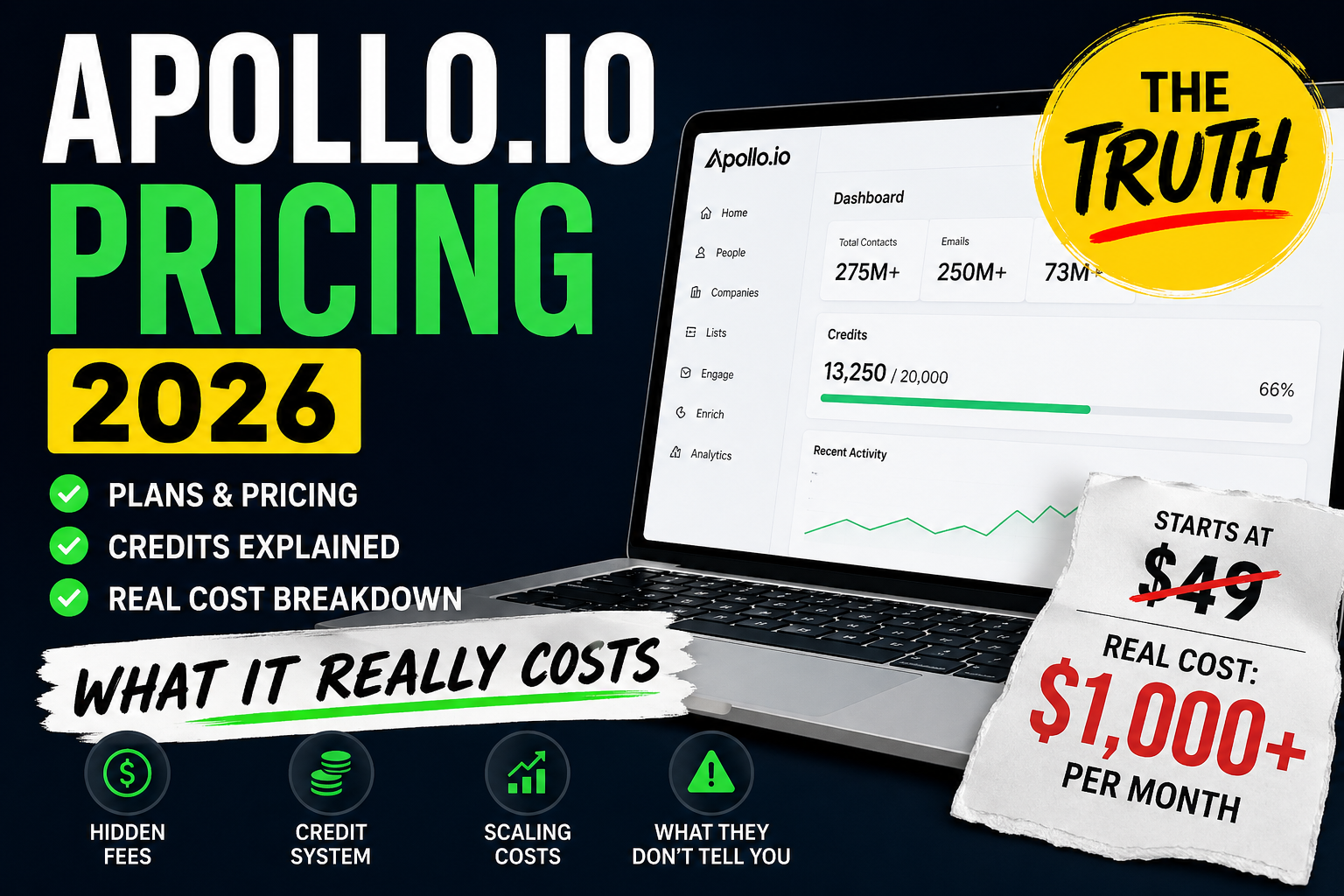
Apollo.io Pricing 2026: What It Really Costs (Plans, Credits & Hidden Fees)
Apollo.io pricing starts at around $49 per user per month, but most teams end up paying significantly more once they begin using credits at scale. Understanding how Apollo’s pricing actually works is critical before committing to the platform.
Apollo.io uses a credit-based pricing model, meaning you pay based on data usage—not just your subscription. This is where many sales teams underestimate their total cost.
In simple terms: Apollo looks inexpensive upfront, but becomes more expensive as your outbound activity increases.
For broader trends in B2B sales tools and pricing, see research from Gartner.
Quick Answer: How Much Does Apollo.io Cost?
Apollo.io costs between $49 and $79 per user per month for most teams, but real monthly costs often range from $600 to $1,000+ depending on credit usage.
This happens because credits are consumed every time you unlock, export, or enrich contact data.
Most teams don’t realize that subscription pricing is only part of the equation—the real driver of cost is how much data you use.
For a comparison with more predictable pricing models, see Lead411 pricing.
Apollo.io Pricing Plans (2026)
| Plan | Price | Credits | Best For |
|---|---|---|---|
| Free | $0 | Very limited | Testing the platform |
| Basic | ~$49/user/month | Moderate | Small teams starting outbound |
| Professional | ~$79/user/month | Higher limits | Scaling sales teams |
| Organization | Custom | Custom | Larger teams with advanced needs |
While these plans look straightforward, they don’t tell the full story. The credit system is what ultimately determines how much you pay.
How Apollo Credits Actually Work
Apollo credits are used whenever you access or export data. This includes unlocking email addresses, accessing phone numbers, exporting contacts, and enriching CRM records.
Every action consumes credits, which means your cost scales directly with your outbound activity. The more you prospect, the more you spend.
This model is very different from flat-rate pricing, where access is more predictable regardless of usage.
According to Salesforce, consistent access to reliable data is one of the biggest drivers of sales productivity.
Credit Usage Breakdown (Realistic Estimates)
| Action | Estimated Credits Used |
|---|---|
| Unlock email | ~1 credit |
| Unlock phone number | ~5–10 credits |
| Export contact | ~1–2 credits |
| Bulk enrichment | Varies by volume |
This means a single outbound campaign targeting hundreds or thousands of contacts can quickly consume your monthly allowance.
If you’re evaluating options with verified contact data, you can explore Lead411 data solutions for comparison.
Real Cost Scenarios: What Teams Actually Pay
Most pricing pages don’t show real-world usage. Here’s what Apollo typically costs once teams start using it seriously.
Small Team (3 SDRs)
- Professional plan
- Moderate outbound activity
Estimated total cost: $300–$500 per month
Growing Team (5–10 reps)
- Higher outbound volume
- Additional credits required
Estimated total cost: $600–$1,200 per month
High-Volume Outbound Team
- Daily prospecting at scale
- Heavy data usage
Estimated total cost: $1,000–$2,500+ per month
This is why Apollo’s pricing can feel unpredictable—your costs increase as your team becomes more active.
For context on enterprise pricing models, review ZoomInfo pricing.
Cost Per Lead: The Metric That Actually Matters
Instead of focusing only on subscription cost, high-performing teams evaluate cost per lead.
Example scenario:
- 1,000 contacts unlocked
- Credits consumed quickly
- Total spend: ~$800
Estimated cost per lead: ~$0.80
However, if data accuracy is lower, your effective cost increases due to bounce rates and wasted outreach.
According to McKinsey, poor data quality can cost companies up to 20% of revenue.
Hidden Costs of Apollo.io
Credit Burn Rate
Most teams underestimate how quickly credits are used during outbound campaigns.
Data Accuracy Variability
Large databases can sometimes include outdated or incomplete contact information.
Scaling Costs
As your team grows, your data usage—and therefore your costs—grow with it.
Add-Ons and Upgrades
Additional credits and features increase total spend over time.
If predictable pricing is important, you can explore alternative platforms that structure costs differently.
Apollo.io vs Alternatives
Apollo.io vs ZoomInfo: Apollo is more affordable upfront, while ZoomInfo provides larger datasets and enterprise-level features at a higher cost.
Apollo.io vs Lead411: Apollo uses a credit-based system, while Lead411 focuses on verified data and more predictable pricing structures.
Apollo.io vs Cognism: Cognism emphasizes global compliance and international coverage, often at a higher price point.
Each platform has tradeoffs, and the best choice depends on your team size, budget, and outbound strategy.
Is Apollo.io Worth It?
Apollo.io is a strong option for startups and small sales teams looking for a low-cost entry into outbound prospecting.
However, as outbound volume increases, costs can rise quickly due to the credit-based model.
For teams that prioritize predictable pricing and consistent access to verified data, it may be worth comparing alternatives before committing.
You can explore different pricing models or request a demo to see how other platforms approach cost and data access.
Final Thoughts
Apollo.io pricing is appealing at first glance, but the credit system makes real costs highly dependent on usage.
The key takeaway is simple: Apollo is affordable to start, but not always predictable at scale.
Understanding how credits work—and how quickly they are consumed—is essential before making a decision.
If your team needs consistent access to accurate data without worrying about usage limits, consider exploring options like Lead411.
Apollo.io Pricing FAQs (2026)
How much does Apollo.io cost per month?
Apollo.io typically costs between $49 and $79 per user per month for its paid plans. However, most teams spend more due to credit usage, with real monthly costs often ranging from $600 to $1,000 or more depending on outbound activity.
Does Apollo.io charge per contact?
Yes, Apollo.io effectively charges per contact through its credit system. Each time you unlock or export a contact, credits are consumed, which means your total cost depends on how much data you use.
What are Apollo credits and how do they work?
Apollo credits are used to access contact data such as emails and phone numbers. Every action—like unlocking a contact, exporting a list, or enriching CRM data—consumes credits, making usage a key factor in overall cost.
How many credits do you need in Apollo.io?
The number of credits you need depends on your outreach volume. A small team may need a few hundred credits per month, while high-volume sales teams can require thousands, especially when running large outbound campaigns.
Is Apollo.io really cheaper than ZoomInfo?
Apollo.io is generally cheaper upfront than ZoomInfo, especially for small teams. However, at scale, the cost difference can shrink significantly due to Apollo’s credit-based pricing model and additional data usage.
What happens when you run out of credits in Apollo?
When you run out of credits, you lose the ability to unlock or export new contact data. You’ll need to wait for your credits to reset at the next billing cycle or purchase additional credits to continue using the platform.
Does Apollo.io include phone numbers?
Yes, Apollo.io includes phone numbers, but they typically cost more credits than email addresses. This makes phone-based outreach more expensive compared to email campaigns.
Is Apollo.io good for small businesses?
Apollo.io is a strong option for small businesses and startups due to its low entry price and flexible plans. It allows teams to test outbound strategies without committing to expensive enterprise contracts.
Is Apollo.io worth it for large sales teams?
Apollo.io can work for larger teams, but costs often increase significantly as usage grows. High-volume teams may find the credit system less predictable compared to flat-rate or usage-unlimited platforms.
Are there hidden fees in Apollo.io pricing?
Apollo.io doesn’t have traditional hidden fees, but the credit-based model can create unexpected costs. As your team increases activity, you may need to purchase additional credits, which raises total spend.
How accurate is Apollo.io data?
Apollo.io offers a large database of contacts, but accuracy can vary depending on the region and data source. Some users report inconsistencies, especially with phone numbers and less frequently updated records.
Can you use Apollo.io for free?
Yes, Apollo.io offers a free plan with limited credits and basic features. While useful for testing, it’s not sufficient for teams that need to run consistent outbound campaigns.
Does Apollo.io integrate with CRM platforms?
Apollo.io integrates with popular CRM platforms like Salesforce and HubSpot. These integrations allow users to sync contacts, enrich data, and manage outreach more efficiently.
What is the biggest downside of Apollo.io?
The biggest downside of Apollo.io is its credit-based pricing model. While affordable initially, costs can become unpredictable and increase quickly as teams scale their outreach efforts.
What are the best alternatives to Apollo.io?
Popular alternatives to Apollo.io include Lead411, ZoomInfo, and Cognism. Each platform differs in pricing structure, data accuracy, and coverage, so the best choice depends on your team’s size and goals.
Recent Posts

Signal-Based Prospecting: The New Outbound Playbook
Signal-Based Prospecting: The New Outbound Playbook Outbound sales changed quietly. Most companies just have not fully realized it yet. For years, the dominant outbound model was simple: build a giant list, load a sequence, send enough emails, and let volume do the...
How do I Find Companies Using HubSpot? (Complete B2B Prospecting Guide)
How to Find Companies Using HubSpot (Complete B2B Prospecting Guide) If you work in B2B sales, one of the highest-leverage prospecting strategies today is targeting companies based on the software they already use. This is known as technographic prospecting. And among...
Lead411 vs Clay: Which GTM Platform Fits Your Team in 2026?
Lead411 vs Clay: Which GTM Platform Fits Your Team in 2026? Modern GTM teams are overwhelmed with tooling decisions. Between AI agents, enrichment workflows, intent platforms, outbound automation, and SDR infrastructure, the average sales stack is more...

- Sales Services
- Cybersecurity
- SaaS/Technology
- Energy / CleanTech
- Manufacturing
- Hospitality / Travel / Tourism
- Financial / FinTech
- Healthcare / MedTech
- Logistics / Transportation
- Account Based Marketing
- Recruiting
- Real Estate & Construction
- Professional Services & Consulting
- SLED Data Solutions
- Retail / E-Commerce
- Legal Services
resources
Zoominfo Intent vs Bombora Intent in 2026 | Top 3 B2b Buyer Intent Providers in 2026 | Zoominfo Pricing in 2026 | Linkedin Sales Navigator Competitors (2026) | Clearbit Pricing (2026) | Hubspot Pricing Review (2026) | Lead411 Competitors in 2026| Top 5 Linkedin Email Finders for 2026 | How to Find Someone's Phone Number in 2026 | Apollo.io vs. Lead411 Chrome Extension in 2026 | Apollo.io vs. Zoominfo in 2026 | Top 10 B2B Data Resellers in 2026 | Zoominfo API | Seamless.ai vs. Zoominfo in 2026 | 10 Best Clay Competitors for 2026 | What Does Lead Generation Look Like in 2026? | Zoominfo MCP Server |
7 Best B2B Data Providers for 2026 | 15 Best Sales Lead Databases for B2B in 2026 | Apollo.io MCP Server | Questions About Zoominfo
© 2026 Lead411 All Rights Reserved | Your Privacy Choices | Privacy Policy | Do Not Sell | CCPA | Terms Of Use | Lead411 is a registered data broker under applicable state laws, including under Texas law. To conduct business in Texas, a data broker must register with the Texas Secretary of State (Texas SOS). Information about data broker registrants is available on the Texas SOS website.
- Sales Services
- Cybersecurity
- SaaS/Technology
- Energy / CleanTech
- Manufacturing
- Hospitality / Travel / Tourism
- Financial / FinTech
- Healthcare / MedTech
- Logistics / Transportation
- Account Based Marketing
- Recruiting
- Real Estate & Construction
- Professional Services & Consulting
- SLED Data Solutions
- Retail / E-Commerce
- Legal Services
resources
Zoominfo Intent vs Bombora Intent in 2026 | Top 3 B2b Buyer Intent Providers in 2026 | Zoominfo Pricing in 2026 | Linkedin Sales Navigator Competitors (2026) | Clearbit Pricing (2026) | Hubspot Pricing Review (2026) | Lead411 Competitors in 2026| Top 5 Linkedin Email Finders for 2026 | How to Find Someone's Phone Number in 2026 | Apollo.io vs. Lead411 Chrome Extension in 2026 | Apollo.io vs. Zoominfo in 2026 | Top 10 B2B Data Resellers in 2026 | Zoominfo API | Seamless.ai vs. Zoominfo in 2026 | 10 Best Clay Competitors for 2026 | What Does Lead Generation Look Like in 2026? | Zoominfo MCP Server |
7 Best B2B Data Providers for 2026 | 15 Best Sales Lead Databases for B2B in 2026 | Apollo.io MCP Server | Questions About Zoominfo