
B2B Data Providers with Phone Numbers: Direct Dials vs Office vs HQ Numbers (2026 Guide)
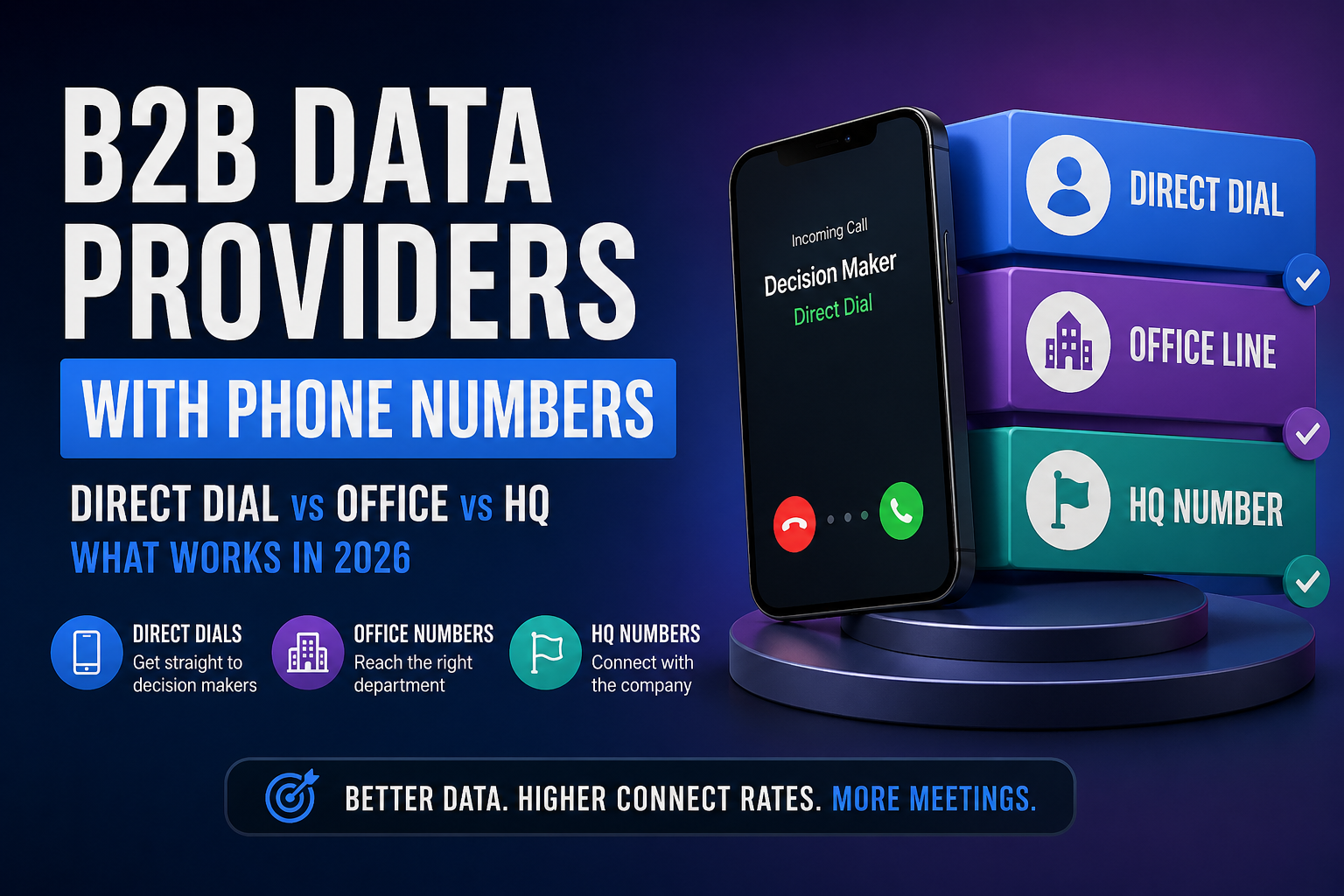
B2B Data Providers with Phone Numbers: Direct Dials vs Office vs HQ Numbers (2026 Guide)
Quick Summary: Not all B2B phone numbers are equal. Direct dials and mobile numbers drive the highest connect rates, while office and HQ lines are best used strategically. In 2026, top-performing outbound teams prioritize verified direct dials—but use a mix of all number types to maximize coverage and conversion.
Most teams think they have a data problem.
They don’t—they have an access problem.
The difference between a booked meeting and a missed opportunity often comes down to one thing:
the type of phone number you’re calling.
If you’ve already explored strategies like building high-converting prospect lists or identifying high-growth companies, this is where execution either works—or breaks.
Because in outbound, access drives outcomes.
---
Table of Contents
- Types of B2B Phone Numbers Explained
- Direct Dial vs Mobile vs Office vs HQ
- How to Use Each Number Type (Real Strategy)
- How to Choose the Right Data Provider
- Quick Comparison of Providers
- Best B2B Data Providers for Phone Numbers
- Why Lead411 Stands Out
- Common Mistakes Teams Make
- Final Takeaways
---
Types of B2B Phone Numbers Explained
Most B2B databases include four core types of phone numbers—and each one behaves very differently in practice.
Direct Dial Numbers
Direct dials connect you straight to an individual—no gatekeeper, no routing.
In most teams we see, these are the highest-performing numbers because they remove friction entirely.
Mobile / Cell Phone Numbers
Mobile numbers offer the highest connection rates.
But in practice, they only work when used correctly—timing and context matter.
Office Phone Numbers
Office lines often connect to assistants or shared lines.
They can work—but require persistence and navigation.
HQ (Headquarters) Numbers
HQ numbers are the least targeted.
What usually happens is reps get routed, delayed, or blocked entirely.
A direct dial creates access. An HQ number creates friction.
---
Direct Dial vs Mobile vs Office vs HQ
Let’s simplify this:
Direct Dial: Best balance of access and professionalism
Mobile: Highest connect rate, highest sensitivity
Office: Moderate effectiveness, requires navigation
HQ: Lowest conversion, highest friction
In practice, teams that rely on HQ and office numbers see slower pipeline velocity.
This is why combining direct access with signals—like hiring activity or company expansion—consistently outperforms generic outreach.
---
How to Use Each Number Type (Real Strategy)
This is where most teams get it wrong.
They treat all numbers the same.
High-performing teams don’t.
Outbound Sequence That Actually Works
- Email → establish context
- Direct dial → primary call attempt
- Mobile → follow-up (high intent only)
- Office/HQ → fallback
In most outbound teams we analyze, reversing this sequence leads to:
- Lower connect rates
- More gatekeeper friction
- Lost opportunities
The mistake isn’t calling—it’s calling the wrong number first.
This aligns closely with outreach performance patterns like deliverability benchmarks and engagement timing.
---
How to Choose the Right B2B Data Provider
Most teams choose based on volume.
High-performing teams choose based on access.
What actually matters:
- Direct dial availability
- Mobile number coverage
- Accuracy and refresh cycles
- Consistency across teams
- Ease of integration into workflows
This becomes critical in harder-to-reach industries like financial services or logistics.
---
Quick Comparison of Providers
Lead411: Best for accurate direct dials + full number coverage
Apollo: Best for volume, weaker phone reliability
ZoomInfo: Best for enterprise scale, higher cost + complexity
Lusha: Best for quick lookup, limited phone depth
The tradeoff is always the same: scale vs access.
---
Best B2B Data Providers for Phone Numbers
Lead411
Lead411 is built around delivering usable contact data—not just large datasets.
Pricing: Subscription-based
Geography: Strong US, expanding globally
Its strength is consistency.
In practice, teams using Lead411 typically see:
- Higher direct dial availability
- More consistent contact coverage across roles
- Less variability between reps
Unlike many platforms, Lead411 provides:
- Direct dials (primary access)
- Office lines (coverage)
- HQ numbers (fallback)
This creates a layered approach to outreach.
It works especially well when combined with strategies like decision-maker targeting or SaaS prospecting.
Best for: Teams that prioritize connect rates, accuracy, and scalable outbound systems
Explore data solutions, prospecting tools, or pricing.
---
Apollo.io
Apollo is widely used for high-volume outbound and automation.
Pricing: Credit-based tiers
Geography: Global
Its core strength is scale—not precision.
In practice, teams often find:
- Email data is strong and consistent
- Direct dial coverage is inconsistent across industries
- Mobile numbers are limited compared to competitors
What usually happens is different reps pull slightly different datasets—leading to inconsistent results.
This becomes a problem when phone outreach is a primary channel.
Instead of a predictable system, performance varies rep to rep.
See this comparison or Apollo pricing.
Best for: Teams running high-volume, email-first outbound strategies
Limitation: Less reliable for consistent direct dial coverage at scale
---
ZoomInfo
ZoomInfo offers one of the largest B2B datasets available.
Pricing: Enterprise-level contracts
Geography: Global
It does provide direct dials and phone data—but access depends heavily on plan level.
In practice, this creates tradeoffs:
- Direct dial availability can vary by subscription tier
- Mobile coverage often requires add-ons
- Complex setup slows adoption across teams
What we typically see is partial usage—teams only leveraging a portion of the platform.
This reduces the effectiveness of phone-based outreach.
Compare in this breakdown or ZoomInfo pricing.
Best for: Enterprise teams with budget and structured RevOps systems
Limitation: Cost and complexity can reduce practical phone data usage
---
Lusha
Lusha is designed for fast, simple contact discovery.
Pricing: Credit-based
Geography: Strong in select regions
Its strength is simplicity.
But in practice, that comes with limitations:
- Direct dial coverage is limited compared to larger platforms
- Mobile numbers are inconsistent across industries
- Phone data depth is not sufficient for structured outbound campaigns
What usually happens is teams use Lusha for quick enrichment—not full outreach systems.
See alternatives here.
Best for: Quick prospecting and enrichment
Limitation: Not built for scalable phone-based outbound workflows
---
Why Lead411 Stands Out for Phone Data
Most tools give you numbers.
Few give you access.
Lead411 stands out because it delivers:
- Direct dials (primary connection path)
- Office numbers (organizational coverage)
- HQ numbers (fallback access)
- Verified accuracy (reducing wasted effort)
This creates a complete outbound system.
You’re not guessing who to call—you’re reaching them.
---
Common Mistakes Teams Make
- Over-relying on HQ numbers
- Ignoring phone data accuracy
- Using mobile numbers too aggressively
- Not sequencing outreach properly
The biggest mistake:
Trying to scale outbound without direct access.
In practice, this leads to stalled pipeline and inconsistent results.
---
Final Takeaways
Not all phone numbers are equal.
And not all providers deliver usable phone data.
The difference between connection and friction is the number type.
The teams that win in 2026:
- Prioritize direct access
- Use mobile strategically
- Leverage office/HQ as fallback
Because in outbound, access drives outcomes.
If you want to improve connect rates and reach decision-makers faster, request a demo.
B2B Phone Data FAQs (Direct Dials, Mobile & Office Numbers)
What is the difference between direct dial and office phone numbers?
A direct dial connects you directly to an individual, while an office number typically routes through a receptionist or shared line. Direct dials remove friction and are more effective for reaching decision-makers quickly.
Are mobile phone numbers better than direct dials for B2B outreach?
Mobile numbers often have higher connection rates, but they require careful use. Direct dials are usually better for initial outreach because they balance accessibility with professionalism, while mobile numbers are more effective for follow-ups.
Do B2B data providers offer accurate phone numbers?
Accuracy varies widely between providers. Some platforms prioritize volume over verification, which leads to outdated or incorrect numbers. Providers that focus on verified data tend to deliver more reliable direct dials and better outreach results.
What type of phone number has the highest connect rate?
Mobile numbers typically have the highest connect rates, followed by direct dials. Office and HQ numbers tend to have lower connection rates because they involve gatekeepers or phone routing systems.
When should you use HQ phone numbers?
HQ numbers are best used as a fallback option when no direct dial or mobile number is available. They can also be useful for verifying company information or navigating smaller organizations.
Why are direct dial numbers important in B2B sales?
Direct dials provide immediate access to decision-makers without needing to go through gatekeepers. This reduces friction, shortens sales cycles, and increases the likelihood of meaningful conversations.
What is the best B2B data provider for phone numbers?
The best provider depends on your strategy, but platforms that offer verified direct dials, mobile numbers, and full coverage tend to perform better. Tools like Lead411, ZoomInfo, and Apollo each offer different strengths depending on your needs.
How do B2B data providers collect phone numbers?
Providers use a mix of public data sources, partnerships, user contributions, and verification processes. The quality of phone data depends on how frequently it is updated and validated.
Why do some phone numbers not work in B2B databases?
Phone numbers can become outdated due to job changes, company restructuring, or poor data verification. Providers that do not regularly refresh their data tend to have higher failure rates.
How should you use mobile numbers without being intrusive?
Mobile numbers should be used strategically, typically after initial contact has been established through email or other channels. Timing and context are critical to avoid appearing intrusive.
What is the best call sequence for outbound sales?
Most high-performing teams start with email to establish context, followed by a direct dial call. Mobile numbers are used for follow-ups, while office or HQ numbers serve as fallback options.
Are office phone numbers still useful in 2026?
Office numbers can still be useful, especially for navigating organizations or reaching administrative contacts. However, they are less effective than direct dials for reaching decision-makers directly.
How do you improve connect rates when cold calling?
Connect rates improve when using accurate direct dials, targeting the right contacts, and timing outreach based on signals like hiring or company growth. Poor data and bad timing are the biggest factors behind low connect rates.
What industries are hardest to reach by phone?
Industries like financial services, healthcare, and enterprise SaaS tend to have more gatekeeping and stricter communication controls, making direct dials and accurate contact data even more important.
What is the future of B2B phone data?
B2B phone data is becoming more focused on accuracy and real-time validation rather than volume. Teams that prioritize verified direct access and combine it with timing signals will outperform those relying on outdated or generic data.
Recent Posts

What Are the Cheapest and Best Alternatives to ZoomInfo? (2026 Deep-Dive Guide)
What Are the Cheapest and Best Alternatives to ZoomInfo? (2026 Deep-Dive Guide) For years, ZoomInfo dominated the B2B sales intelligence market so aggressively that most outbound teams rarely questioned whether there were better options. If your company needed:...
Why Hundreds of Companies Are Leaving ZoomInfo for Lead411 in 2026
Why Hundreds of Companies Are Leaving ZoomInfo for Lead411 in 2026 For nearly a decade, ZoomInfo became synonymous with B2B sales intelligence. If a company needed direct dials, contact enrichment, buyer intent data, or outbound prospecting infrastructure, ZoomInfo...

ZoomInfo vs RocketReach: Why Most Sales Teams End Up Frustrated With Both
ZoomInfo vs RocketReach: Why Most Sales Teams End Up Frustrated With Both Most sales intelligence comparison articles make the same mistake. They compare: database size, contact counts, features, and pricing tiers. But that is not actually what most outbound teams are...

- Sales Services
- Cybersecurity
- SaaS/Technology
- Energy / CleanTech
- Manufacturing
- Hospitality / Travel / Tourism
- Financial / FinTech
- Healthcare / MedTech
- Logistics / Transportation
- Account Based Marketing
- Recruiting
- Real Estate & Construction
- Professional Services & Consulting
- SLED Data Solutions
- Retail / E-Commerce
- Legal Services
resources
Zoominfo Intent vs Bombora Intent in 2026 | Top 3 B2b Buyer Intent Providers in 2026 | Zoominfo Pricing in 2026 | Linkedin Sales Navigator Competitors (2026) | Clearbit Pricing (2026) | Hubspot Pricing Review (2026) | Lead411 Competitors in 2026| Top 5 Linkedin Email Finders for 2026 | How to Find Someone's Phone Number in 2026 | Apollo.io vs. Lead411 Chrome Extension in 2026 | Apollo.io vs. Zoominfo in 2026 | Top 10 B2B Data Resellers in 2026 | Zoominfo API | Seamless.ai vs. Zoominfo in 2026 | 10 Best Clay Competitors for 2026 | What Does Lead Generation Look Like in 2026? | Zoominfo MCP Server |
7 Best B2B Data Providers for 2026 | 15 Best Sales Lead Databases for B2B in 2026 | Apollo.io MCP Server | Questions About Zoominfo
© 2026 Lead411 All Rights Reserved | Your Privacy Choices | Privacy Policy | Do Not Sell | CCPA | Terms Of Use | Lead411 is a registered data broker under applicable state laws, including under Texas law. To conduct business in Texas, a data broker must register with the Texas Secretary of State (Texas SOS). Information about data broker registrants is available on the Texas SOS website.
- Sales Services
- Cybersecurity
- SaaS/Technology
- Energy / CleanTech
- Manufacturing
- Hospitality / Travel / Tourism
- Financial / FinTech
- Healthcare / MedTech
- Logistics / Transportation
- Account Based Marketing
- Recruiting
- Real Estate & Construction
- Professional Services & Consulting
- SLED Data Solutions
- Retail / E-Commerce
- Legal Services
resources
Zoominfo Intent vs Bombora Intent in 2026 | Top 3 B2b Buyer Intent Providers in 2026 | Zoominfo Pricing in 2026 | Linkedin Sales Navigator Competitors (2026) | Clearbit Pricing (2026) | Hubspot Pricing Review (2026) | Lead411 Competitors in 2026| Top 5 Linkedin Email Finders for 2026 | How to Find Someone's Phone Number in 2026 | Apollo.io vs. Lead411 Chrome Extension in 2026 | Apollo.io vs. Zoominfo in 2026 | Top 10 B2B Data Resellers in 2026 | Zoominfo API | Seamless.ai vs. Zoominfo in 2026 | 10 Best Clay Competitors for 2026 | What Does Lead Generation Look Like in 2026? | Zoominfo MCP Server |
7 Best B2B Data Providers for 2026 | 15 Best Sales Lead Databases for B2B in 2026 | Apollo.io MCP Server | Questions About Zoominfo