
Best Email Finder Tools in 2026 (Accuracy Test + Deliverability Results)
Best Email Finder Tools in 2026 (Accuracy Test + Deliverability Results)
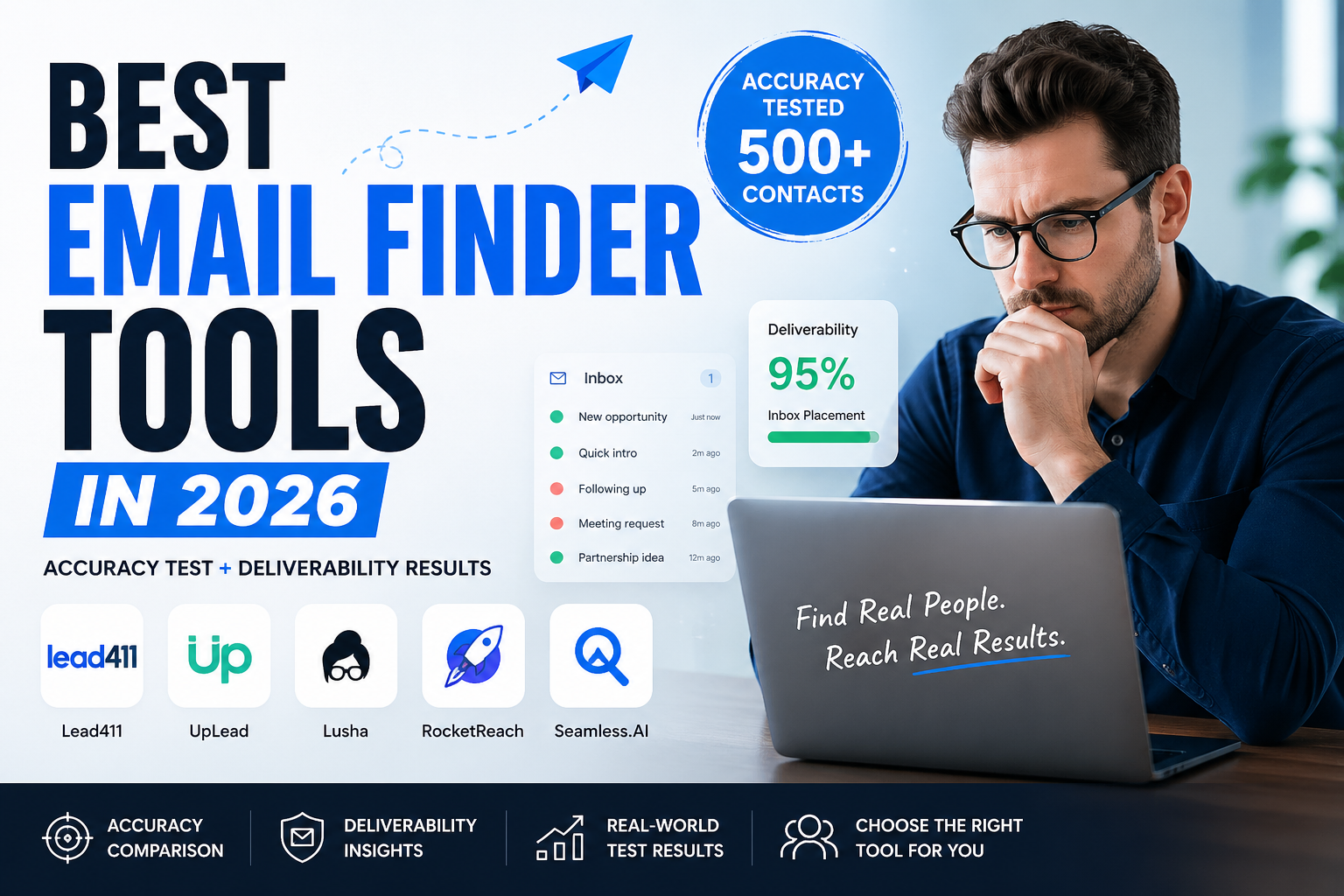
Quick Summary: Most email finder tools look similar, but they perform very differently in real outreach. After testing 500+ contacts, the biggest takeaway is simple: accuracy and re-verification matter more than database size. Tools with cleaner data consistently produce better deliverability, higher reply rates, and more reliable pipeline.
Most email finder tools promise the same thing: more contacts, more leads, more pipeline. But in 2026, that’s not what actually determines success.
The best email finder tool isn’t the one that finds the most emails—it’s the one that helps you reach real people consistently.
We analyzed over 500 contacts across SaaS, healthcare, and financial services to see how these platforms perform in real outbound campaigns—not just in demos.
If you're exploring the broader landscape, this B2B data providers guide gives a wider breakdown of how these tools compare.
Table of Contents
- What Actually Matters
- Accuracy Test Results
- How We Tested
- Why Accuracy Impacts Deliverability
- Detailed Tool Breakdown
- Comparison Table
- Accuracy vs Scale
- Best Tool by Use Case
- Common Mistakes
- Final Recommendation
What Actually Matters in 2026
There’s been a quiet shift in outbound.
It’s no longer about how many emails you send—it’s about whether those emails land and reach the right person.
- Re-verification frequency
- Data accuracy
- Intent signals
Bad data compounds over time and quietly destroys performance.
If you're dealing with deliverability issues already, this bounce rate guide explains how data quality impacts inbox placement.
Email Finder Accuracy Test (2026)
- Lead411: ~95% accuracy
- Quickenrich: ~95% accuracy
- UpLead: ~90–92%
- Lusha: ~80–85%
- RocketReach: ~75–85%
- Seamless.AI: ~70–85%
These numbers align closely with broader benchmarks seen in this deliverability study.
How We Tested
Each tool was tested using the same dataset across industries and roles.
We measured:
- Email validity
- Role accuracy
- Consistency across industries
This reflects real outbound—not ideal conditions.
Why Accuracy Impacts Deliverability
Every bounced email damages your domain reputation.
Over time, this reduces inbox placement—even for valid contacts.
Better data = better deliverability = more pipeline.
This is why many teams switch tools after comparing results in guides like this accuracy comparison.
Best Email Finder Tools (Detailed Breakdown)
Lead411
Lead411 focuses on verified data rather than volume, which becomes obvious once you start running campaigns.
Pricing: Subscription
Geo: Strong US
Re-verification: Continuous
Intent: Yes
The real advantage is combining accuracy with timing signals. You’re not just reaching people—you’re reaching them at the right time.
Explore data solutions, prospecting tools, or pricing.
You can also see how it compares directly in this ZoomInfo comparison.
Lusha
Lusha is built for quick prospecting, especially via Chrome extension workflows.
Pricing: Credits
Geo: US + Europe
Re-verification: Periodic
Intent: No
It works well for lightweight use, but struggles with consistency at scale.
For deeper comparison, see Lusha alternatives or try a demo comparison.
QuickEnrich
QuickEnrich focuses on accurate emails for hard to find contacts.
Pricing: Credits
Geo: Global
Re-verification: Real-time
Intent: None
It offers strong accuracy on hard to find contacts with unlimited subscriptions.
See the 2026 Guide for Email Finders.
RocketReach
RocketReach prioritizes coverage over precision.
Pricing: Credits
Geo: Global
Re-verification: Less frequent
Intent: No
This makes it useful for wide searches but introduces inconsistency.
Compare it here: RocketReach alternatives.
Seamless.AI
Seamless.AI focuses on real-time discovery and automation.
Pricing: Credits
Geo: US
Re-verification: Dynamic
Intent: Limited
It works best in automation-heavy environments but can require validation.
See detailed comparison: Seamless.AI vs Lead411.
UpLead
UpLead focuses on accuracy and real-time validation.
Pricing: Credits
Geo: US + global
Re-verification: Real-time
Intent: Limited
It offers strong accuracy, but with less overall scale.
Compare here: UpLead comparison.
Comparison Table
| Tool | Accuracy | Pricing | Intent |
|---|---|---|---|
| Lead411 | 95% | Subscription | Yes |
| Lusha | 80–85% | Credits | No |
| RocketReach | 75–85% | Credits | No |
| Seamless.AI | 70–85% | Credits | Limited |
| UpLead | 90% | Credits | Limited |
| UpLead | 95% | Credits | Unlimited |
Accuracy vs Scale
More data ≠ better results.
The pattern is consistent:
- More data → more noise
- Better data → better outcomes
Best Tool by Use Case
- Outbound teams → Lead411
- Quick prospecting → Lusha
- Global reach → RocketReach
- Automation → Seamless.AI
- Accuracy-first → UpLead
- Better Coverage→ Quickenrich
Industry-specific targeting? See examples like targeting SaaS leaders or healthcare decision-makers.
Common Mistakes
- Choosing based on volume
- Ignoring re-verification
- Overlooking deliverability
- Skipping intent data
Final Recommendation
If you want volume, tools like RocketReach or Seamless.AI can help.
If you want consistent pipeline, accuracy matters more.
Lead411 stands out because it combines verified data with intent signals—two factors that directly impact results.
To see it in action, request a demo.
Email Finder Tools FAQs (2026 Guide)
What is the best email finder tool in 2026?
There isn’t a single “best” tool for every team—it depends on how you prioritize accuracy, coverage, and workflow. That said, tools that focus on verified data and consistent re-validation tend to perform better in real outbound campaigns, especially when deliverability matters.
How accurate are email finder tools?
Accuracy varies widely. Some platforms consistently deliver above 90% accuracy, while others fluctuate depending on data source and refresh frequency. Tools that validate data continuously or in real time generally produce more reliable results.
Why do some email finder tools have lower accuracy?
Many tools rely on scraped data or inferred email patterns, which can introduce errors. Others maintain proprietary databases and invest in re-verification, which tends to produce more consistent accuracy across industries.
Do email finder tools affect email deliverability?
Yes—data quality has a direct impact on deliverability. Higher bounce rates signal issues to email providers, which can reduce inbox placement over time. Using cleaner, verified data helps protect domain health and improves long-term results.
What is a good bounce rate for cold email campaigns?
Most teams aim to stay under 2–3%. Once bounce rates climb above that, deliverability can start to decline. The quality of your data provider plays a major role in maintaining healthy bounce rates.
Are free email finder tools reliable?
Free tools can be helpful for occasional use, but they typically rely on less consistent data sources. For teams running regular outbound campaigns, reliability and data freshness usually become more important than cost alone.
What’s the difference between email finding and email verification?
Email finding identifies potential contact information, while verification checks whether that information is valid and deliverable. Some platforms combine both steps, which can reduce bounce rates and improve campaign performance.
Which email finder tool is best for sales teams?
Sales teams generally benefit from tools that balance accuracy with usability. Platforms that also include context—such as company growth signals or hiring activity—can make outreach more relevant and improve response rates.
Which email finder tool is best for recruiters?
Recruiters often prioritize speed and broad coverage, so tools with large databases can be useful. However, accuracy still matters, especially when reaching out to passive candidates where first impressions count.
How often should email data be updated?
B2B data changes frequently as people move roles or companies. Tools that re-verify data continuously or on a regular schedule tend to produce better results than those with static datasets.
What is intent data and how does it help?
Intent data highlights when companies or individuals are showing signs of change, such as hiring or expansion. This allows teams to prioritize outreach when timing is more favorable, rather than relying on static lists.
What is the biggest mistake when choosing an email finder tool?
A common mistake is focusing too much on database size. Larger datasets can include outdated or unverified contacts, which often leads to higher bounce rates and lower overall performance.
Is it better to have more contacts or more accurate data?
In most cases, more accurate data produces better results. Smaller, cleaner lists tend to generate higher engagement and protect deliverability, while larger lists can introduce more risk if the data isn’t well maintained.
How can I improve cold email response rates?
Response rates improve when outreach is both relevant and well-timed. Accurate contact data, combined with clear messaging and awareness of timing signals, tends to produce more consistent results.
What should I look for in an email finder tool going forward?
Teams are increasingly prioritizing data accuracy, re-verification frequency, and context signals over sheer volume. Tools that combine these elements are generally better aligned with how outbound works today.
Recent Posts

Lead411 vs Cognism: Which B2B Data Provider Delivers Better Data, More Meetings, and Higher ROI in 2026?
If you're evaluating B2B data providers in 2026, there's a good chance Lead411 and Cognism are both on your shortlist. Both platforms help sales and marketing teams identify decision-makers, access contact information, improve prospecting efficiency, and generate more...
Why Companies Move On From Clay: The Hidden Cost of Chasing More Data
Over the past few years, few platforms have generated as much excitement in sales, RevOps, and growth circles as Clay. It has become one of the most talked-about prospecting platforms in modern outbound sales, helping teams automate research, enrich contacts, build...

Why Outbound Feels Harder Than It Did 3 Years Ago
Talk to almost any SDR leader, founder, VP of Sales, CRO, or RevOps professional today and you'll hear some version of the same concern: Outbound feels harder than it used to. Three years ago, many sales teams could build a prospect list, launch a sequence, make a few...

- Sales Services
- Cybersecurity
- SaaS/Technology
- Energy / CleanTech
- Manufacturing
- Hospitality / Travel / Tourism
- Financial / FinTech
- Healthcare / MedTech
- Logistics / Transportation
- Account Based Marketing
- Recruiting
- Real Estate & Construction
- Professional Services & Consulting
- SLED Data Solutions
- Retail / E-Commerce
- Legal Services
resources
Zoominfo Intent vs Bombora Intent in 2026 | Top 3 B2b Buyer Intent Providers in 2026 | Zoominfo Pricing in 2026 | Linkedin Sales Navigator Competitors (2026) | Clearbit Pricing (2026) | Hubspot Pricing Review (2026) | Lead411 Competitors in 2026| Top 5 Linkedin Email Finders for 2026 | How to Find Someone's Phone Number in 2026 | Apollo.io vs. Lead411 Chrome Extension in 2026 | Apollo.io vs. Zoominfo in 2026 | Top 10 B2B Data Resellers in 2026 | Zoominfo API | Seamless.ai vs. Zoominfo in 2026 | 10 Best Clay Competitors for 2026 | What Does Lead Generation Look Like in 2026? | Zoominfo MCP Server |
7 Best B2B Data Providers for 2026 | 15 Best Sales Lead Databases for B2B in 2026 | Apollo.io MCP Server | Questions About Zoominfo
© 2026 Lead411 All Rights Reserved | Your Privacy Choices | Privacy Policy | Do Not Sell | CCPA | Terms Of Use | Lead411 is a registered data broker under applicable state laws, including under Texas law. To conduct business in Texas, a data broker must register with the Texas Secretary of State (Texas SOS). Information about data broker registrants is available on the Texas SOS website.
- Sales Services
- Cybersecurity
- SaaS/Technology
- Energy / CleanTech
- Manufacturing
- Hospitality / Travel / Tourism
- Financial / FinTech
- Healthcare / MedTech
- Logistics / Transportation
- Account Based Marketing
- Recruiting
- Real Estate & Construction
- Professional Services & Consulting
- SLED Data Solutions
- Retail / E-Commerce
- Legal Services
resources
Zoominfo Intent vs Bombora Intent in 2026 | Top 3 B2b Buyer Intent Providers in 2026 | Zoominfo Pricing in 2026 | Linkedin Sales Navigator Competitors (2026) | Clearbit Pricing (2026) | Hubspot Pricing Review (2026) | Lead411 Competitors in 2026| Top 5 Linkedin Email Finders for 2026 | How to Find Someone's Phone Number in 2026 | Apollo.io vs. Lead411 Chrome Extension in 2026 | Apollo.io vs. Zoominfo in 2026 | Top 10 B2B Data Resellers in 2026 | Zoominfo API | Seamless.ai vs. Zoominfo in 2026 | 10 Best Clay Competitors for 2026 | What Does Lead Generation Look Like in 2026? | Zoominfo MCP Server |
7 Best B2B Data Providers for 2026 | 15 Best Sales Lead Databases for B2B in 2026 | Apollo.io MCP Server | Questions About Zoominfo