
How to Prospect Retail and E-Commerce Brands Using Hiring Signals (2026 Guide)
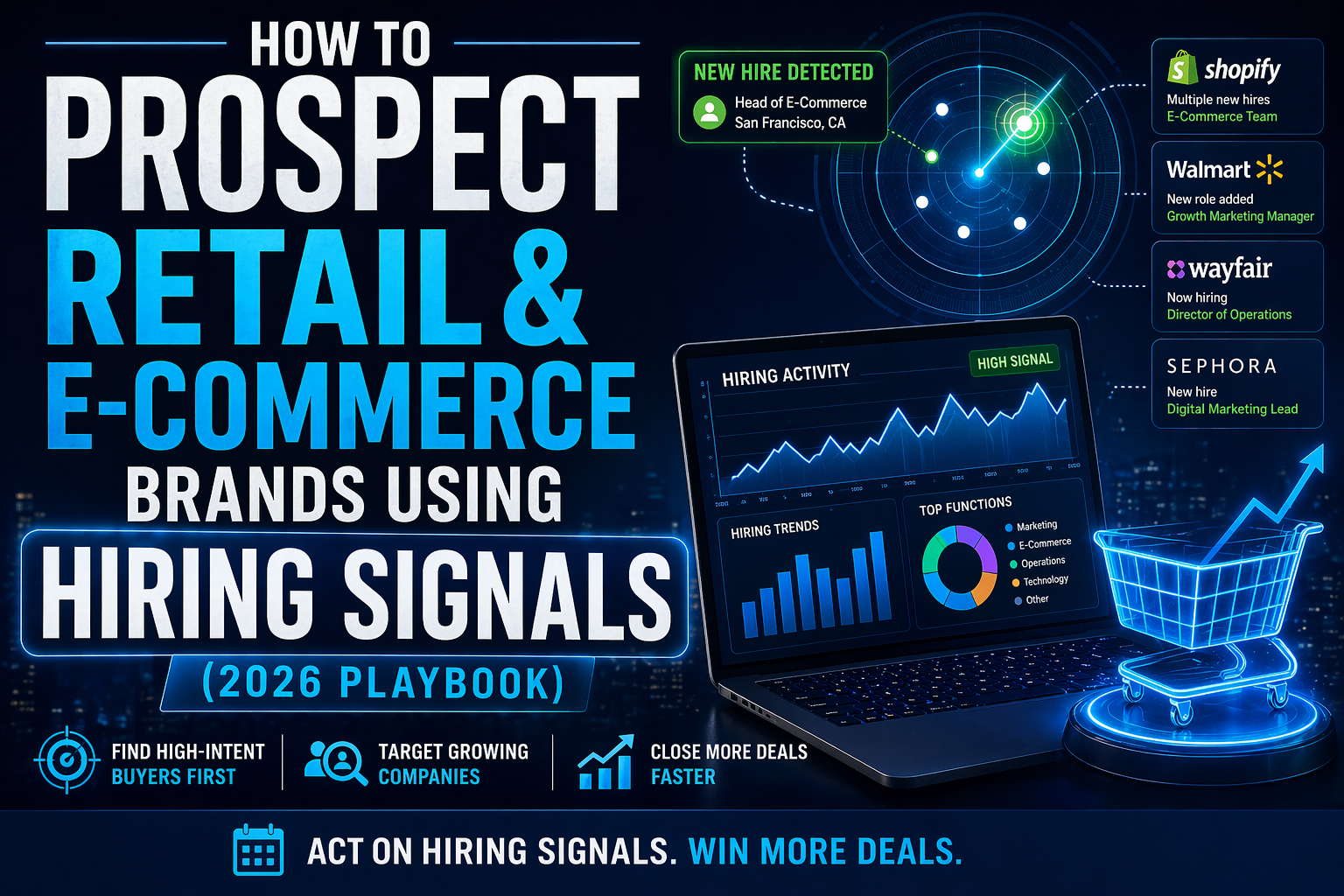
How to Prospect Retail and E-Commerce Brands Using Hiring Signals (2026 Playbook)
Quick Summary
Retail and e-commerce brands don’t buy on long timelines—they buy when something changes. Hiring is one of the earliest and most reliable indicators of that change.
The most effective way to prospect retail and e-commerce companies is to track hiring signals and act immediately while those companies are actively scaling.
Teams that combine hiring signals with platforms like Lead411’s prospecting tools, supported by contact enrichment and layered with intent data, consistently outperform traditional outbound strategies built on static lists.
---
What is the best way to prospect retail and e-commerce brands?
The best approach is to identify companies hiring for growth-related roles and reach decision makers immediately during that expansion window, before competitors even recognize the opportunity.
---
Why Hiring Signals Matter
Hiring signals reveal internal change before most other data points. When a retail brand begins hiring, it’s usually preparing to invest—whether in marketing, operations, logistics, or technology.
Unlike traditional intent data, which captures research behavior, hiring shows structural change inside the company. That makes it one of the earliest and most actionable signals available.
---
How Retail & E-Commerce Companies Actually Buy
Retail buyers behave differently from enterprise SaaS buyers. They are faster, more reactive, and heavily focused on ROI.
Instead of long evaluation cycles, most purchases are triggered by immediate needs such as scaling paid media, improving conversion rates, or expanding fulfillment capabilities.
This creates a key advantage: if you reach them during hiring, you are early. If you wait, you are irrelevant.
---
Why Timing Matters More Than Targeting
Most sales teams over-optimize targeting and underestimate timing. A perfectly defined ICP account is useless if the company isn’t actively buying.
Hiring signals reveal when a company is entering a buying window. For example, a brand hiring a Head of E-Commerce is likely evaluating platforms, while a surge in marketing hires suggests increased spend and tool adoption.
To capitalize on these moments, teams rely on accurate contact data from platforms like Lead411, ensuring outreach reaches the right decision makers while the opportunity is still fresh.
---
Step-by-Step Hiring Signal Prospecting Framework
Start by defining your ICP based on revenue, growth stage, and channel focus. From there, monitor hiring activity through LinkedIn and signal-based tools. Once signals are identified, use data enrichment to locate verified contacts and prioritize companies showing rapid hiring across key departments. The final step is execution—acting quickly before competitors engage.
---
Comparison Table
| Tool | Best For | Pricing | Strength | Weakness |
|---|---|---|---|---|
| Lead411 | Execution | $$ | Signals + contacts | Less global |
| ZoomInfo | Enterprise | $$$$ | Scale | Expensive |
| Apollo | Budget | $$ | Affordable | Accuracy varies |
| Signals | $ | Real-time hiring | No contact data | |
| Bombora | Intent | $$$ | Buyer signals | No outreach |
---
Top Tools for Hiring Signal Prospecting
1. Lead411 — Best for Converting Hiring Signals Into Pipeline
Lead411 is designed to solve the biggest problem in hiring-signal prospecting: execution. Many tools surface signals, but very few allow teams to act on them immediately. Lead411 closes that gap by combining verified contact data with signal-based prioritization.
When a retail or e-commerce company begins hiring for key roles, Lead411 allows teams to quickly identify decision makers and launch outreach without switching between platforms. This speed is critical because hiring signals create short buying windows, often measured in weeks rather than months.
Another major advantage is data accuracy. Retail teams are typically lean, and missing one or two key contacts can eliminate the entire opportunity. Lead411’s verified emails and direct dials significantly improve connection rates compared to less curated databases.
In addition, the integration of intent data allows teams to prioritize accounts that are not only hiring but actively researching solutions. This layered approach reduces wasted outreach and increases conversion rates.
There are limitations. Lead411 is not a native hiring data platform, so teams still rely on sources like LinkedIn for initial signal detection. It is also more U.S.-focused compared to global enterprise platforms.
Overall, Lead411 is best suited for mid-market teams, SaaS companies, and agencies that need speed, accuracy, and strong ROI. You can explore options through Lead411 pricing or evaluate fit with a live demo.
---
2. ZoomInfo — Best for Enterprise Scale
ZoomInfo is built for scale. Its primary strength lies in its massive database and enterprise-level workflows, making it a common choice for large sales organizations targeting multiple industries.
For hiring-signal prospecting, ZoomInfo provides access to a broad range of data, but it is not optimized for speed. Teams often need to combine it with other tools to identify hiring signals and then execute outreach, which introduces delays.
Cost is another significant factor. ZoomInfo’s pricing structure is typically suited for enterprise budgets, and many mid-market teams find that they are paying for features they do not fully utilize.
Additionally, while ZoomInfo performs well in larger organizations, its accuracy can be less reliable in smaller e-commerce companies where data is harder to verify. This can reduce effectiveness in niche targeting scenarios.
ZoomInfo is best for large teams that prioritize scale and automation over speed. For teams focused on efficiency and timing, exploring ZoomInfo alternatives may provide better ROI.
---
3. Apollo — Best Budget-Friendly Platform
Apollo has positioned itself as an affordable, all-in-one platform combining prospecting and outreach. For startups and smaller teams, this makes it an attractive entry point into outbound sales.
The platform’s biggest advantage is cost. It allows teams to run campaigns without investing heavily in multiple tools, and its built-in sequencing functionality simplifies workflows.
However, Apollo’s limitations become clear in hiring-signal prospecting. Data accuracy can be inconsistent, particularly in retail and e-commerce segments where company structures are less standardized. This can lead to lower connection rates and reduced efficiency.
Additionally, Apollo does not provide native hiring signals, meaning teams must rely on external sources to identify opportunities. This extra step reduces speed and adds complexity.
Apollo is best suited for early-stage teams that need a low-cost solution. For more advanced strategies focused on timing and precision, it may fall short.
---
4. LinkedIn — Best Source of Hiring Signals
LinkedIn is the most important platform for identifying hiring signals. Nearly every retail and e-commerce company posts jobs there, making it the most reliable source of real-time hiring data.
Its strength lies in visibility. Teams can see which companies are growing, what roles they are hiring for, and how quickly they are expanding.
However, LinkedIn is not designed for outbound execution. It does not provide verified contact data, and outreach is limited to in-platform messaging, which can be inconsistent.
This means LinkedIn is best used as a signal discovery tool rather than a complete prospecting solution. It must be paired with a platform like Lead411 to convert signals into pipeline.
---
5. Bombora — Best for Intent Data Layer
Bombora specializes in intent data, tracking which companies are actively researching specific topics across the web. This provides a valuable complement to hiring signals.
Not every company that is hiring is ready to buy. By layering intent data on top of hiring signals, teams can prioritize accounts that are both growing and actively evaluating solutions.
However, Bombora does not provide contact data or outreach capabilities. It must be integrated with another platform to be effective.
As a result, Bombora is best used as a prioritization layer rather than a standalone tool.
---
Real Scenarios
SaaS companies use hiring signals to identify Shopify brands expanding marketing teams. Agencies use them to target brands increasing paid media investment. Logistics providers use them to find companies scaling fulfillment operations.
For a broader breakdown of tools, see this retail data guide.
---
Common Mistakes
- Ignoring timing
- Relying on outdated data
- Delaying outreach
---
Why Lead411 Wins
Lead411 stands out because it connects signals with execution. While many tools provide data, few allow teams to act on it immediately and efficiently.
---
Final Thoughts
Hiring signals are one of the earliest indicators of buying intent. Teams that act quickly, use accurate data, and personalize outreach consistently outperform competitors.
The advantage isn’t just knowing who is hiring—it’s acting on it first.
Frequently Asked Questions About Prospecting Retail and E-Commerce Brands Using Hiring Signals
What are hiring signals in B2B prospecting?
Hiring signals are indicators that a company is growing or changing, typically shown through job postings, new roles, or team expansion. These signals often reveal upcoming investments in tools, services, or infrastructure.
Why are hiring signals effective for retail and e-commerce companies?
Retail and e-commerce brands operate in fast growth cycles. Hiring usually happens right before or during expansion, making it one of the earliest indicators of buying intent.
What roles indicate the highest buying intent?
Roles such as Head of E-Commerce, VP Marketing, Director of Growth, and Operations Manager typically signal increased investment in platforms, marketing, or logistics.
How quickly should sales teams act on hiring signals?
Sales teams should act within days. Retail companies move quickly, and delayed outreach often results in missed opportunities.
What is the difference between hiring signals and intent data?
Hiring signals reflect internal company changes, while intent data reflects external research behavior. Combining both provides a stronger view of buying readiness.
Are hiring signals always reliable?
Not always. A single hire may not indicate immediate buying intent, but multiple hires or leadership roles significantly increase the likelihood of investment.
What tools are best for tracking hiring signals?
LinkedIn is the primary source, while platforms like Lead411, ZoomInfo, and Bombora help turn those signals into actionable outreach.
How do you prioritize accounts using hiring signals?
Focus on companies with multiple hires, rapid expansion, or leadership-level roles. These indicate higher urgency and budget allocation.
What is the biggest mistake when using hiring signals?
The biggest mistake is acting too slowly. Hiring signals create short buying windows, and delayed outreach reduces conversion rates.
Can hiring signals replace traditional prospecting?
No, but they significantly improve it. They should be combined with firmographic and intent data for best results.
How do hiring signals improve outbound conversion rates?
They improve timing and relevance. Outreach tied to hiring context aligns with real business needs.
What industries benefit most from hiring signal prospecting?
Retail, e-commerce, SaaS, logistics, and fintech benefit most due to rapid growth cycles.
Can AI be used with hiring signals?
Yes, AI can help prioritize accounts, analyze hiring patterns, and generate personalized outreach.
Is hiring signal prospecting scalable?
Yes, especially when combined with automation and data platforms that integrate signals with contact data.
What improves success when using hiring signals?
Speed, data accuracy, and personalization are the three biggest factors that drive results.
Recent Posts
What Are the Cheapest and Best Alternatives to ZoomInfo? (2026 Deep-Dive Guide)
What Are the Cheapest and Best Alternatives to ZoomInfo? (2026 Deep-Dive Guide) For years, ZoomInfo dominated the B2B sales intelligence market so aggressively that most outbound teams rarely questioned whether there were better options. If your company needed:...
Why Hundreds of Companies Are Leaving ZoomInfo for Lead411 in 2026
Why Hundreds of Companies Are Leaving ZoomInfo for Lead411 in 2026 For nearly a decade, ZoomInfo became synonymous with B2B sales intelligence. If a company needed direct dials, contact enrichment, buyer intent data, or outbound prospecting infrastructure, ZoomInfo...

ZoomInfo vs RocketReach: Why Most Sales Teams End Up Frustrated With Both
ZoomInfo vs RocketReach: Why Most Sales Teams End Up Frustrated With Both Most sales intelligence comparison articles make the same mistake. They compare: database size, contact counts, features, and pricing tiers. But that is not actually what most outbound teams are...

- Sales Services
- Cybersecurity
- SaaS/Technology
- Energy / CleanTech
- Manufacturing
- Hospitality / Travel / Tourism
- Financial / FinTech
- Healthcare / MedTech
- Logistics / Transportation
- Account Based Marketing
- Recruiting
- Real Estate & Construction
- Professional Services & Consulting
- SLED Data Solutions
- Retail / E-Commerce
- Legal Services
resources
Zoominfo Intent vs Bombora Intent in 2026 | Top 3 B2b Buyer Intent Providers in 2026 | Zoominfo Pricing in 2026 | Linkedin Sales Navigator Competitors (2026) | Clearbit Pricing (2026) | Hubspot Pricing Review (2026) | Lead411 Competitors in 2026| Top 5 Linkedin Email Finders for 2026 | How to Find Someone's Phone Number in 2026 | Apollo.io vs. Lead411 Chrome Extension in 2026 | Apollo.io vs. Zoominfo in 2026 | Top 10 B2B Data Resellers in 2026 | Zoominfo API | Seamless.ai vs. Zoominfo in 2026 | 10 Best Clay Competitors for 2026 | What Does Lead Generation Look Like in 2026? | Zoominfo MCP Server |
7 Best B2B Data Providers for 2026 | 15 Best Sales Lead Databases for B2B in 2026 | Apollo.io MCP Server | Questions About Zoominfo