
Lead411 vs Clay: Which GTM Platform Fits Your Team in 2026?
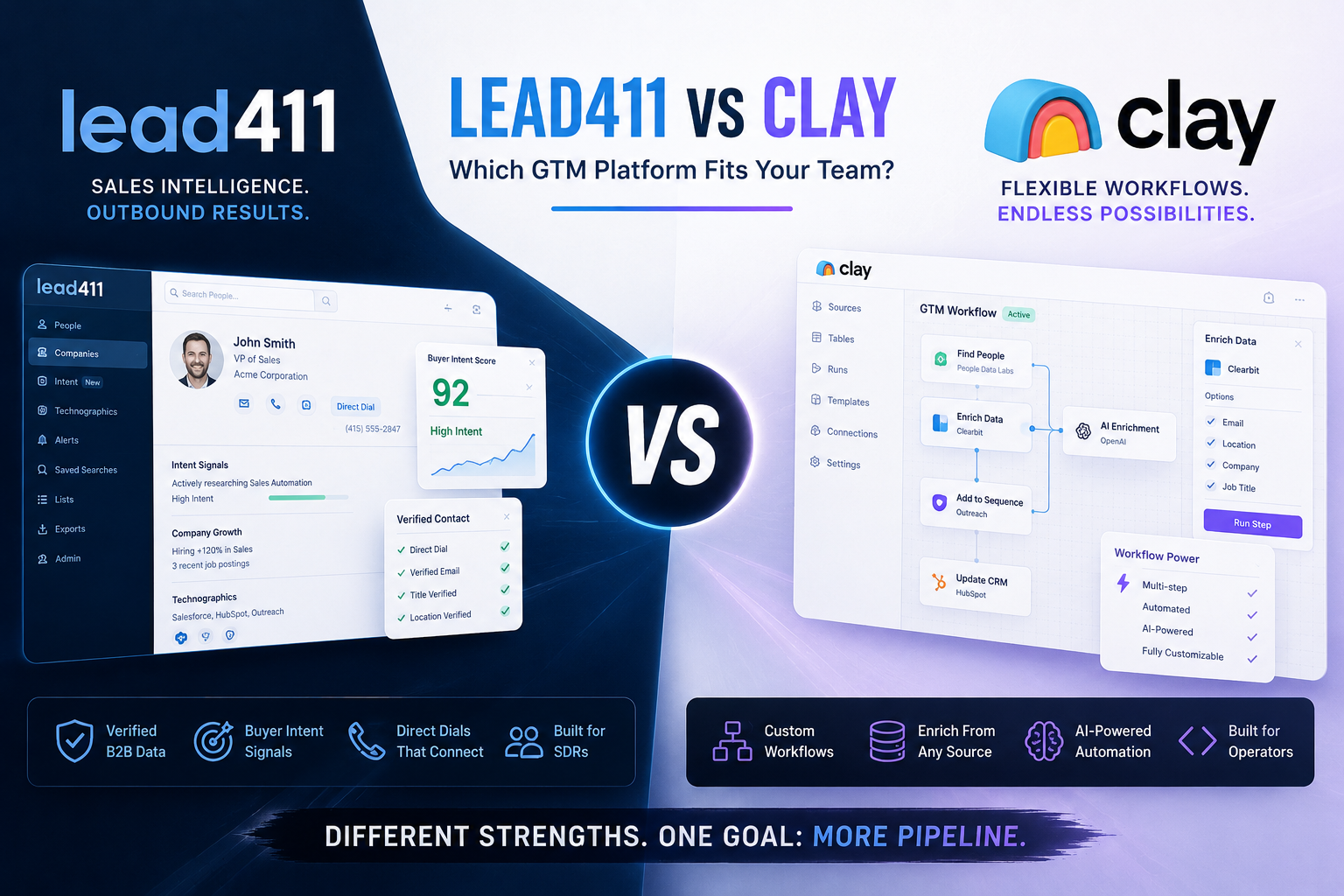
Lead411 vs Clay: Which GTM Platform Fits Your Team in 2026?
Modern GTM teams are overwhelmed with tooling decisions.
Between AI agents, enrichment workflows, intent platforms, outbound automation, and SDR infrastructure, the average sales stack is more complicated than ever.
That complexity is exactly why platforms like Clay and Lead411 are increasingly being compared.
At first glance, they seem similar.
Both help sales teams:
- find prospects,
- enrich accounts,
- improve outbound targeting,
- and operationalize modern GTM workflows.
But underneath the surface, they are built around completely different philosophies.
Clay is fundamentally a workflow orchestration platform.
Lead411 is fundamentally an outbound sales intelligence platform.
That distinction matters enormously when deciding which platform fits your team.
Because this is not simply a “features comparison.”
It is a comparison between:
- different operating models,
- different workflow assumptions,
- and different approaches to outbound execution.
The best choice depends less on “which tool is better” and more on:
- your team structure,
- technical maturity,
- workflow complexity,
- and GTM priorities.
Quick Summary
- Clay is best for highly technical GTM teams that want flexible enrichment workflows, composable automations, and custom AI-powered data orchestration.
- Lead411 is best for outbound sales teams prioritizing verified contact data, buyer intent signals, SDR efficiency, and fast operational execution.
- Clay excels at workflow flexibility and experimentation.
- Lead411 excels at speed-to-execution and signal-based prospecting.
- Clay typically requires more operational setup and technical workflow design.
- Lead411 is generally easier for SDR teams and non-technical outbound organizations to adopt quickly.
- The right choice depends on whether your GTM organization values infrastructure flexibility or outbound operational simplicity.
Table of Contents
- Why Teams Compare Lead411 and Clay
- The Core Philosophy Difference
- What Lead411 Does Best
- What Clay Does Best
- Feature Comparison
- Data Quality and Verification
- Intent Data and Buying Signals
- AI Workflows and Automation
- SDR Usability and Operational Fit
- Pricing and Operational Costs
- Best Fit by Team Type
- What Most Teams Get Wrong
- Final Verdict
Why Teams Compare Lead411 and Clay
The rise of AI-assisted outbound completely changed how companies think about prospecting infrastructure.
Five years ago, most outbound teams simply wanted:
- a contact database,
- a sequencing platform,
- and maybe basic enrichment.
Today, outbound systems are significantly more sophisticated.
Modern GTM teams increasingly care about:
- signal-based prospecting,
- AI personalization,
- workflow automation,
- buyer intent data,
- dynamic enrichment,
- and multi-system orchestration.
That evolution created two major categories of GTM tooling:
1. Workflow Infrastructure Platforms
These platforms prioritize:
- customization,
- data orchestration,
- workflow flexibility,
- and AI-driven enrichment pipelines.
Clay sits heavily in this category.
2. Operational Sales Intelligence Platforms
These platforms prioritize:
- verified contacts,
- signal-based prospecting,
- speed-to-execution,
- and SDR productivity.
Lead411 sales intelligence fits much more directly into this model.
This is why comparing the two platforms requires more nuance than a standard “feature checklist.”
The Core Philosophy Difference
The biggest difference between Lead411 and Clay is not the feature set.
It is the operational philosophy.
| Category | Lead411 | Clay |
|---|---|---|
| Core Identity | Sales intelligence platform | Workflow orchestration platform |
| Primary Focus | Outbound execution | Workflow flexibility |
| Ideal User | SDRs and sales teams | Technical GTM operators |
| Main Strength | Verified data + signals | Composable automations |
| Learning Curve | Lower | Higher |
| Time-to-Value | Fast | Variable |
This distinction affects almost everything:
- implementation speed,
- workflow complexity,
- maintenance burden,
- and operational scalability.
What Lead411 Does Best
Lead411 is built primarily for outbound execution.
The platform focuses heavily on:
- verified B2B contacts,
- direct dials,
- buyer intent signals,
- technographics,
- and SDR workflow efficiency.
Its biggest strength is operational simplicity.
Most outbound teams can:
- find prospects,
- identify buying signals,
- enrich records,
- and launch outreach
without building complicated infrastructure layers.
Where Lead411 Excels
- Verified contact data
- Buyer intent targeting
- Signal-based prospecting
- Fast SDR onboarding
- Direct dial coverage
- Operational speed
- Outbound execution simplicity
Potential Limitations
- Less workflow flexibility than Clay
- Less customization for highly technical RevOps teams
- Less composable infrastructure for advanced enrichment pipelines
For most outbound-focused organizations, however, those tradeoffs are acceptable because the platform optimizes for speed and execution quality.
What Clay Does Best
Clay approaches GTM from a very different angle.
Instead of primarily acting as a sales intelligence platform, Clay functions more like a composable GTM workflow layer.
Its core strength is flexibility.
Teams can build highly customized workflows involving:
- AI enrichment,
- multi-source data aggregation,
- custom automations,
- waterfall enrichment,
- and dynamic outbound systems.
Where Clay Excels
- Workflow customization
- Advanced enrichment pipelines
- AI-powered orchestration
- Custom GTM infrastructure
- Technical workflow experimentation
Potential Limitations
- Higher learning curve
- Longer implementation time
- Requires stronger operational design skills
- Can become workflow-heavy quickly
- May overwhelm smaller SDR teams
Clay is exceptionally powerful for technical GTM operators.
But not every sales organization wants to become a workflow engineering team.
Feature Comparison
| Feature | Lead411 | Clay |
|---|---|---|
| Verified Emails | Strong | Depends on enrichment source |
| Direct Dials | Strong | Variable |
| Intent Data | Built-in | Requires integrations |
| Workflow Flexibility | Moderate | Extremely high |
| AI Workflow Design | Moderate | Excellent |
| Ease of Use | Higher | Lower |
| Technical Complexity | Lower | Higher |
| Speed-to-Value | Fast | Medium to slow |
| Best for SDR Teams | Excellent | Depends on setup quality |
Data Quality and Verification
One of the biggest operational differences between these platforms is how they approach data quality.
Lead411 data solutions are built around verified contact intelligence.
This matters because poor data quality destroys outbound performance through:
- bounces,
- missed buyers,
- and wasted SDR effort.
Lead411 emphasizes:
- verified emails,
- direct dials,
- signal freshness,
- and outbound usability.
Clay, by contrast, acts more as an orchestration layer aggregating multiple enrichment sources.
That creates flexibility—but also variability.
The quality of a Clay workflow depends heavily on:
- workflow design,
- selected providers,
- maintenance quality,
- and operational sophistication.
This is a key philosophical difference:
- Lead411 optimizes for operational reliability.
- Clay optimizes for workflow flexibility.
Intent Data and Buying Signals
Signal-based prospecting is becoming one of the biggest competitive advantages in modern outbound.
Sales teams increasingly prioritize:
- timing,
- buyer behavior,
- and active demand signals.
This is one area where Lead411 Intent Data becomes particularly valuable.
Lead411 provides integrated buyer intent capabilities that help SDR teams identify:
- in-market accounts,
- research activity,
- and active buying windows.
Clay can absolutely support signal-based workflows—but typically through custom integrations and orchestration logic.
Again, the difference is:
- built-in operational simplicity versus composable infrastructure.
AI Workflows and Automation
This is where Clay becomes especially powerful.
Clay was built for teams that want highly customizable AI-assisted workflows.
Technical operators can:
- combine enrichment layers,
- build custom waterfalls,
- trigger AI actions,
- and orchestrate sophisticated outbound systems.
For advanced RevOps teams, that flexibility is incredibly valuable.
However, there is an important tradeoff:
More workflow flexibility usually means more operational complexity.
Lead411 takes a different approach.
Instead of emphasizing composable infrastructure, it focuses more heavily on:
- speed-to-execution,
- SDR productivity,
- and operational simplicity.
For many sales organizations, especially lean outbound teams, that simplicity is a competitive advantage.
SDR Usability and Operational Fit
One of the most overlooked factors in GTM tooling is SDR adoption.
A platform can be incredibly powerful technically and still fail operationally if reps:
- do not trust it,
- cannot learn it quickly,
- or struggle to operationalize workflows consistently.
Lead411 generally performs very well with:
- SDR onboarding,
- speed-to-productivity,
- and day-to-day outbound usability.
Clay tends to shine more with:
- RevOps leaders,
- technical growth teams,
- and sophisticated workflow architects.
This is why the “best” platform depends heavily on organizational maturity.
Pricing and Operational Costs
Most SaaS comparison articles oversimplify pricing.
The real cost of a GTM platform is not just subscription price.
It also includes:
- implementation time,
- workflow maintenance,
- training overhead,
- and operational complexity.
Clay’s flexibility can create tremendous leverage for advanced teams.
But flexibility also creates:
- maintenance burden,
- workflow sprawl,
- and higher operational overhead.
Lead411’s value proposition is more heavily centered around:
- fast onboarding,
- faster time-to-value,
- and streamlined outbound execution.
That operational simplicity can dramatically reduce hidden GTM costs.
Want to explore Lead411 pricing and outbound workflows?
View Lead411 pricing or request a demo to see how modern SDR teams operationalize signal-based prospecting.
Best Fit by Team Type
Choose Lead411 If:
- You prioritize outbound execution speed
- You want verified contact data immediately
- Your SDR team needs fast onboarding
- You value operational simplicity
- You rely heavily on signal-based prospecting
- You want faster time-to-value
Choose Clay If:
- You have strong RevOps resources
- You want custom workflow orchestration
- Your GTM team is highly technical
- You need complex enrichment pipelines
- You enjoy infrastructure experimentation
- You want maximum workflow flexibility
Use Both If:
- You want verified sales intelligence plus advanced orchestration
- You operate sophisticated multi-layer outbound systems
- You combine SDR execution with technical workflow engineering
For many advanced GTM teams, these platforms are complementary—not necessarily competitors.
What Most Teams Get Wrong
The biggest mistake companies make is choosing tooling before defining workflow philosophy.
Many teams buy advanced workflow systems before they even understand:
- their ICP,
- their outbound process,
- their messaging strategy,
- or their operational bottlenecks.
That usually creates:
- workflow sprawl,
- over-automation,
- and operational confusion.
The best GTM organizations first decide:
- how they want outbound to operate,
- what level of complexity they can maintain,
- and where human judgment should remain involved.
Then they select tooling that supports that model.
Not the other way around.
Final Verdict
The comparison between Lead411 and Clay is not really about “which platform is better.”
It is about which operational model fits your organization.
Lead411 is ideal for teams prioritizing:
- verified outbound data,
- signal-based prospecting,
- SDR efficiency,
- and operational simplicity.
Clay is ideal for teams prioritizing:
- workflow flexibility,
- AI-driven orchestration,
- and highly customized GTM infrastructure.
The future of outbound will likely combine both philosophies:
- strong infrastructure,
- verified signals,
- AI-assisted workflows,
- and human judgment.
The winning teams in 2026 will not simply buy more tools.
They will build smarter operational systems around:
- timing,
- buyer relevance,
- signal intelligence,
- and scalable execution.
Frequently Asked Questions
What is the main difference between Lead411 and Clay?
The biggest difference is operational philosophy. Lead411 is primarily a sales intelligence platform focused on verified B2B data, buyer intent signals, and SDR execution, while Clay is primarily a workflow orchestration platform designed for flexible enrichment and custom GTM automation.
Is Lead411 a competitor to Clay?
In some cases, yes, but many advanced GTM teams use both platforms together. Lead411 often serves as the verified data and signal layer, while Clay acts as the workflow orchestration and enrichment engine.
Which platform is better for SDR teams?
Lead411 is generally easier for SDR teams to adopt because it emphasizes operational simplicity, verified contacts, direct dials, and fast outbound execution. Clay is often better suited for technical RevOps teams managing complex workflows.
Which platform is better for AI workflows?
Clay offers significantly more flexibility for custom AI workflows, enrichment pipelines, and automation orchestration. Lead411 focuses more on delivering clean data, buyer signals, and streamlined prospecting workflows for sales execution.
Does Lead411 provide buyer intent data?
Yes. Lead411 includes buyer intent capabilities that help SDRs identify companies actively researching relevant solutions, making outbound timing more effective and improving prospecting efficiency.
Can Clay replace a sales intelligence platform?
Clay can orchestrate multiple data sources and enrichment providers, but many companies still rely on dedicated sales intelligence platforms for verified contact data, direct dials, and intent signals. Clay often functions best as an orchestration layer rather than a standalone data source.
Which platform is easier to implement?
Lead411 generally has a faster time-to-value because it is designed around outbound execution and SDR usability. Clay typically requires more workflow design, technical setup, and operational maintenance.
Is Clay better for RevOps teams?
Clay is especially strong for RevOps teams that want highly customizable workflows, advanced enrichment logic, and composable GTM infrastructure. Technical operators often prefer its flexibility.
Does Lead411 support signal-based prospecting?
Yes. Lead411 supports signal-based prospecting through buyer intent data, growth signals, technographics, and outbound intelligence designed to help sales teams prioritize in-market accounts.
Which platform is better for startups?
It depends on the startup’s operational maturity. Startups needing fast outbound execution and simple SDR workflows often benefit more from Lead411, while highly technical growth teams may prefer Clay’s workflow flexibility.
Can Lead411 and Clay work together?
Yes. Many sophisticated GTM teams combine Lead411’s verified data and intent signals with Clay’s workflow orchestration capabilities to create more advanced outbound systems.
Which platform has the steeper learning curve?
Clay typically has a steeper learning curve because of its flexibility and workflow complexity. Lead411 is generally easier for non-technical outbound teams to operationalize quickly.
What type of company should choose Lead411?
Companies focused on outbound sales execution, SDR productivity, signal-based prospecting, and fast onboarding are often a strong fit for Lead411.
What type of company should choose Clay?
Companies with advanced RevOps resources, custom workflow requirements, and highly technical GTM teams are often better suited for Clay’s composable infrastructure model.
What matters more in modern GTM: data quality or workflow flexibility?
Both matter, but the priority depends on organizational needs. Teams struggling with outbound execution often benefit most from reliable data and signal quality, while mature GTM organizations may prioritize workflow flexibility and orchestration.
Recent Posts

What Are the Cheapest and Best Alternatives to ZoomInfo? (2026 Deep-Dive Guide)
What Are the Cheapest and Best Alternatives to ZoomInfo? (2026 Deep-Dive Guide) For years, ZoomInfo dominated the B2B sales intelligence market so aggressively that most outbound teams rarely questioned whether there were better options. If your company needed:...

Why Hundreds of Companies Are Leaving ZoomInfo for Lead411 in 2026
Why Hundreds of Companies Are Leaving ZoomInfo for Lead411 in 2026 For nearly a decade, ZoomInfo became synonymous with B2B sales intelligence. If a company needed direct dials, contact enrichment, buyer intent data, or outbound prospecting infrastructure, ZoomInfo...

ZoomInfo vs RocketReach: Why Most Sales Teams End Up Frustrated With Both
ZoomInfo vs RocketReach: Why Most Sales Teams End Up Frustrated With Both Most sales intelligence comparison articles make the same mistake. They compare: database size, contact counts, features, and pricing tiers. But that is not actually what most outbound teams are...

- Sales Services
- Cybersecurity
- SaaS/Technology
- Energy / CleanTech
- Manufacturing
- Hospitality / Travel / Tourism
- Financial / FinTech
- Healthcare / MedTech
- Logistics / Transportation
- Account Based Marketing
- Recruiting
- Real Estate & Construction
- Professional Services & Consulting
- SLED Data Solutions
- Retail / E-Commerce
- Legal Services
resources
Zoominfo Intent vs Bombora Intent in 2026 | Top 3 B2b Buyer Intent Providers in 2026 | Zoominfo Pricing in 2026 | Linkedin Sales Navigator Competitors (2026) | Clearbit Pricing (2026) | Hubspot Pricing Review (2026) | Lead411 Competitors in 2026| Top 5 Linkedin Email Finders for 2026 | How to Find Someone's Phone Number in 2026 | Apollo.io vs. Lead411 Chrome Extension in 2026 | Apollo.io vs. Zoominfo in 2026 | Top 10 B2B Data Resellers in 2026 | Zoominfo API | Seamless.ai vs. Zoominfo in 2026 | 10 Best Clay Competitors for 2026 | What Does Lead Generation Look Like in 2026? | Zoominfo MCP Server |
7 Best B2B Data Providers for 2026 | 15 Best Sales Lead Databases for B2B in 2026 | Apollo.io MCP Server | Questions About Zoominfo
© 2026 Lead411 All Rights Reserved | Your Privacy Choices | Privacy Policy | Do Not Sell | CCPA | Terms Of Use | Lead411 is a registered data broker under applicable state laws, including under Texas law. To conduct business in Texas, a data broker must register with the Texas Secretary of State (Texas SOS). Information about data broker registrants is available on the Texas SOS website.
- Sales Services
- Cybersecurity
- SaaS/Technology
- Energy / CleanTech
- Manufacturing
- Hospitality / Travel / Tourism
- Financial / FinTech
- Healthcare / MedTech
- Logistics / Transportation
- Account Based Marketing
- Recruiting
- Real Estate & Construction
- Professional Services & Consulting
- SLED Data Solutions
- Retail / E-Commerce
- Legal Services
resources
Zoominfo Intent vs Bombora Intent in 2026 | Top 3 B2b Buyer Intent Providers in 2026 | Zoominfo Pricing in 2026 | Linkedin Sales Navigator Competitors (2026) | Clearbit Pricing (2026) | Hubspot Pricing Review (2026) | Lead411 Competitors in 2026| Top 5 Linkedin Email Finders for 2026 | How to Find Someone's Phone Number in 2026 | Apollo.io vs. Lead411 Chrome Extension in 2026 | Apollo.io vs. Zoominfo in 2026 | Top 10 B2B Data Resellers in 2026 | Zoominfo API | Seamless.ai vs. Zoominfo in 2026 | 10 Best Clay Competitors for 2026 | What Does Lead Generation Look Like in 2026? | Zoominfo MCP Server |
7 Best B2B Data Providers for 2026 | 15 Best Sales Lead Databases for B2B in 2026 | Apollo.io MCP Server | Questions About Zoominfo