
The B2B Data Provider Bracket (2026): 36 Tools Enter. One Actually Wins.
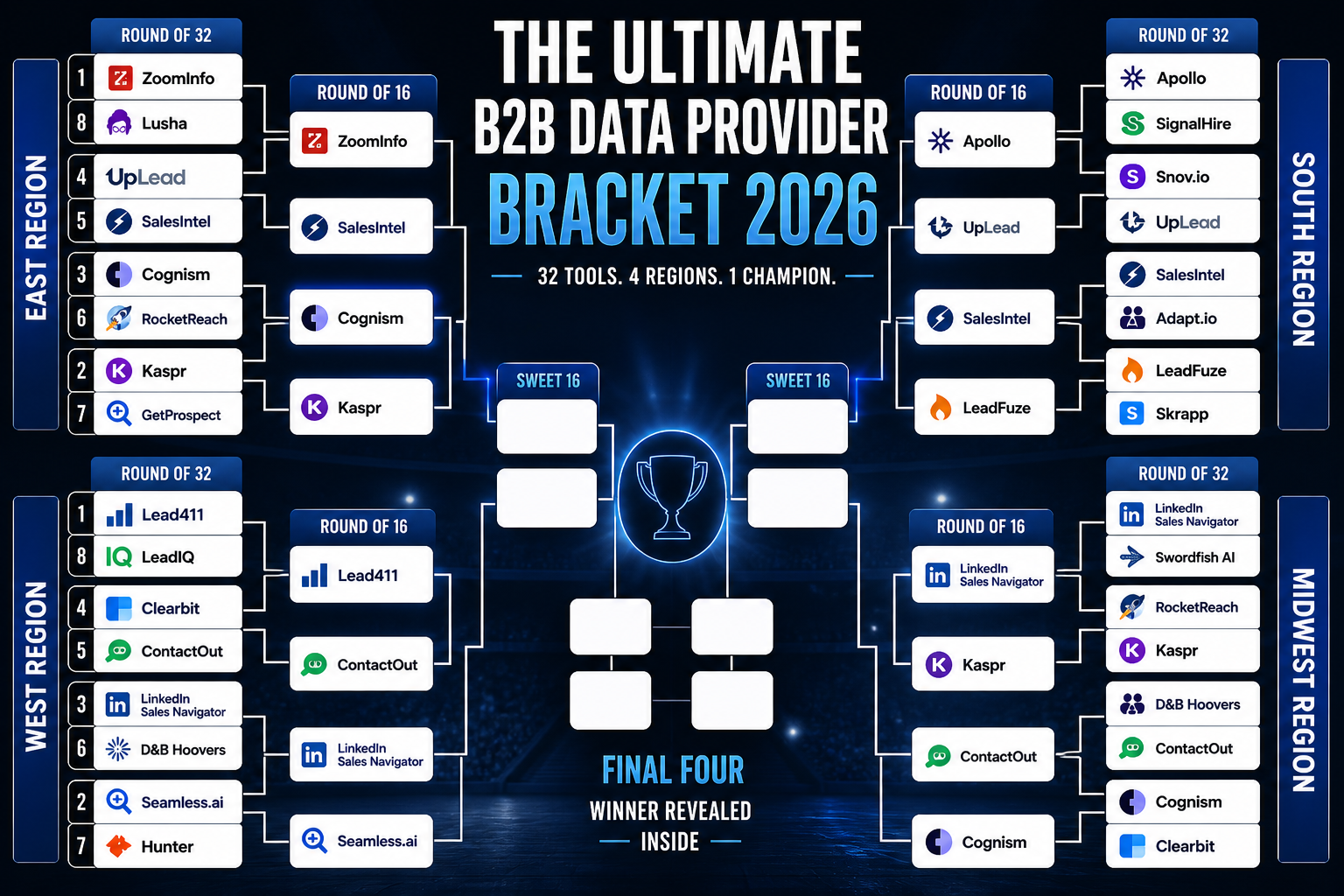
The Ultimate B2B Data Provider Bracket (2026): 32 Tools. 4 Regions. One Winner.
Quick Summary: 32 B2B data providers. Single elimination. Every matchup is decided on one outcome: which platform actually creates pipeline—not just data, not just activity.
If your outbound isn’t converting, fix the foundation first:
build a high-converting prospect list, understand why outbound fails, and make sure you're using accurate email data sources.
Table of Contents
Round of 32
East Region
(1) ZoomInfo vs (8) Lusha
Lusha enables fast prospecting, but that speed creates hidden inefficiencies—limited segmentation, inconsistent enrichment, and frequent validation mid-workflow. ZoomInfo, as a (1) seed, wins because it enables structured targeting from the start—firmographics, technographics, and layered segmentation. This becomes especially powerful when paired with high-converting prospect list strategies, where prioritization determines outcomes. Over time, strategic targeting outperforms speed alone.
Winner: (1) ZoomInfo
(4) UpLead vs (5) SalesIntel
This is a close matchup, but the (5) seed SalesIntel wins because human verification changes execution behavior. When reps trust data, they eliminate hesitation—no second-guessing emails or delaying calls. That confidence increases activity consistency, which compounds into more pipeline than incremental differences in data quality alone. This directly impacts deliverability and performance, as outlined in email accuracy benchmarks.
Winner: (5) SalesIntel
(3) Cognism vs (6) RocketReach
RocketReach provides broad access, but Cognism’s (3) seed advantage comes from structured datasets built for scale. Structure enables repeatable outbound systems, especially when aligning with sales and marketing workflows. Systems outperform one-off prospecting efforts.
Winner: (3) Cognism
(2) Kaspr vs (7) GetProspect
Kaspr wins as the (2) seed because it aligns with real rep workflows—fast, frictionless, and embedded. GetProspect is effective, but requires more deliberate setup. Tools that get used consistently outperform tools that are technically strong but operationally inconvenient.
Winner: (2) Kaspr
West Region
(1) Lead411 vs (8) LeadIQ
LeadIQ supports prospecting workflows, but Lead411 eliminates friction entirely. As a (1) seed, it delivers verified emails, direct dials, and intent signals in one place. That reduces time-to-contact significantly—critical when engaging buying committees, where timing drives outcomes.
Winner: (1) Lead411
(4) Clearbit vs (5) ContactOut
Clearbit improves targeting clarity, but ContactOut (5) enables action. In outbound, enrichment without execution doesn’t create pipeline. ContactOut provides immediate access to decision-makers, which increases outreach velocity and meeting volume.
Winner: (5) ContactOut
(3) LinkedIn Sales Navigator vs (6) D&B Hoovers
Hoovers offers structured company data, but LinkedIn’s (3) seed advantage lies in real-time context—job changes, org structure, and engagement signals. This context improves outreach personalization, which directly impacts reply rates.
Winner: (3) LinkedIn Sales Navigator
(2) Seamless.ai vs (7) Hunter
Hunter excels at email lookup, but Seamless (2) supports broader discovery across channels. As outbound becomes multi-channel, flexibility becomes a competitive advantage.
Winner: (2) Seamless.ai
South Region
(1) Apollo vs (8) SignalHire
SignalHire identifies contacts, but Apollo (1) operationalizes them. By connecting data directly to sequences and workflows, Apollo eliminates friction between discovery and execution—one of the core issues highlighted in
why outbound fails. That integration increases both speed and consistency.
Winner: (1) Apollo
(4) Snov.io vs (5) UpLead
Snov offers flexibility, but UpLead (5) delivers consistency. Consistent data improves deliverability and protects domain health, which becomes critical as campaigns scale. This ties directly into findings from email accuracy studies.
Winner: (5) UpLead
(3) SalesIntel vs (6) Adapt.io
Adapt.io provides volume, but SalesIntel (3) provides confidence. Confidence reduces friction and allows reps to execute faster and more consistently.
Winner: (3) SalesIntel
(2) LeadFuze vs (7) Skrapp
LeadFuze (2) supports structured targeting aligned to ICPs, while Skrapp focuses on scraping. Better targeting leads to higher-quality conversations and stronger pipeline.
Winner: (2) LeadFuze
Midwest Region
(1) LinkedIn Sales Navigator vs (8) Swordfish
Swordfish provides direct dials, but LinkedIn (1) provides context—roles, relationships, and timing. That context improves outreach relevance, aligning with best practices for targeting decision-makers, and directly impacts response rates.
Winner: (1) LinkedIn Sales Navigator
(4) RocketReach vs (5) Kaspr
RocketReach offers scale, but Kaspr (5) wins on usability and speed. Tools that integrate into daily workflows produce more consistent activity.
Winner: (5) Kaspr
(3) Hoovers vs (6) ContactOut
Hoovers provides insight, but ContactOut (6) enables action. Speed to contact is often the deciding factor in outbound success.
Winner: (6) ContactOut
(2) Cognism vs (7) Clearbit
Clearbit enriches data, but Cognism (2) supports scalable outbound execution. Execution—not enrichment—drives pipeline.
Winner: (2) Cognism
Sweet 16
(1) ZoomInfo vs (5) SalesIntel
At this level, the decision shifts from data trust to strategic leverage. SalesIntel improves confidence in individual records, but ZoomInfo (1) enables entire targeting systems—segmentation layers, prioritization models, and ICP refinement. This aligns directly with modern prospecting frameworks, where strategy determines scale.
Winner: (1) ZoomInfo
(3) Cognism vs (2) Kaspr
Kaspr improves individual rep efficiency, but Cognism (3) improves organizational consistency. As outbound programs scale, repeatable systems outperform individual speed.
Winner: (3) Cognism
(1) Lead411 vs (5) ContactOut
Both tools enable access, but Lead411 (1) improves connection rates through verified data and direct dials. That improvement increases the percentage of successful touches, directly impacting pipeline creation.
Winner: (1) Lead411
(3) LinkedIn Sales Navigator vs (2) Seamless.ai
Seamless accelerates discovery, but LinkedIn (3) improves targeting precision and messaging quality. Better messaging strategies are explored in cold outreach personalization guides, which show why relevance wins over speed.
Winner: (3) LinkedIn Sales Navigator
(1) Apollo vs (5) UpLead
UpLead improves inputs, but Apollo (1) improves outputs. By integrating workflows, Apollo ensures data turns into action consistently.
Winner: (1) Apollo
(3) SalesIntel vs (2) LeadFuze
SalesIntel (3) reduces uncertainty, allowing reps to execute faster and maintain momentum.
Winner: (3) SalesIntel
(1) LinkedIn Sales Navigator vs (5) Kaspr
Kaspr is fast, but LinkedIn (1) enables more strategic outreach. In complex deals, strategy beats speed.
Winner: (1) LinkedIn Sales Navigator
(6) ContactOut vs (2) Cognism
ContactOut simplifies access, but Cognism (2) enables scalable outbound systems.
Winner: (2) Cognism
Elite 8
(East) (1) ZoomInfo vs (3) Cognism
Both platforms enable structured outbound, but ZoomInfo (1) provides deeper segmentation capabilities. That depth allows teams to refine targeting at a granular level, producing higher-quality pipeline.
East Winner: (1) ZoomInfo
(West) (1) Lead411 vs (3) LinkedIn Sales Navigator
LinkedIn identifies prospects, but Lead411 (1) ensures reps can reach them. This aligns with common outbound failures where targeting exists but execution does not.
West Winner: (1) Lead411
(South) (1) Apollo vs (3) SalesIntel
SalesIntel improves accuracy, but Apollo (1) improves throughput and execution consistency.
South Winner: (1) Apollo
(Midwest) (1) LinkedIn Sales Navigator vs (2) Cognism
LinkedIn provides context, but Cognism (2) provides scalable systems.
Midwest Winner: (2) Cognism
Final Four
(1) ZoomInfo vs (1) Lead411
ZoomInfo provides depth, but Lead411 provides immediacy. Faster execution leads to more pipeline generation, especially when aligned with high-performing outbound systems.
Winner: (1) Lead411
(1) Apollo vs (2) Cognism
Cognism strengthens data inputs, but Apollo (1) converts those inputs into output.
Winner: (1) Apollo
Championship
(1) Lead411 vs (1) Apollo
Apollo drives activity. Lead411 drives connection. And connection rate compounds faster than activity volume. More activity without connection creates noise. More connection creates pipeline.
Winner: (1) Lead411
Frequently Asked Questions About B2B Data Provider Matchups
Which B2B data provider is best overall in 2026?
The “best” provider depends on what problem you're solving, but most teams fail by optimizing for the wrong metric. If you're optimizing for database size, tools like ZoomInfo may appear strongest. If you're optimizing for execution and pipeline creation, platforms that combine verified contact data with usability and direct dial access—like Lead411—tend to outperform over time.
The key distinction is this: data alone doesn’t create pipeline. The ability to convert that data into conversations—quickly and consistently—is what determines performance.
ZoomInfo vs Cognism: Which is better for outbound?
ZoomInfo excels in depth—its strength lies in segmentation, firmographics, and advanced targeting capabilities. Cognism, on the other hand, focuses on structured, compliant datasets that are easier to operationalize across teams.
In practice, ZoomInfo is often better for teams that want to build highly refined targeting strategies, while Cognism is better for teams prioritizing consistency and scalability across global outbound programs. That’s why ZoomInfo edges this matchup—it provides more strategic flexibility at scale.
Lead411 vs ZoomInfo: Why does Lead411 win?
This matchup comes down to usability versus depth. ZoomInfo provides more data, but Lead411 makes that data immediately actionable. With verified emails, direct dials, and intent signals in one platform, Lead411 reduces the time between identifying a prospect and contacting them.
Most outbound teams don’t lose because they lack data—they lose because they move too slowly. Lead411 wins because it compresses the time-to-contact and improves connection rates, which compounds into more pipeline.
Apollo vs Lead411: Which is better for sales teams?
Apollo is built for execution at scale—it combines data with sequencing and automation, allowing teams to generate consistent outbound activity. Lead411, however, focuses on improving connection rates by providing higher-quality contact data and direct dials.
The tradeoff is activity versus connection. Apollo helps you do more. Lead411 helps you connect more. In most outbound environments, connection rate compounds faster than activity volume, which is why Lead411 ultimately wins the bracket.
Why do some lower-seeded tools (like SalesIntel) win early matchups?
Lower-seeded tools often outperform expectations because they solve very specific problems exceptionally well. SalesIntel, for example, focuses heavily on human-verified data, which directly impacts rep confidence and execution speed.
In early rounds, where differences between tools are narrower, these focused advantages can outweigh broader feature sets—leading to “upsets” that mirror real-world buying decisions.
What matters more: data accuracy or data volume?
Accuracy almost always wins over volume in outbound. High-volume datasets with low accuracy lead to bounced emails, wasted calls, and reduced deliverability—ultimately hurting performance.
Accurate data, even at smaller scale, improves connection rates and ensures that outreach efforts translate into conversations. Over time, higher connection rates produce more pipeline than simply increasing activity volume.
Why is LinkedIn Sales Navigator so competitive in this bracket?
LinkedIn Sales Navigator doesn’t provide traditional contact data, but it offers something equally valuable: context. Understanding job changes, reporting structures, and engagement signals allows reps to personalize outreach and time their messaging effectively.
That context improves response rates, which is why LinkedIn consistently advances deep into the bracket—even without direct dial or email capabilities.
What is the biggest mistake companies make when choosing a data provider?
The biggest mistake is evaluating tools based on features instead of outcomes. Teams often compare database size, filters, or integrations, but ignore how those features translate into pipeline.
The better approach is to ask: does this tool help reps move faster, connect more often, and generate more conversations? If the answer is no, the feature set doesn’t matter.
Why does execution matter more than data in later rounds?
In early rounds, differences in data quality and features can determine outcomes. But as you move deeper into the bracket, most tools provide “good enough” data. At that point, execution becomes the differentiator.
Tools that reduce friction—by integrating workflows, improving usability, or providing ready-to-use data—enable teams to operate more efficiently. That efficiency translates directly into pipeline.
How should I choose the right B2B data provider for my team?
Start by identifying your biggest bottleneck:
- If your issue is targeting → prioritize segmentation and data depth
- If your issue is execution → prioritize usability and workflow integration
- If your issue is connection rates → prioritize data accuracy and direct dials
The best tool isn’t the one with the most features—it’s the one that removes your biggest constraint.
Do all these tools work for both SMB and enterprise teams?
Not equally. Some tools are better suited for enterprise environments where scale and segmentation are critical, while others are optimized for SMB teams that need speed and simplicity.
Enterprise teams often benefit from platforms like ZoomInfo or Cognism due to their depth and scalability, while smaller teams may see faster results with tools that prioritize usability and immediate execution.
Why doesn’t enrichment alone create pipeline?
Enrichment improves your understanding of accounts, but it doesn’t create conversations. Pipeline is generated through outreach—emails, calls, and meetings—not data enhancement.
That’s why tools that combine enrichment with execution capabilities consistently outperform those that focus solely on data enhancement.
Recent Posts

Why “Taste > Technology” Is the Wrong Debate in Modern GTM (2026)
Why “Taste > Technology” Is the Wrong Debate in Modern GTM There’s a new anti-tech movement happening inside B2B go-to-market teams. After years of over-automation, bloated sales stacks, and AI hype cycles, more operators are arguing that tools don’t matter nearly...
Why Most B2B Companies Are Targeting the Wrong Accounts in 2026
Why Most B2B Companies Are Targeting the Wrong Accounts in 2026 Quick Summary Most outbound teams do not have a messaging problem. They have a targeting problem. In 2026, many B2B sales organizations are still relying on outdated account selection models built...
Why Most B2B Intent Data Is Wrong (And What Actually Predicts Buying Intent in 2026)
Why Most B2B Intent Data Is Wrong (And What Actually Predicts Buying Intent in 2026) Quick Summary B2B intent data has become one of the most overhyped categories in outbound sales. Nearly every sales intelligence platform now claims to identify “in-market...

- Sales Services
- Cybersecurity
- SaaS/Technology
- Energy / CleanTech
- Manufacturing
- Hospitality / Travel / Tourism
- Financial / FinTech
- Healthcare / MedTech
- Logistics / Transportation
- Account Based Marketing
- Recruiting
- Real Estate & Construction
- Professional Services & Consulting
- SLED Data Solutions
- Retail / E-Commerce
- Legal Services
resources
Zoominfo Intent vs Bombora Intent in 2026 | Top 3 B2b Buyer Intent Providers in 2026 | Zoominfo Pricing in 2026 | Linkedin Sales Navigator Competitors (2026) | Clearbit Pricing (2026) | Hubspot Pricing Review (2026) | Lead411 Competitors in 2026| Top 5 Linkedin Email Finders for 2026 | How to Find Someone's Phone Number in 2026 | Apollo.io vs. Lead411 Chrome Extension in 2026 | Apollo.io vs. Zoominfo in 2026 | Top 10 B2B Data Resellers in 2026 | Zoominfo API | Seamless.ai vs. Zoominfo in 2026 | 10 Best Clay Competitors for 2026 | What Does Lead Generation Look Like in 2026? | Zoominfo MCP Server |
7 Best B2B Data Providers for 2026 | 15 Best Sales Lead Databases for B2B in 2026 | Apollo.io MCP Server | Questions About Zoominfo
© 2026 Lead411 All Rights Reserved | Your Privacy Choices | Privacy Policy | Do Not Sell | CCPA | Terms Of Use | Lead411 is a registered data broker under applicable state laws, including under Texas law. To conduct business in Texas, a data broker must register with the Texas Secretary of State (Texas SOS). Information about data broker registrants is available on the Texas SOS website.
- Sales Services
- Cybersecurity
- SaaS/Technology
- Energy / CleanTech
- Manufacturing
- Hospitality / Travel / Tourism
- Financial / FinTech
- Healthcare / MedTech
- Logistics / Transportation
- Account Based Marketing
- Recruiting
- Real Estate & Construction
- Professional Services & Consulting
- SLED Data Solutions
- Retail / E-Commerce
- Legal Services
resources
Zoominfo Intent vs Bombora Intent in 2026 | Top 3 B2b Buyer Intent Providers in 2026 | Zoominfo Pricing in 2026 | Linkedin Sales Navigator Competitors (2026) | Clearbit Pricing (2026) | Hubspot Pricing Review (2026) | Lead411 Competitors in 2026| Top 5 Linkedin Email Finders for 2026 | How to Find Someone's Phone Number in 2026 | Apollo.io vs. Lead411 Chrome Extension in 2026 | Apollo.io vs. Zoominfo in 2026 | Top 10 B2B Data Resellers in 2026 | Zoominfo API | Seamless.ai vs. Zoominfo in 2026 | 10 Best Clay Competitors for 2026 | What Does Lead Generation Look Like in 2026? | Zoominfo MCP Server |
7 Best B2B Data Providers for 2026 | 15 Best Sales Lead Databases for B2B in 2026 | Apollo.io MCP Server | Questions About Zoominfo