
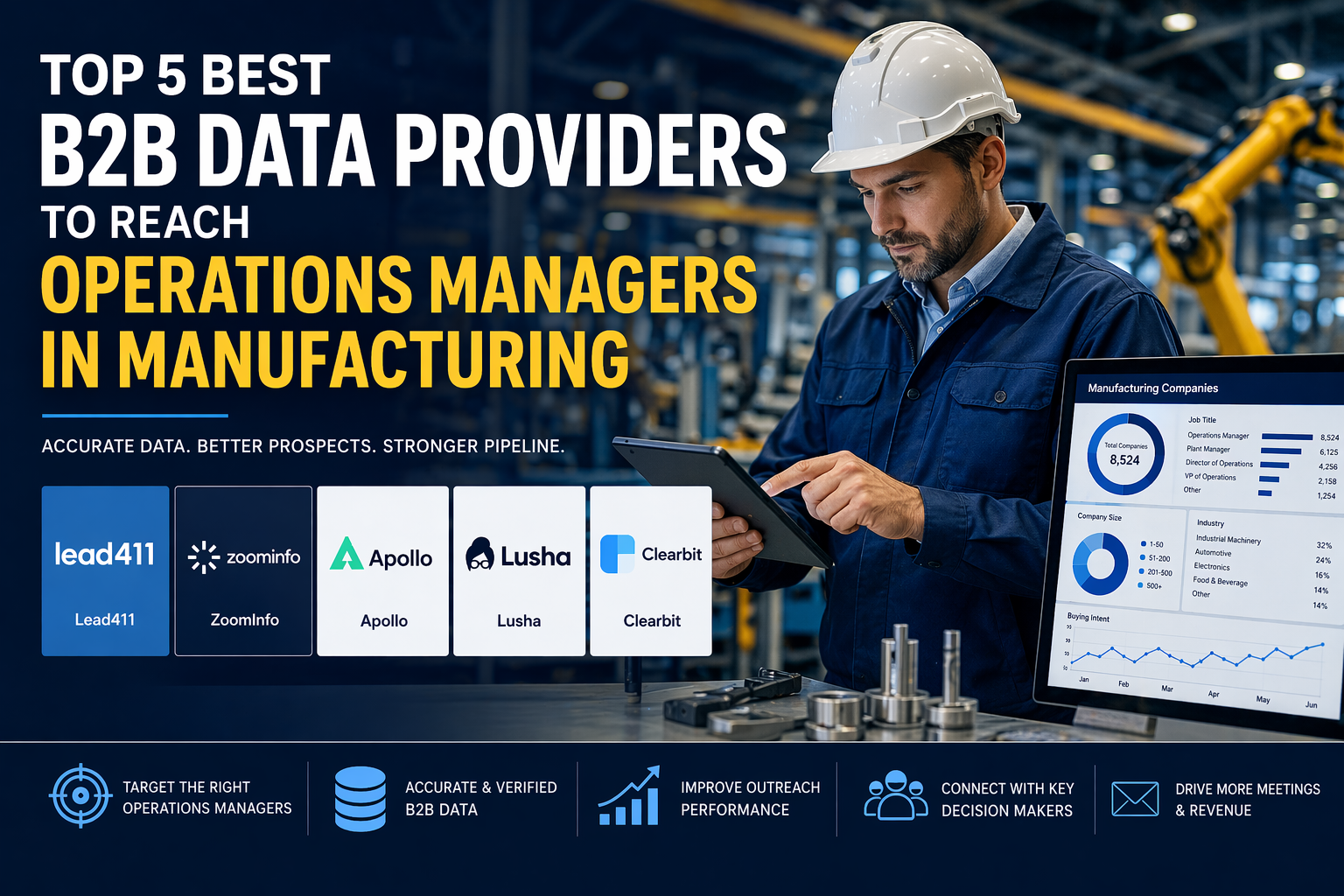
Top 5 Best B2B Data Providers to Reach Operations Managers in Manufacturing
Quick Summary
The best way to reach Operations Managers in manufacturing companies is to combine accurate B2B contact data with intent signals and industry-specific targeting. These buyers are responsible for efficiency, cost control, and production performance — making them highly valuable but difficult to reach.
This guide compares the top B2B data providers for manufacturing prospecting, breaking down their strengths, weaknesses, pricing, and ideal use cases so you can choose the right platform.
- Best overall: Lead411
- Best for enterprise: ZoomInfo
- Best all-in-one platform: Apollo
- Best for quick prospecting: Lusha
- Best for enrichment workflows: Clearbit
Table of Contents
- Introduction
- How to Reach Operations Managers in Manufacturing
- How to Choose the Right Provider
- Top 5 B2B Data Providers
- Which Tool Is Best for Your Use Case?
- What Most Teams Get Wrong
- Why Lead411 Stands Out
- Use Cases
- Final Thoughts
Introduction
Operations Managers in manufacturing are responsible for production output, cost efficiency, and supply chain coordination. Because they directly impact profitability, they are often key decision makers when evaluating new tools or vendors.
However, finding and reaching them is difficult. Manufacturing companies often have decentralized structures, multiple facilities, and inconsistent job titles. Without accurate data and proper targeting, sales teams struggle to connect with the right contacts.
To find Operations Managers in manufacturing companies, you need accurate contact data, role-based targeting, and intent signals that identify active buyers.
How to Reach Operations Managers in Manufacturing
The most effective prospecting strategies combine multiple data signals to identify high-value opportunities.
1. Target Multiple Job Titles
Don’t rely on “Operations Manager” alone. Include Plant Manager, Director of Operations, VP of Manufacturing, and Supply Chain leaders.
2. Segment by Manufacturing Sub-Industry
Automotive, industrial equipment, and consumer goods manufacturing have different structures and priorities.
3. Use Intent Data
Intent data reveals which companies are actively researching operational tools, allowing you to prioritize outreach.
4. Combine Firmographic + Behavioral Data
Target companies based on size, revenue, and growth signals alongside buying intent.
How to Choose the Right B2B Data Provider
The right provider depends on your team size, budget, and target market.
The best B2B data providers for manufacturing combine accuracy, coverage, and intent data to identify decision makers at the right time.
- Accuracy: Verified emails and direct dials
- Coverage: SMB vs enterprise manufacturing
- Intent: Identifying active buyers
- Ease of use: Adoption across teams
Top 5 B2B Data Providers to Reach Operations Managers
1. Lead411
Lead411 is a B2B data platform focused on delivering accurate contact data combined with intent signals, making it particularly effective for targeting Operations Managers in manufacturing companies.
Core Features:
- Verified emails and direct dials
- Bombora-powered intent data
- Lead prospecting tools
- CRM integrations and enrichment
Strengths:
Lead411’s biggest advantage is its balance between accuracy and usability. Manufacturing organizations often have distributed teams across plants and regions, which makes outdated or incomplete data a major issue. Lead411 continuously verifies its contact data, helping reduce bounce rates and improve connect rates.
Its intent data is particularly valuable for manufacturing prospecting. For example, if a company is researching supply chain optimization tools or operational efficiency software, Lead411 can surface that signal, allowing sales teams to prioritize outreach when interest is highest.
Another major strength is cost efficiency. Unlike enterprise tools, Lead411 offers strong functionality without requiring large contracts, making it accessible for mid-market teams.
Weaknesses:
Global coverage is not as extensive as enterprise-focused platforms, which may be a limitation for companies targeting international manufacturing markets.
Best Use Cases:
- Outbound sales targeting U.S. manufacturing companies
- SaaS platforms focused on operations or logistics
- Mid-market ABM campaigns
Ideal Customer Profile:
Teams with 5–100 reps targeting mid-market manufacturing companies in North America, with moderate budgets and a focus on pipeline generation.
Pricing:
Flexible pricing model. See pricing or request a demo.
2. ZoomInfo
ZoomInfo is an enterprise-grade B2B data provider known for its scale and advanced features, making it a strong option for large organizations targeting manufacturing companies globally.
Core Features:
- Extensive global database
- Advanced intent data and analytics
- Org chart mapping
- Technographic insights
Strengths:
ZoomInfo’s biggest strength is its database size and global coverage. For companies targeting large manufacturing enterprises with multiple facilities, its ability to map organizational hierarchies is valuable. Sales teams can identify not only Operations Managers but also adjacent stakeholders across departments.
The platform also offers advanced filtering and segmentation, allowing teams to build highly targeted lists based on company size, revenue, and technology usage.
Weaknesses:
ZoomInfo is expensive and often requires long-term contracts, making it less accessible for smaller teams. Additionally, data accuracy can vary in mid-market manufacturing segments, where companies may not be as well documented as enterprise organizations.
Best Use Cases:
- Enterprise manufacturing targeting
- Global sales campaigns
- Complex account-based marketing
Ideal Customer Profile:
Large organizations with dedicated RevOps teams, global targeting needs, and enterprise budgets.
Pricing:
Enterprise pricing. See ZoomInfo comparison.
3. Apollo
Apollo is a hybrid platform combining B2B data with outreach tools, making it popular among startups and SMB sales teams.
Core Features:
- Contact database
- Email sequencing
- Basic intent signals
- Chrome extension
Strengths:
Apollo’s main advantage is its all-in-one functionality. Teams can manage prospecting and outreach in a single platform, reducing the need for additional tools. Its pricing is also accessible, making it attractive for smaller teams entering manufacturing markets.
Weaknesses:
Data accuracy can be inconsistent, particularly in manufacturing where job titles and company structures vary widely. Its intent data capabilities are also less advanced compared to premium platforms.
Best Use Cases:
- Startups targeting manufacturing companies
- Small outbound teams
Ideal Customer Profile:
Teams with limited budgets that need an all-in-one prospecting solution.
Pricing:
Freemium model. See Apollo alternatives.
4. Lusha
Lusha is a lightweight prospecting tool focused on simplicity and speed.
Core Features:
- Browser extension
- Direct contact data
Strengths:
Lusha is easy to use and allows quick extraction of contact data from LinkedIn profiles, making it useful for individual reps.
Weaknesses:
It lacks advanced filtering, intent data, and scalability, making it less effective for large manufacturing campaigns.
Pricing:
Credit-based. See alternatives.
5. Clearbit
Clearbit focuses on data enrichment and APIs.
Core Features:
- Data enrichment
- Firmographic insights
Strengths:
Strong for enriching inbound leads and improving CRM data quality.
Weaknesses:
Not designed for outbound prospecting and lacks direct contact data depth.
Pricing:
Premium. See alternatives.
Which Tool Is Best for Your Use Case?
Lead411 vs ZoomInfo: Lead411 is better for mid-market teams focused on accuracy and affordability, while ZoomInfo is better for enterprise organizations needing global scale.
Apollo vs Lead411: Apollo offers convenience, but Lead411 provides stronger data accuracy and intent signals.
What Most Teams Get Wrong
- Targeting only one job title
- Ignoring intent data
- Using outdated contact data
Why Lead411 Stands Out
Lead411 stands out because it combines verified contact data, intent signals, and affordability — making it ideal for targeting Operations Managers in manufacturing.
Use Cases
- Outbound prospecting
- ABM campaigns
- Supply chain SaaS targeting
Final Thoughts
The best way to reach Operations Managers in manufacturing is through accurate data, proper segmentation, and timing. Choosing the right B2B data provider can significantly impact your pipeline and conversion rates.