
Why AI SDRs Won’t Replace Human Outbound Teams in 2026
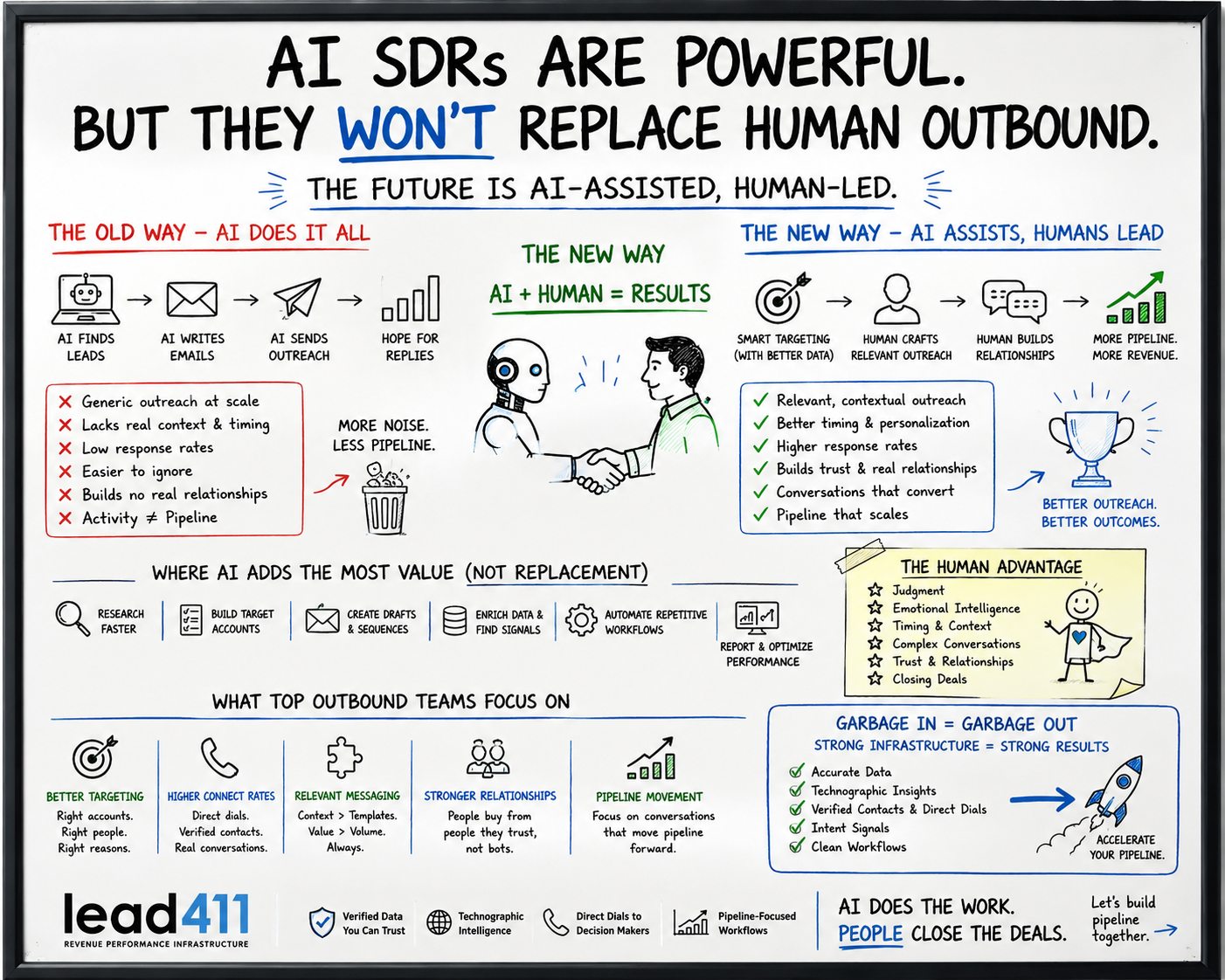
Why AI SDRs Won’t Replace Human Outbound Teams in 2026
Quick Summary
AI SDR tools are exploding across the sales industry. Automated outbound systems can now generate prospect lists, write cold emails, personalize messaging, trigger workflows, and manage outreach sequences at a scale that was impossible just a few years ago.
But despite the hype, most revenue teams are discovering a difficult reality:
AI does not automatically create pipeline.
In many cases, companies deploying fully automated outbound systems are simply scaling bad targeting, flooding inboxes with generic messaging, and creating outbound workflows that feel indistinguishable from every other company using the exact same AI tools.
The future of outbound sales is not fully autonomous AI replacing human reps.
The future is AI-assisted outbound teams using automation to eliminate friction while humans continue handling judgment, timing, trust, positioning, and relationship-building.
The companies winning outbound in 2026 are not replacing humans. They are building smarter revenue infrastructure around them.
Table of Contents
- The Rise of AI SDR Platforms
- The Biggest Myth About AI SDRs
- What Most Companies Get Wrong About AI Outbound
- Why Context Still Beats Automation
- Why Human SDRs Still Matter
- Why Precision Matters More Than Volume
- Why Data Quality Is More Important Than AI Copywriting
- How Technographic Data Improves AI Outbound
- What the Future of Outbound Actually Looks Like
- Why Revenue Infrastructure Matters More Than Ever
- Final Thoughts
The Rise of AI SDR Platforms
AI SDR platforms have become one of the fastest-growing categories in sales technology.
In the span of just a few years, the market has been flooded with tools promising to automate prospecting, personalization, outbound sequencing, lead research, follow-ups, qualification, and even sales conversations themselves.
The pitch is seductive:
Why hire expensive outbound teams when AI can do the work automatically?
For leadership teams under pressure to reduce costs and increase efficiency, that narrative sounds almost inevitable.
Modern AI outbound systems can now:
- Generate personalized cold emails
- Build prospect lists automatically
- Research companies at scale
- Create outbound sequences
- Enrich contact records
- Trigger automated workflows
On the surface, it looks like the traditional SDR role is disappearing.
But inside real outbound organizations, the reality looks very different.
Many companies are discovering that AI is extremely effective at automating repetitive tasks while being surprisingly weak at generating meaningful pipeline consistently.
The Biggest Myth About AI SDRs
The biggest misconception in outbound sales right now is the belief that automation itself creates revenue.
It does not.
Automation amplifies systems that already work. It does not magically fix weak positioning, poor targeting, irrelevant messaging, or bad data.
This is where many organizations misunderstand AI outbound entirely.
Most AI SDR tools are automating the least important part of outbound sales.
Generating email copy is not the hard part.
The hard part is:
- Finding the right accounts
- Understanding timing
- Recognizing urgency signals
- Identifying organizational fit
- Reaching actual decision makers
- Building trust with skeptical buyers
That is where most outbound systems still break down.
Ironically, many companies deploying AI SDR tools are simply scaling the exact same problems that already existed inside outbound sales.
More automation does not fix bad targeting.
It just creates bad targeting at a larger scale.
What Most Companies Get Wrong About AI Outbound
Most companies adopt AI outbound too early in the process.
They automate before fixing the fundamentals.
They automate weak positioning. They automate poor-fit account lists. They automate stale data. They automate generic messaging.
Then they wonder why response rates collapse.
The reality is that many AI SDR systems today feel eerily similar.
Buyers are increasingly able to recognize AI-generated outreach almost instantly because most systems rely on the same personalization structures, the same sequencing logic, and the same language patterns.
That creates a new problem:
When every company uses AI-generated personalization, personalization itself becomes commoditized.
This is one reason why outbound teams are increasingly focusing on data accuracy, targeting quality, and workflow efficiency rather than simply increasing outbound volume.
The irony is that widespread AI adoption may actually increase the value of great human SDRs because authentic communication becomes rarer.
Why Context Still Beats Automation
The biggest weakness in fully automated outbound systems is not content generation.
It is context.
Outbound sales is not just a workflow problem. It is a judgment problem.
Strong outbound reps constantly make nuanced decisions around timing, positioning, organizational dynamics, buyer psychology, and account prioritization.
AI can assist with pieces of that process, but it still struggles to replicate situational awareness.
For example, an AI-generated message may technically sound personalized while completely misunderstanding the strategic reality of the company receiving it.
That is why many outbound teams are increasingly prioritizing technographic targeting and intent-driven workflows before automation even begins.
Because better context consistently outperforms better copywriting.
Why Human SDRs Still Matter
The strongest SDRs do far more than send emails.
They identify timing windows. They recognize subtle buying signals. They build rapport. They adjust positioning dynamically. They understand organizational politics.
Most importantly, they create trust.
That becomes increasingly valuable in a world flooded with synthetic outreach.
Human reps also excel in situations where outbound success depends on emotional intelligence rather than automation logic.
For example:
- Handling objections
- Navigating executive conversations
- Recognizing urgency
- Adapting messaging in real time
- Building authentic relationships
These are not small details.
They are often the difference between pipeline and ignored outreach.
The future of outbound sales is not AI versus humans.
It is AI-assisted humans outperforming teams that rely entirely on automation.
Why Precision Matters More Than Volume
One of the biggest outbound mistakes companies still make is assuming more activity automatically creates more opportunities.
It does not.
The teams consistently outperforming the market are usually not sending the most outreach.
They are targeting better-fit accounts.
Precision increasingly matters more than scale.
For example, many revenue teams now build campaigns around companies already using Salesforce because those organizations are often structurally aligned with their products and services.
Others use verified executive phone numbers because connect rates often matter more than outreach volume.
This is why many outbound teams are increasingly moving away from generic mass prospecting and toward revenue infrastructure built around relevance and workflow efficiency.
Why Data Quality Is More Important Than AI Copywriting
One of the most overlooked realities in outbound sales is that bad targeting destroys even the best messaging.
An AI-generated email cannot compensate for:
- Disconnected phone numbers
- Outdated contacts
- Poor-fit accounts
- Incorrect decision makers
- Low-confidence data
This is why outbound infrastructure matters far more than most companies realize.
The organizations generating the strongest pipeline in 2026 are usually not the ones with the most advanced AI writing tools.
They are the companies with:
- Better targeting systems
- Cleaner contact data
- Higher connect rates
- More accurate prioritization
- Stronger outbound workflows
This is also why many organizations evaluating ZoomInfo competitors or exploring Apollo.io alternatives are increasingly focused on operational efficiency rather than sheer database size.
The market is slowly realizing that outbound success is an execution problem, not just a data problem.
How Technographic Data Improves AI Outbound
The future of AI-assisted outbound will depend heavily on better signals.
Technographic data identifies the tools and platforms companies already use. Intent data identifies organizations actively researching solutions.
Together, these signals dramatically improve targeting precision.
Instead of blasting generic outreach to massive prospect lists, outbound teams can focus on companies with significantly higher conversion potential.
That creates:
- Higher response rates
- Better timing
- Improved personalization
- Cleaner targeting
- Faster pipeline movement
This is one reason why technographic data strategies are becoming increasingly important inside modern outbound workflows.
What the Future of Outbound Actually Looks Like
The future of outbound sales is not fully autonomous AI replacing humans.
That narrative dramatically oversimplifies how real revenue organizations operate.
The future is AI-assisted outbound teams operating with significantly better infrastructure.
AI will absolutely automate parts of outbound sales:
- List building
- Research workflows
- Administrative tasks
- Sequencing
- Workflow orchestration
- Basic personalization
But humans will continue handling:
- Judgment
- Trust-building
- Buyer psychology
- Complex positioning
- Negotiation
- Relationship development
The companies dominating outbound over the next five years will not be the ones replacing humans with AI.
They will be the ones using AI to remove friction while human reps focus on strategy, timing, and trust.
Why Revenue Infrastructure Matters More Than Ever
As outbound sales becomes increasingly AI-assisted, infrastructure quality becomes even more important.
AI systems are only as effective as the targeting, workflows, and data supporting them.
Companies deploying AI outbound systems on top of poor data infrastructure often amplify inefficiency rather than improving performance.
This is why revenue infrastructure is becoming significantly more important than commodity databases.
Platforms like Lead411 increasingly position around:
- Verified direct dials
- Accurate targeting
- Technographic intelligence
- Outbound workflows
- Pipeline movement
- Revenue execution
That shift matters because the future of outbound sales is not about sending more messages.
It is about improving execution.
That is also why more organizations evaluating ZoomInfo pricing are increasingly questioning whether oversized enterprise platforms actually improve outbound efficiency or simply create more operational complexity.
Build Smarter AI-Assisted Outbound Workflows
AI alone does not create pipeline. Strong targeting, verified contact data, operational efficiency, and better outbound infrastructure still determine revenue performance.
Final Thoughts
AI SDRs are not replacing human outbound teams.
They are changing how outbound teams operate.
The companies generating the strongest pipeline in 2026 are not blindly automating everything. They are combining AI efficiency with human judgment, stronger targeting, better infrastructure, and cleaner execution.
Because in modern outbound sales, automation alone is not the advantage.
Execution is.
Frequently Asked Questions About AI SDRs and Human Outbound Teams
Will AI SDRs completely replace human sales development reps?
Probably not.
AI SDR systems are extremely effective at automating repetitive outbound tasks such as list building, sequencing, basic personalization, lead enrichment, and workflow orchestration. But outbound sales is not purely a workflow problem. It is also a judgment problem.
Strong SDRs constantly make nuanced decisions around timing, organizational dynamics, buyer psychology, positioning, and relationship-building. Those decisions are often context-heavy and difficult for fully automated systems to replicate consistently.
What is far more likely is that AI will eliminate low-value administrative work while human reps focus more heavily on strategic conversations, trust-building, qualification, and high-context outreach.
The future of outbound sales is increasingly AI-assisted human teams rather than fully autonomous AI replacing people entirely.
Why are so many companies investing in AI SDR tools right now?
Many organizations are under pressure to improve efficiency, reduce outbound costs, and generate more pipeline with leaner sales teams.
AI SDR platforms promise scalability by automating prospect research, outreach sequencing, email generation, and repetitive outbound workflows.
The idea of automating large portions of outbound sales is extremely appealing because traditional outbound operations are often labor-intensive and expensive to scale.
However, many companies are now discovering that automation alone does not automatically create pipeline. Poor targeting, weak positioning, outdated data, and generic messaging still create major outbound problems regardless of how advanced the automation layer becomes.
What is the biggest weakness of AI-generated outbound outreach?
The biggest weakness is context.
Most AI-generated outbound systems can produce technically correct messaging, but they often struggle to understand timing, organizational nuance, buyer intent, urgency, and strategic fit.
This is why many AI-generated outbound emails feel superficially personalized while still sounding generic.
As more companies deploy similar AI outreach systems, buyers are becoming increasingly capable of recognizing automated messaging patterns. That creates a growing risk that AI-generated outreach becomes commoditized and ignored.
The companies generating strong outbound results in 2026 are typically combining AI efficiency with better targeting and stronger human judgment.
Why is outbound personalization becoming less effective?
Personalization itself is not becoming less effective. Generic personalization is.
Many AI SDR systems rely on the same personalization formulas, the same sequencing structures, and the same language patterns. As a result, buyers increasingly receive outbound messages that look and sound almost identical.
Simply inserting a company name, funding announcement, or job title into an automated email no longer creates meaningful differentiation.
Modern outbound success increasingly depends on relevance, timing, targeting precision, and genuine context rather than surface-level personalization tokens.
What role does data quality play in AI outbound sales?
Data quality is one of the most important factors in outbound performance.
Even highly advanced AI outreach systems fail when built on poor-quality data. Outdated contacts, disconnected phone numbers, incorrect job titles, and poor-fit accounts create operational inefficiency that weakens outbound performance significantly.
In many cases, companies mistakenly believe their outreach problem is a copywriting problem when it is actually a targeting problem.
This is why verified contact information, accurate direct dials, and better account prioritization often matter more than the AI-generated messaging itself.
Why are connect rates becoming more important than outbound volume?
Outbound sales has become significantly noisier over the last several years.
Most buyers are overwhelmed with cold emails, LinkedIn messages, automated sequences, and generic prospecting attempts. As a result, increasing outreach volume alone often produces diminishing returns.
Modern outbound teams are increasingly prioritizing connect rates, targeting quality, and conversion efficiency over sheer activity volume.
A smaller number of highly relevant conversations often produces significantly better pipeline outcomes than massive outbound campaigns targeting poor-fit accounts.
How does technographic data improve AI-assisted outbound?
Technographic data identifies the tools and technologies companies already use.
This allows outbound teams to prioritize accounts that are structurally aligned with their products and services.
For example, a company already using Salesforce may be more likely to adopt tools that integrate into the Salesforce ecosystem.
Combining technographic signals with AI-assisted workflows improves targeting precision, personalization quality, and conversion efficiency significantly.
This is one reason why technographic targeting is becoming increasingly important in modern outbound sales infrastructure.
What do most companies get wrong about AI SDR systems?
The biggest mistake is automating before fixing the fundamentals.
Many organizations deploy AI outbound systems on top of poor targeting, weak positioning, outdated data, and inefficient workflows.
Automation amplifies existing systems. It does not magically repair broken outbound strategy.
Companies that consistently generate strong pipeline with AI typically focus heavily on:
- Better targeting
- Cleaner data
- Workflow efficiency
- Connect rates
- Operational execution
AI becomes significantly more effective when layered on top of strong revenue infrastructure.
Why are many companies reevaluating enterprise sales intelligence platforms?
Many outbound teams are becoming frustrated with bloated enterprise systems that create operational complexity without meaningfully improving execution.
As outbound sales becomes more performance-driven, companies increasingly prioritize usability, targeting precision, speed, workflow simplicity, and connect-rate performance over massive feature sets.
This shift is one reason why many organizations are exploring alternatives to traditional enterprise sales intelligence providers and evaluating more focused revenue infrastructure platforms.
What does the future of outbound sales actually look like?
The future of outbound sales will likely combine AI automation with human judgment.
AI will continue handling repetitive tasks such as research, sequencing, administrative workflows, and basic personalization.
Human reps will continue handling relationship-building, strategic conversations, negotiation, emotional intelligence, timing, and high-context communication.
The companies that dominate outbound sales over the next five years will not be the ones replacing humans entirely. They will be the ones using AI to eliminate friction while allowing human reps to focus on the highest-value parts of the sales process.
Recent Posts
Apollo.io Pricing 2026: What It Really Costs (Plans, Credits & Hidden Fees)
Apollo.io Pricing 2026: What It Really Costs (Plans, Credits & Hidden Fees) Apollo.io pricing starts at around $49 per user per month, but most teams end up paying significantly more once they begin using credits at scale. Understanding how Apollo’s pricing actually...
How to Build a High-Converting B2B Prospect List (2026 Framework)
How to Build a High-Converting B2B Prospect List (Step-by-Step Framework for 2026) Quick Summary Most prospect lists fail before the first email is even sent. Teams often assume the issue is messaging, but in reality, poor list construction is the root cause of...
Best B2B Data Providers for Email Deliverability in 2026
Best B2B Data Providers for Email Deliverability in 2026 Quick Summary The best B2B data providers for email deliverability prioritize accuracy over volume. Across most outbound teams, a clear pattern emerges: Verified data → 90%+ deliverability Aggregated data →...

- Sales Services
- Cybersecurity
- SaaS/Technology
- Energy / CleanTech
- Manufacturing
- Hospitality / Travel / Tourism
- Financial / FinTech
- Healthcare / MedTech
- Logistics / Transportation
- Account Based Marketing
- Recruiting
- Real Estate & Construction
- Professional Services & Consulting
- SLED Data Solutions
- Retail / E-Commerce
- Legal Services
resources
Zoominfo Intent vs Bombora Intent in 2026 | Top 3 B2b Buyer Intent Providers in 2026 | Zoominfo Pricing in 2026 | Linkedin Sales Navigator Competitors (2026) | Clearbit Pricing (2026) | Hubspot Pricing Review (2026) | Lead411 Competitors in 2026| Top 5 Linkedin Email Finders for 2026 | How to Find Someone's Phone Number in 2026 | Apollo.io vs. Lead411 Chrome Extension in 2026 | Apollo.io vs. Zoominfo in 2026 | Top 10 B2B Data Resellers in 2026 | Zoominfo API | Seamless.ai vs. Zoominfo in 2026 | 10 Best Clay Competitors for 2026 | What Does Lead Generation Look Like in 2026? | Zoominfo MCP Server |
7 Best B2B Data Providers for 2026 | 15 Best Sales Lead Databases for B2B in 2026 | Apollo.io MCP Server | Questions About Zoominfo
© 2026 Lead411 All Rights Reserved | Your Privacy Choices | Privacy Policy | Do Not Sell | CCPA | Terms Of Use | Lead411 is a registered data broker under applicable state laws, including under Texas law. To conduct business in Texas, a data broker must register with the Texas Secretary of State (Texas SOS). Information about data broker registrants is available on the Texas SOS website.
- Sales Services
- Cybersecurity
- SaaS/Technology
- Energy / CleanTech
- Manufacturing
- Hospitality / Travel / Tourism
- Financial / FinTech
- Healthcare / MedTech
- Logistics / Transportation
- Account Based Marketing
- Recruiting
- Real Estate & Construction
- Professional Services & Consulting
- SLED Data Solutions
- Retail / E-Commerce
- Legal Services
resources
Zoominfo Intent vs Bombora Intent in 2026 | Top 3 B2b Buyer Intent Providers in 2026 | Zoominfo Pricing in 2026 | Linkedin Sales Navigator Competitors (2026) | Clearbit Pricing (2026) | Hubspot Pricing Review (2026) | Lead411 Competitors in 2026| Top 5 Linkedin Email Finders for 2026 | How to Find Someone's Phone Number in 2026 | Apollo.io vs. Lead411 Chrome Extension in 2026 | Apollo.io vs. Zoominfo in 2026 | Top 10 B2B Data Resellers in 2026 | Zoominfo API | Seamless.ai vs. Zoominfo in 2026 | 10 Best Clay Competitors for 2026 | What Does Lead Generation Look Like in 2026? | Zoominfo MCP Server |
7 Best B2B Data Providers for 2026 | 15 Best Sales Lead Databases for B2B in 2026 | Apollo.io MCP Server | Questions About Zoominfo