
Why Most B2B Companies Are Targeting the Wrong Accounts in 2026
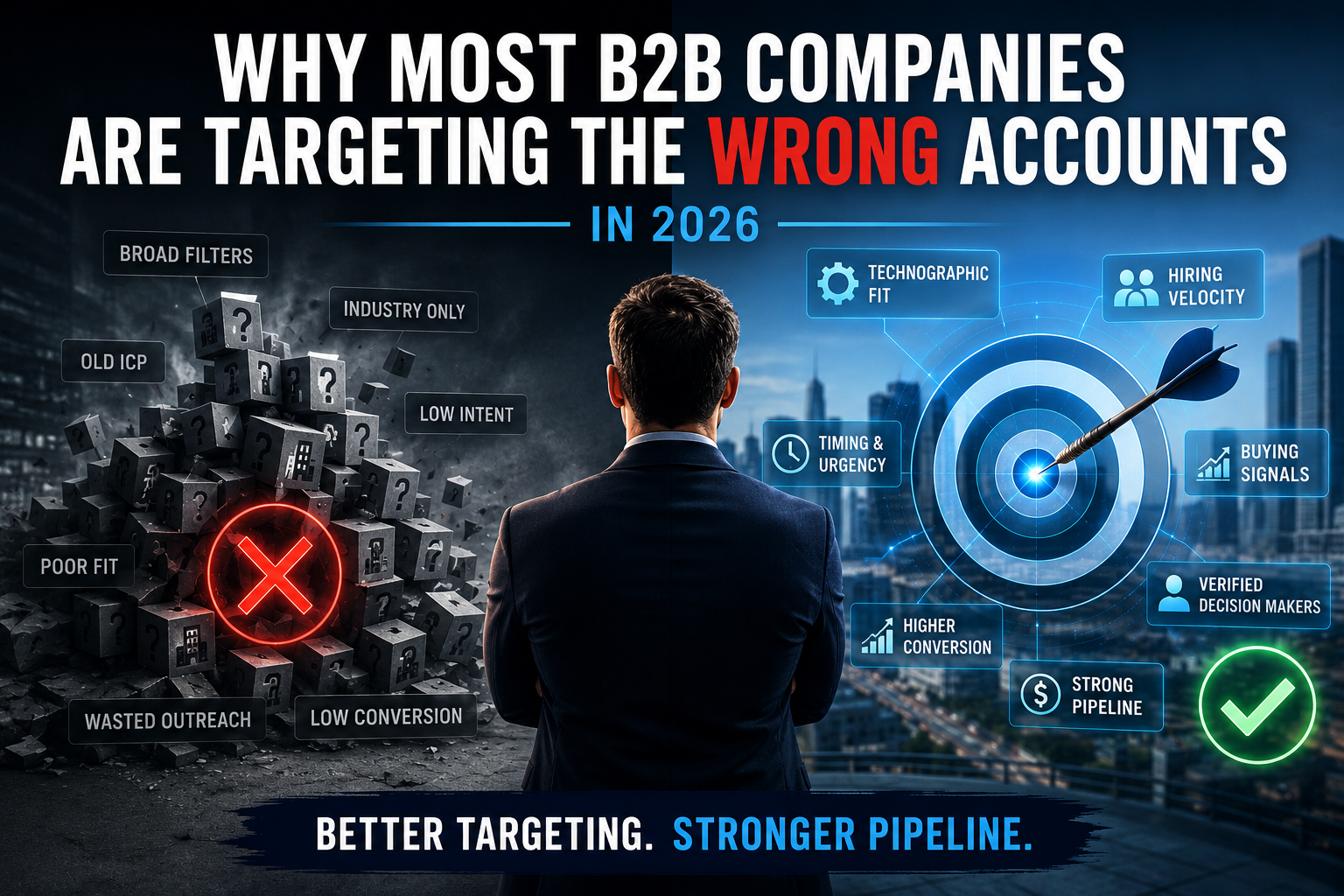
Why Most B2B Companies Are Targeting the Wrong Accounts in 2026
Quick Summary
Most outbound teams do not have a messaging problem.
They have a targeting problem.
In 2026, many B2B sales organizations are still relying on outdated account selection models built around broad industry filters, generic employee-count ranges, and static ICP definitions that no longer accurately predict conversion probability.
The result is predictable:
- Lower connect rates
- Declining email engagement
- Weak pipeline efficiency
- Burned-out SDR teams
- Massive outbound waste
The companies consistently generating pipeline today are not simply sending better emails.
They are targeting fundamentally different accounts.
Modern outbound sales is shifting toward layered signal intelligence that combines technographic fit, operational timing, hiring activity, outbound engagement behavior, revenue infrastructure maturity, and verified buyer targeting.
This is why companies increasingly view platforms like Lead411 as revenue performance infrastructure rather than commodity B2B databases.
Because in modern outbound sales, better targeting is becoming the biggest competitive advantage in the market.
Table of Contents
- The Real Problem With Modern Outbound Sales
- Why Most ICP Models Are Broken
- Why Industry and Employee Count Filters No Longer Work
- How AI Outbound Is Amplifying Bad Targeting
- What Actually Predicts Conversion in 2026
- Why Technographic Data Is Becoming Essential
- Why Timing Matters More Than Total Addressable Market
- Why Intent Data Alone Is Not Enough
- Why Revenue Infrastructure Matters More Than Ever
- How Lead411 Helps Teams Target Smarter Accounts
- Final Thoughts
The Real Problem With Modern Outbound Sales
Most outbound organizations assume their biggest problem is messaging.
They obsess over:
- Email subject lines
- Cold call scripts
- AI-generated personalization
- Sequence timing
- Outbound templates
But many of those teams are overlooking the bigger issue entirely.
Most outbound teams are not targeting bad accounts because their messaging is weak. They are targeting bad accounts because their account selection process is outdated.
This is one of the largest hidden inefficiencies inside modern B2B sales.
Many organizations still build outbound lists using simplistic filters like:
- Industry
- Company size
- Revenue bands
- Geography
Those filters worked reasonably well when outbound competition was lower.
They do not work nearly as well today.
In 2026, buyers are overwhelmed with outbound messaging. Generic targeting combined with generic outreach creates a pipeline disaster.
This is one reason why outbound teams increasingly prioritize data accuracy, targeting precision, and layered buying signals rather than simply expanding outbound volume.
Why Most ICP Models Are Broken
The traditional concept of an ideal customer profile was built for a very different era of outbound sales.
Most ICPs still rely heavily on broad demographic filters:
- Industry category
- Company size
- Revenue range
- Geographic region
The problem is that these characteristics rarely predict actual buying behavior consistently anymore.
Two companies with identical employee counts and similar revenue may behave completely differently operationally.
One may be aggressively scaling with active budget allocation and modern GTM infrastructure.
The other may be operationally stagnant with no urgency to purchase anything.
Yet many outbound teams treat both accounts as equally valuable simply because they fit the same surface-level ICP filters.
This creates enormous outbound inefficiency.
Modern account targeting increasingly requires operational context, not just demographic matching.
Why Industry and Employee Count Filters No Longer Work
Industry targeting is becoming increasingly unreliable as a standalone outbound strategy.
Most industries today contain companies operating at completely different levels of maturity, urgency, infrastructure sophistication, and growth velocity.
For example:
| Company | Industry | Employee Count | Actual Buying Probability |
|---|---|---|---|
| SaaS Company A | Software | 250 | High |
| SaaS Company B | Software | 250 | Low |
On paper, these companies look identical.
Operationally, they may be completely different.
One may be hiring aggressively, expanding RevOps, implementing new GTM systems, and adopting modern outbound infrastructure.
The other may be reducing headcount and freezing software spend.
This is why broad industry segmentation alone no longer predicts conversion effectively.
The future of outbound targeting is moving toward signal layering and operational context.
How AI Outbound Is Amplifying Bad Targeting
AI outbound systems are dramatically increasing outbound activity across the market.
That creates both opportunity and danger.
Many companies now use AI to automate:
- Prospect research
- Cold email generation
- Outbound sequencing
- List enrichment
- Personalization workflows
But AI introduces a major risk:
AI does not fix bad targeting. It amplifies it faster.
If an outbound team is targeting the wrong accounts, AI simply allows them to target the wrong accounts at a larger scale.
This is one reason why many organizations deploying AI SDR systems are experiencing disappointing pipeline results despite dramatically increasing outbound activity.
The future of outbound sales is not more automation alone.
It is smarter account selection combined with better execution.
This is also why topics like AI SDRs and outbound automation are becoming increasingly important inside modern revenue organizations.
What Actually Predicts Conversion in 2026
The outbound teams consistently generating pipeline today are not relying on static ICPs alone.
They are combining multiple predictive signals together.
Some of the strongest conversion indicators now include:
- Hiring velocity
- Sales team expansion
- Leadership hiring
- Technographic overlap
- Funding events
- Operational scaling activity
- Revenue infrastructure maturity
- Outbound engagement behavior
These signals create operational context.
And operational context is becoming far more predictive than simplistic demographic segmentation.
This is one reason why many outbound teams increasingly prioritize layered intent intelligence instead of relying entirely on generic keyword engagement data.
Why Technographic Data Is Becoming Essential
One of the strongest predictors of account fit today is technographic alignment.
Companies already using certain technologies are often significantly more likely to adopt complementary products and integrations.
For example, organizations already using Salesforce are frequently strong candidates for outbound infrastructure, RevOps tooling, and sales enablement systems.
This is why many outbound teams now build campaigns around companies using Salesforce rather than broad industry filters alone.
Technographic targeting creates significantly better context than generic demographic segmentation because it reflects how a company actually operates.
This is also why technographic data is rapidly becoming one of the most valuable layers in modern outbound targeting.
Why Timing Matters More Than Total Addressable Market
Many companies still obsess over TAM size.
But total addressable market means very little if the majority of those accounts have no urgency to buy.
Timing is becoming significantly more important than sheer market size.
Strong timing indicators include:
- Funding announcements
- Hiring spikes
- Sales team expansion
- Technology migrations
- Operational restructuring
- Leadership changes
These events often create significantly stronger buying windows than static demographic characteristics alone.
This is why modern outbound sales increasingly depends on identifying operational timing rather than simply maximizing list size.
Why Intent Data Alone Is Not Enough
Intent data can absolutely improve outbound targeting.
But intent signals alone rarely predict buying readiness consistently.
Many companies researching software online have no budget, no internal urgency, and no active purchase process.
This is why many outbound teams eventually realize that raw intent spikes often produce disappointing results.
The strongest revenue teams combine intent data with:
- Technographic alignment
- Operational timing
- Hiring activity
- Verified buyer targeting
- Revenue infrastructure maturity
This layered approach creates significantly stronger account prioritization.
It also reduces wasted outreach and improves pipeline efficiency dramatically.
Why Revenue Infrastructure Matters More Than Ever
Modern outbound sales is increasingly becoming an execution problem rather than a database problem.
The companies winning today are not simply buying larger datasets.
They are building stronger revenue infrastructure around targeting precision, outbound workflows, connect rates, and pipeline movement.
This is one reason why more organizations are reevaluating oversized enterprise platforms and researching ZoomInfo competitors or exploring Apollo alternatives that prioritize operational efficiency over sheer feature volume.
The market is shifting toward platforms designed to improve outbound execution itself.
That is a fundamentally different category.
How Lead411 Helps Teams Target Smarter Accounts
Lead411 increasingly focuses on helping outbound teams improve account selection quality rather than simply expanding outbound volume.
That includes:
- Verified direct dials
- Technographic targeting
- Intent intelligence
- Accurate contact data
- Outbound workflow infrastructure
- Decision-maker identification
This allows revenue teams to prioritize accounts with significantly stronger conversion potential.
Because modern outbound success is no longer about how many accounts you target.
It is about targeting the right accounts at the right time with the right operational context.
That is also why many organizations increasingly view Lead411 as revenue performance infrastructure rather than simply another B2B contact database.
Target Smarter Accounts With Lead411
Lead411 helps outbound teams improve targeting precision, connect rates, and pipeline generation through technographic data, intent intelligence, verified direct dials, and revenue-focused outbound infrastructure.
Final Thoughts
Most outbound teams are not struggling because their SDRs are weak.
They are struggling because their targeting systems are outdated.
Modern pipeline generation increasingly depends on operational context, timing precision, technographic alignment, layered intent signals, and stronger revenue infrastructure.
The companies that continue relying on broad ICP filters and generic account segmentation may increasingly struggle as outbound competition intensifies.
Because in modern B2B sales, the future does not belong to the companies sending the most outbound activity.
The future belongs to the companies targeting the right accounts first.
Frequently Asked Questions About B2B Account Targeting in 2026
Why are so many B2B companies struggling with outbound sales in 2026?
Many outbound teams are still relying on outdated targeting models built around broad industry filters, employee counts, and static ideal customer profiles that no longer accurately predict buying behavior.
Modern buyers are overwhelmed with outbound messaging, which means generic targeting creates lower response rates, weaker connect rates, and declining pipeline efficiency.
The companies consistently generating pipeline today are focusing much more heavily on timing signals, technographic alignment, operational growth indicators, and verified decision-maker targeting.
What is the biggest mistake companies make with account targeting?
The biggest mistake is assuming that demographic filters alone predict conversion probability.
Many companies still build outbound lists using simplistic criteria like industry, employee count, geography, and annual revenue. While those filters can provide a basic starting point, they rarely reflect actual buying readiness or operational urgency.
Modern outbound targeting increasingly requires layered signal intelligence that combines timing indicators, technology adoption, growth activity, and buyer behavior.
Why are traditional ICPs becoming less effective?
Traditional ICPs were designed for a much less competitive outbound environment.
Most ICP frameworks rely heavily on static company characteristics rather than operational context. But two companies with similar employee counts and revenue can behave completely differently depending on growth velocity, leadership priorities, technology maturity, and internal urgency.
As outbound sales becomes more precision-driven, static ICPs alone are no longer enough to consistently generate qualified pipeline.
What actually predicts conversion in modern B2B sales?
The strongest conversion indicators in 2026 typically involve overlapping operational signals rather than isolated demographic filters.
Some of the strongest predictive signals include:
- Hiring velocity
- Sales team expansion
- Funding events
- Technographic overlap
- Leadership growth
- Revenue infrastructure maturity
- Outbound engagement behavior
- Technology migrations
These signals create much stronger context around actual buying probability.
Why is technographic data becoming so important for outbound sales?
Technographic data identifies the tools and technologies companies already use.
This matters because organizations already operating within certain technology ecosystems are often significantly more likely to adopt related products and integrations.
For example, companies already using Salesforce are frequently strong candidates for RevOps tools, outbound infrastructure platforms, and sales enablement systems that integrate directly into the Salesforce environment.
Technographic targeting creates stronger outbound context than industry segmentation alone.
How does bad targeting hurt outbound performance?
Bad targeting creates inefficiency throughout the entire outbound process.
When SDR teams pursue poor-fit accounts, the result is usually:
- Lower connect rates
- Declining email engagement
- Weak meeting conversion
- Higher outbound costs
- Longer sales cycles
- Pipeline inconsistency
Many organizations mistakenly believe they have a messaging problem when the real issue is that they are targeting accounts with little actual buying probability.
Why is AI outbound making targeting mistakes worse?
AI outbound systems can automate prospecting, sequencing, research, and personalization at massive scale.
But automation does not fix poor targeting. It amplifies it faster.
If an organization is targeting low-probability accounts, AI simply allows them to scale ineffective outreach much more aggressively.
This is why many companies deploying AI SDR systems are discovering that targeting precision matters far more than outbound volume.
Is intent data enough to identify the right accounts?
No. Intent data alone is usually incomplete.
Many companies researching software online have no active buying process, no budget approval, or no operational urgency.
The strongest outbound teams combine intent data with:
- Technographic alignment
- Hiring activity
- Funding indicators
- Operational growth signals
- Verified buyer targeting
- Revenue infrastructure maturity
This layered approach creates much stronger account prioritization.
Why are connect rates becoming more important than outbound volume?
Modern buyers receive an overwhelming amount of cold outreach every day.
As outbound competition increases, connect quality becomes significantly more important than sheer outreach volume.
Revenue teams generating strong pipeline today are usually prioritizing better-fit accounts, verified direct dials, cleaner targeting workflows, and higher conversion efficiency rather than maximizing outbound activity metrics.
What role does timing play in B2B account targeting?
Timing is one of the most important variables in outbound sales.
A company may fit your ideal customer profile perfectly while still having no urgency to purchase anything.
Strong timing indicators often include:
- Funding rounds
- Rapid hiring growth
- Sales team expansion
- Operational restructuring
- Technology changes
- Leadership hiring
These events frequently create significantly stronger buying windows than demographic fit alone.
Why are many companies reevaluating enterprise sales intelligence platforms?
Many outbound teams are becoming frustrated with bloated enterprise systems that prioritize scale and feature accumulation over operational efficiency.
Modern revenue teams increasingly want:
- Cleaner workflows
- Faster onboarding
- Better targeting precision
- Higher connect rates
- More accurate data
- Simpler outbound infrastructure
This shift is driving more organizations toward revenue performance infrastructure platforms focused on execution quality rather than database volume alone.
What is revenue performance infrastructure?
Revenue performance infrastructure refers to outbound systems designed to improve targeting precision, workflow efficiency, connect rates, and pipeline generation rather than simply functioning as static contact databases.
These platforms focus on helping revenue teams execute more effectively by combining data intelligence, operational signals, targeting workflows, and outbound infrastructure into a unified system.
How does Lead411 help companies target better accounts?
Lead411 combines verified direct dials, accurate contact intelligence, technographic targeting, intent signals, and outbound workflow infrastructure to help revenue teams identify stronger-fit opportunities.
Rather than focusing purely on database size, Lead411 emphasizes operational targeting quality and outbound execution efficiency.
This helps SDR teams reduce wasted outreach and improve pipeline conversion rates.
What industries benefit most from precision account targeting?
Precision targeting is especially valuable in highly competitive outbound industries where sales cycles are complex and buyers receive large amounts of outreach.
Examples include:
- B2B SaaS
- Cybersecurity
- IT services
- Sales technology
- Recruiting platforms
- Marketing automation
- Revenue operations software
These industries typically depend heavily on timing, targeting quality, and operational context.
What does the future of outbound account targeting look like?
The future of outbound targeting is becoming increasingly signal-driven and operationally intelligent.
The strongest outbound teams will combine:
- Technographic intelligence
- AI-assisted workflows
- Operational growth signals
- Intent layering
- Verified buyer targeting
- Revenue infrastructure systems
The companies that win outbound sales over the next several years will not simply target more accounts.
They will target the right accounts with significantly greater precision.
Recent Posts
What Are the Cheapest and Best Alternatives to ZoomInfo? (2026 Deep-Dive Guide)
What Are the Cheapest and Best Alternatives to ZoomInfo? (2026 Deep-Dive Guide) For years, ZoomInfo dominated the B2B sales intelligence market so aggressively that most outbound teams rarely questioned whether there were better options. If your company needed:...
Why Hundreds of Companies Are Leaving ZoomInfo for Lead411 in 2026
Why Hundreds of Companies Are Leaving ZoomInfo for Lead411 in 2026 For nearly a decade, ZoomInfo became synonymous with B2B sales intelligence. If a company needed direct dials, contact enrichment, buyer intent data, or outbound prospecting infrastructure, ZoomInfo...

ZoomInfo vs RocketReach: Why Most Sales Teams End Up Frustrated With Both
ZoomInfo vs RocketReach: Why Most Sales Teams End Up Frustrated With Both Most sales intelligence comparison articles make the same mistake. They compare: database size, contact counts, features, and pricing tiers. But that is not actually what most outbound teams are...
- Sales Services
- Cybersecurity
- SaaS/Technology
- Energy / CleanTech
- Manufacturing
- Hospitality / Travel / Tourism
- Financial / FinTech
- Healthcare / MedTech
- Logistics / Transportation
- Account Based Marketing
- Recruiting
- Real Estate & Construction
- Professional Services & Consulting
- SLED Data Solutions
- Retail / E-Commerce
- Legal Services
resources
Zoominfo Intent vs Bombora Intent in 2026 | Top 3 B2b Buyer Intent Providers in 2026 | Zoominfo Pricing in 2026 | Linkedin Sales Navigator Competitors (2026) | Clearbit Pricing (2026) | Hubspot Pricing Review (2026) | Lead411 Competitors in 2026| Top 5 Linkedin Email Finders for 2026 | How to Find Someone's Phone Number in 2026 | Apollo.io vs. Lead411 Chrome Extension in 2026 | Apollo.io vs. Zoominfo in 2026 | Top 10 B2B Data Resellers in 2026 | Zoominfo API | Seamless.ai vs. Zoominfo in 2026 | 10 Best Clay Competitors for 2026 | What Does Lead Generation Look Like in 2026? | Zoominfo MCP Server |
7 Best B2B Data Providers for 2026 | 15 Best Sales Lead Databases for B2B in 2026 | Apollo.io MCP Server | Questions About Zoominfo
© 2026 Lead411 All Rights Reserved | Your Privacy Choices | Privacy Policy | Do Not Sell | CCPA | Terms Of Use | Lead411 is a registered data broker under applicable state laws, including under Texas law. To conduct business in Texas, a data broker must register with the Texas Secretary of State (Texas SOS). Information about data broker registrants is available on the Texas SOS website.
- Sales Services
- Cybersecurity
- SaaS/Technology
- Energy / CleanTech
- Manufacturing
- Hospitality / Travel / Tourism
- Financial / FinTech
- Healthcare / MedTech
- Logistics / Transportation
- Account Based Marketing
- Recruiting
- Real Estate & Construction
- Professional Services & Consulting
- SLED Data Solutions
- Retail / E-Commerce
- Legal Services
resources
Zoominfo Intent vs Bombora Intent in 2026 | Top 3 B2b Buyer Intent Providers in 2026 | Zoominfo Pricing in 2026 | Linkedin Sales Navigator Competitors (2026) | Clearbit Pricing (2026) | Hubspot Pricing Review (2026) | Lead411 Competitors in 2026| Top 5 Linkedin Email Finders for 2026 | How to Find Someone's Phone Number in 2026 | Apollo.io vs. Lead411 Chrome Extension in 2026 | Apollo.io vs. Zoominfo in 2026 | Top 10 B2B Data Resellers in 2026 | Zoominfo API | Seamless.ai vs. Zoominfo in 2026 | 10 Best Clay Competitors for 2026 | What Does Lead Generation Look Like in 2026? | Zoominfo MCP Server |
7 Best B2B Data Providers for 2026 | 15 Best Sales Lead Databases for B2B in 2026 | Apollo.io MCP Server | Questions About Zoominfo