
Why Customers Leave Apollo.io in 2026 (And What Most Sales Team Realize When Its Too Late)

Most outbound teams think they have a prospecting problem.
Many actually have a revenue infrastructure problem.
That distinction is becoming increasingly important in 2026 as more SDR organizations reevaluate the outbound systems they built during the last several years of aggressive sales software expansion.
Apollo.io became one of the fastest-growing outbound prospecting platforms in the market because it solved a very real problem:
Outbound sales used to be expensive, fragmented, and heavily enterprise-focused.
Apollo changed that dynamic by making prospecting dramatically more accessible for startups, SDR teams, agencies, founders, and growing revenue organizations.
For many teams, Apollo works extremely well in the beginning.
The platform offers:
- large-scale contact access
- basic sequencing functionality
- email outreach tools
- prospecting workflows
- lower pricing
- fast onboarding
And for early outbound growth, that combination can be incredibly attractive.
But something interesting starts happening as outbound organizations mature.
The conversation slowly shifts from:
“How many contacts can we reach?”
to:
“How reliable is our outbound infrastructure?”
That shift is one reason more companies are reevaluating Apollo.io in 2026.
Not necessarily because Apollo is a bad platform.
But because many revenue teams eventually discover that scaling outbound revenue requires more than simply combining data and sequencing inside one platform.
“The biggest outbound problems usually appear after teams scale — not when they start.”
As SDR organizations grow, many revenue leaders begin prioritizing:
- verified contact accuracy
- CRM cleanliness
- workflow consistency
- deliverability stability
- buyer intent quality
- signal-based prospecting
- operational simplicity
- pipeline predictability
That changes how modern outbound teams evaluate software entirely.
Table of Contents
- Why Apollo.io Became So Popular
- Where Many Sales Teams Start Struggling
- The Hidden Cost of Operational Fragmentation
- Why Data Accuracy Matters More at Scale
- Deliverability Problems Change Everything
- Why SDR Teams Become Frustrated
- Signal-Based Prospecting Is Changing Outbound
- Apollo.io vs Modern Revenue Infrastructure
- What High-Performing Revenue Teams Do Differently
- Why More Companies Are Looking for Apollo Alternatives
- Frequently Asked Questions
- Final Thoughts
Why Apollo.io Became So Popular
Apollo.io exploded because it simplified outbound prospecting during a period where many sales intelligence platforms were still heavily enterprise-focused, expensive, and difficult to implement.
For startups and growing outbound organizations, Apollo often felt like a breakthrough.
Revenue teams could suddenly access:
- large contact databases
- prospecting workflows
- email sequencing
- basic enrichment
- outbound automation
without massive annual contracts or enterprise onboarding cycles.
For many organizations, that accessibility mattered far more than having perfect operational infrastructure.
Especially in the early stages of outbound growth.
And to Apollo’s credit:
that approach worked extremely well for a large portion of the market.
This is important because many comparison articles completely misunderstand why customers eventually reevaluate Apollo.
The issue is usually not:
“Apollo failed.”
The issue is that outbound systems become dramatically more complicated as organizations scale.
What works for:
- 2 SDRs
- basic cold email
- small CRM environments
- early-stage outbound
often becomes much harder to manage at larger operational scale.
That is where many revenue teams begin shifting away from “all-in-one prospecting tools” and toward cleaner revenue infrastructure designed around operational consistency.
Where Many Sales Teams Start Struggling
Most outbound teams do not experience serious operational friction immediately.
The problems usually emerge gradually.
Especially after:
- SDR headcount grows
- RevOps becomes more mature
- pipeline forecasting becomes critical
- multi-channel outreach expands
- CRM complexity increases
- deliverability starts declining
This is where many organizations begin noticing operational inconsistencies that were previously hidden.
For example:
- duplicate records increase
- data quality becomes inconsistent
- CRM trust weakens
- mobile accuracy varies heavily
- workflow management becomes fragmented
- SDR onboarding slows down
At small scale, these problems are manageable.
At larger scale, they compound quickly.
Many revenue leaders eventually realize their SDR teams are spending more time:
- cleaning data
- double-checking prospects
- fixing CRM records
- questioning lead quality
- working around workflow inconsistencies
than actually selling.
“Outbound problems become exponentially more expensive as revenue teams grow.”
That realization fundamentally changes how organizations evaluate outbound infrastructure.
The Hidden Cost of Operational Fragmentation
One of the most common realizations scaling outbound teams experience is that software complexity quietly creates operational drag over time.
This is one reason the industry is increasingly shifting toward simpler outbound systems built around cleaner infrastructure.
Many outbound leaders are beginning to realize they do not necessarily suffer from a lack of software.
They suffer from:
- workflow inconsistency
- fragmented enrichment
- dirty CRM environments
- outdated prospect data
- tool fatigue
- operational clutter
These problems compound quietly for months before organizations fully recognize the impact.
By the time leadership notices:
- deliverability has already declined
- SDR morale has weakened
- forecasting reliability has deteriorated
- pipeline generation has slowed
This is one reason modern outbound organizations increasingly prioritize:
- verified contact accuracy
- signal-based targeting
- clean CRM enrichment
- workflow simplicity
- operational consistency
instead of simply adding more prospecting volume.
Why Data Accuracy Matters More at Scale
For years, outbound software companies competed aggressively around database size.
But modern revenue teams increasingly understand something much more important:
“Bad data quietly destroys outbound performance long before most organizations notice the damage.”
As outbound volume increases:
- bad emails hurt deliverability
- outdated contacts waste SDR time
- weak mobile numbers reduce connect rates
- dirty CRM records damage forecasting
- poor enrichment creates operational confusion
This is why many organizations are increasingly prioritizing:
- verified direct dials
- real-time email verification
- CRM enrichment integrity
- buyer intent quality
- signal-based prospecting
instead of simply maximizing outbound activity.
The outbound market is slowly moving away from:
“Who has the biggest database?”
toward:
“Who helps outbound teams execute more consistently?”
This is one reason searches for:
continue growing rapidly in 2026.
Deliverability Problems Change Everything
One of the biggest operational pain points modern SDR organizations experience is declining email performance.
This is often where outbound teams begin reevaluating their infrastructure most aggressively.
Because poor deliverability affects:
- pipeline generation
- meeting conversion
- SDR morale
- domain reputation
- forecast reliability
Many outbound teams eventually discover that sequencing volume alone cannot compensate for inconsistent prospect quality.
This is why modern revenue organizations increasingly focus on:
- verified emails
- clean outbound workflows
- better targeting
- buyer timing signals
- signal-based prospecting
instead of simply increasing outbound volume endlessly.
Why SDR Teams Become Frustrated
Most SDR burnout conversations focus on activity metrics.
But many outbound leaders are beginning to realize the larger issue is operational friction.
Modern SDR teams frequently struggle with:
- duplicate CRM records
- outdated contacts
- bad prospecting data
- workflow inconsistency
- tool fatigue
- operational clutter
This creates frustration long before outbound volume becomes the true problem.
Many companies eventually realize their SDR teams do not necessarily need more software.
They need:
- cleaner workflows
- better data accuracy
- stronger signal quality
- less operational clutter
- simpler outbound systems
Related:
Why SDRs Are More Frustrated Than Ever in 2026
Signal-Based Prospecting Is Changing Outbound
One of the biggest changes happening across outbound sales is the rise of signal-based prospecting.
High-performing revenue teams increasingly prioritize:
- buyer intent signals
- funding events
- hiring activity
- technographic changes
- growth indicators
- executive movement
This dramatically improves outbound efficiency because SDR teams spend less time chasing accounts that are unlikely to convert.
The future of outbound prospecting is not simply more contacts.
It is better timing.
Teams increasingly focused on buyer intent data and signal-based prospecting are prioritizing operational consistency over raw prospect volume.
Apollo.io vs Modern Revenue Infrastructure
| Apollo.io Approach | Modern Revenue Infrastructure |
|---|---|
| All-in-one outbound platform | Connected operational infrastructure |
| High-volume prospecting | Signal-based targeting |
| Database-first workflows | Workflow consistency first |
| Feature density | Operational simplicity |
| Broad contact volume | Verified data accuracy |
| Basic sequencing | Infrastructure-driven outbound |
What High-Performing Revenue Teams Do Differently
The highest-performing outbound organizations increasingly prioritize:
- verified B2B data
- CRM integrity
- workflow simplicity
- buyer timing signals
- deliverability health
- signal-based targeting
- operational consistency
Instead of constantly expanding outbound complexity, modern revenue teams are increasingly simplifying execution.
“Consistent outbound execution creates more pipeline than disconnected software complexity.”
Many revenue leaders are realizing they are not suffering from a lack of prospecting tools.
They are suffering from operational inconsistency.
That realization is fundamentally reshaping modern outbound infrastructure.
Why More Companies Are Looking for Apollo Alternatives
Apollo.io still works extremely well for many startups and early outbound organizations.
Especially for:
- small SDR teams
- budget-conscious organizations
- early-stage outbound growth
- fast onboarding needs
But many scaling revenue teams eventually begin searching for:
- better data accuracy
- verified direct dials
- cleaner CRM enrichment
- stronger buyer intent signals
- more reliable workflows
- operational simplicity
This is one reason more companies are reevaluating how modern outbound infrastructure should operate moving forward.
The market is increasingly shifting away from disconnected prospecting stacks and toward infrastructure-driven GTM systems built around:
- verified data
- buyer signals
- workflow consistency
- AI prioritization
- operational simplicity
Frequently Asked Questions
Why do companies leave Apollo.io?
Many companies eventually leave Apollo.io because they begin prioritizing verified data accuracy, cleaner CRM workflows, operational consistency, stronger buyer intent signals, and more scalable outbound infrastructure.
Is Apollo.io good for startups?
Yes. Apollo.io is often a strong starting point for startups and small outbound teams because it offers affordable prospecting workflows and fast onboarding.
What problems do SDR teams experience with Apollo.io?
Some SDR teams report issues involving outdated contacts, data inconsistency, workflow fragmentation, deliverability concerns, CRM clutter, and operational complexity as teams scale.
What are the best Apollo.io alternatives?
Many outbound organizations evaluate alternatives like Lead411, ZoomInfo, Cognism, and other verified B2B data providers depending on their outbound scale, CRM needs, and workflow priorities.
Why does data accuracy matter so much in outbound sales?
Poor data quality can reduce deliverability, lower connect rates, weaken SDR productivity, damage CRM trust, and create unreliable pipeline forecasting.
Final Thoughts
Apollo.io helped reshape modern outbound sales by making prospecting dramatically more accessible for growing revenue teams.
But the outbound market is evolving quickly.
Modern revenue organizations increasingly prioritize:
- verified data
- buyer intent signals
- workflow consistency
- deliverability stability
- operational simplicity
- signal-based prospecting
instead of simply maximizing outbound volume.
That shift is fundamentally changing how companies evaluate:
- sales intelligence platforms
- B2B data providers
- CRM enrichment systems
- buyer intent platforms
- modern outbound infrastructure
The companies generating the most predictable pipeline growth over the next several years will likely be the organizations that build cleaner revenue infrastructure rather than simply adding more outbound software.
If your organization is reevaluating outbound prospecting, verified contact accuracy, CRM enrichment, and buyer intent workflows, you can explore Lead411 here.
Recent Posts

Lead411 vs Cognism: Which B2B Data Provider Delivers Better Data, More Meetings, and Higher ROI in 2026?
If you're evaluating B2B data providers in 2026, there's a good chance Lead411 and Cognism are both on your shortlist. Both platforms help sales and marketing teams identify decision-makers, access contact information, improve prospecting efficiency, and generate more...
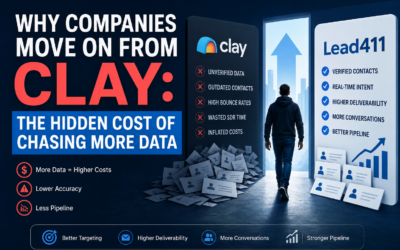
Why Companies Move On From Clay: The Hidden Cost of Chasing More Data
Over the past few years, few platforms have generated as much excitement in sales, RevOps, and growth circles as Clay. It has become one of the most talked-about prospecting platforms in modern outbound sales, helping teams automate research, enrich contacts, build...

Why Outbound Feels Harder Than It Did 3 Years Ago
Talk to almost any SDR leader, founder, VP of Sales, CRO, or RevOps professional today and you'll hear some version of the same concern: Outbound feels harder than it used to. Three years ago, many sales teams could build a prospect list, launch a sequence, make a few...

- Sales Services
- Cybersecurity
- SaaS/Technology
- Energy / CleanTech
- Manufacturing
- Hospitality / Travel / Tourism
- Financial / FinTech
- Healthcare / MedTech
- Logistics / Transportation
- Account Based Marketing
- Recruiting
- Real Estate & Construction
- Professional Services & Consulting
- SLED Data Solutions
- Retail / E-Commerce
- Legal Services
resources
Zoominfo Intent vs Bombora Intent in 2026 | Top 3 B2b Buyer Intent Providers in 2026 | Zoominfo Pricing in 2026 | Linkedin Sales Navigator Competitors (2026) | Clearbit Pricing (2026) | Hubspot Pricing Review (2026) | Lead411 Competitors in 2026| Top 5 Linkedin Email Finders for 2026 | How to Find Someone's Phone Number in 2026 | Apollo.io vs. Lead411 Chrome Extension in 2026 | Apollo.io vs. Zoominfo in 2026 | Top 10 B2B Data Resellers in 2026 | Zoominfo API | Seamless.ai vs. Zoominfo in 2026 | 10 Best Clay Competitors for 2026 | What Does Lead Generation Look Like in 2026? | Zoominfo MCP Server |
7 Best B2B Data Providers for 2026 | 15 Best Sales Lead Databases for B2B in 2026 | Apollo.io MCP Server | Questions About Zoominfo
© 2026 Lead411 All Rights Reserved | Your Privacy Choices | Privacy Policy | Do Not Sell | CCPA | Terms Of Use | Lead411 is a registered data broker under applicable state laws, including under Texas law. To conduct business in Texas, a data broker must register with the Texas Secretary of State (Texas SOS). Information about data broker registrants is available on the Texas SOS website.
- Sales Services
- Cybersecurity
- SaaS/Technology
- Energy / CleanTech
- Manufacturing
- Hospitality / Travel / Tourism
- Financial / FinTech
- Healthcare / MedTech
- Logistics / Transportation
- Account Based Marketing
- Recruiting
- Real Estate & Construction
- Professional Services & Consulting
- SLED Data Solutions
- Retail / E-Commerce
- Legal Services
resources
Zoominfo Intent vs Bombora Intent in 2026 | Top 3 B2b Buyer Intent Providers in 2026 | Zoominfo Pricing in 2026 | Linkedin Sales Navigator Competitors (2026) | Clearbit Pricing (2026) | Hubspot Pricing Review (2026) | Lead411 Competitors in 2026| Top 5 Linkedin Email Finders for 2026 | How to Find Someone's Phone Number in 2026 | Apollo.io vs. Lead411 Chrome Extension in 2026 | Apollo.io vs. Zoominfo in 2026 | Top 10 B2B Data Resellers in 2026 | Zoominfo API | Seamless.ai vs. Zoominfo in 2026 | 10 Best Clay Competitors for 2026 | What Does Lead Generation Look Like in 2026? | Zoominfo MCP Server |
7 Best B2B Data Providers for 2026 | 15 Best Sales Lead Databases for B2B in 2026 | Apollo.io MCP Server | Questions About Zoominfo