
The B2B Data Decay Problem: Why Your Data Is Already Outdated (And What Top Teams Do About It)
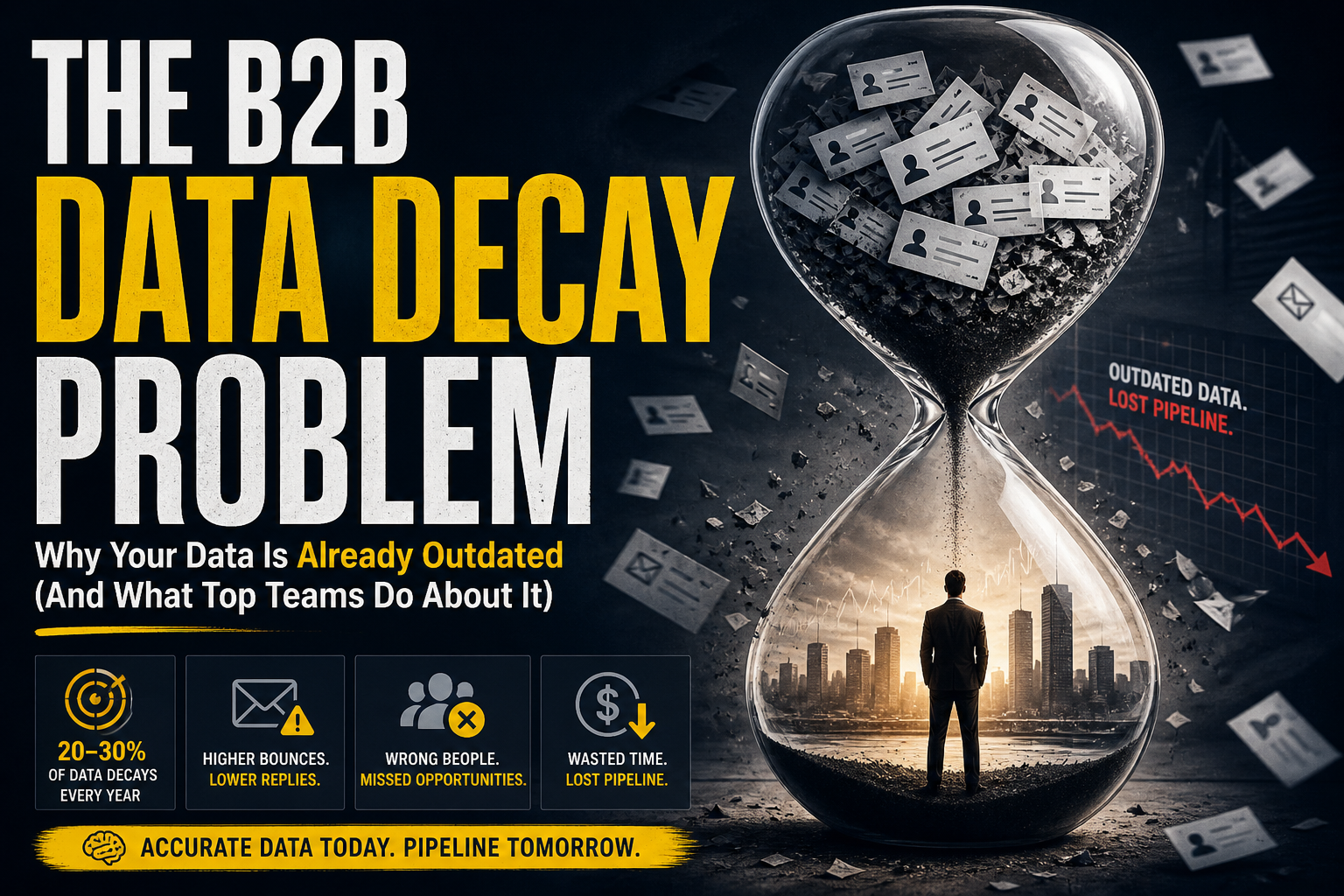
The B2B Data Decay Problem: Why Your Data Is Already Outdated (And What Top Teams Do About It)
Quick Reality: 20–30% of B2B data becomes inaccurate every year. That means nearly a third of your pipeline foundation is quietly degrading—whether you notice it or not.
Most teams don’t detect the problem immediately. Performance slips gradually—reply rates decline, bounce rates rise, and conversion slows. The instinct is to blame messaging or reps. In reality, the issue often starts earlier: the data itself.
If you’re not actively managing data decay, you’re not running outbound—you’re operating on assumptions. Before optimizing sequences or messaging, it’s worth understanding
why outbound fails and how a
high-converting prospect list depends on continuously refreshed inputs.
---
Table of Contents
- What Is B2B Data Decay?
- Why Data Decay Happens Faster Than You Think
- How Data Decay Impacts Outbound Performance
- The Hidden Cost of Bad Data
- Data Accuracy vs Data Decay
- How Top Teams Solve Data Decay
- The New Standard for B2B Data
- Final Takeaway
What Is B2B Data Decay?
Data decay is the ongoing process where contact and account data becomes outdated, incomplete, or incorrect over time. Unlike a one-time data quality issue, decay is continuous—it happens whether you’re actively using the data or not.
What makes data decay dangerous is that it doesn’t happen all at once. It accumulates quietly. A small percentage of inaccuracies compounds into a systemic issue that eventually affects every stage of your outbound funnel.
Even high-quality datasets begin to degrade immediately after they’re collected. That means “accurate data” is always temporary.
---
Why Data Decay Happens Faster Than You Think
Most teams underestimate the velocity of change inside their target accounts. B2B environments are dynamic—people move roles, companies evolve, and communication channels shift constantly.
The biggest drivers of decay include:
- Job mobility: Decision-makers frequently change roles, leaving outdated contacts behind
- Organizational restructuring: Teams, reporting lines, and responsibilities shift
- Email churn: Corporate emails are disabled, replaced, or filtered more aggressively
- Market changes: Companies pivot strategies, affecting relevance and targeting
When these changes happen simultaneously across thousands of records, the result isn’t just outdated data—it’s a distorted view of your market.
---
How Data Decay Impacts Outbound Performance
Data decay doesn’t cause immediate failure—it creates gradual inefficiency that compounds over time.
Declining Deliverability
As data becomes outdated, email bounce rates increase. This damages domain reputation, reducing inbox placement even for valid contacts. Over time, entire campaigns underperform—not because of messaging, but because they never reach the inbox. This pattern is consistently seen in
deliverability benchmarks.
Reduced Connection Rates
Outdated phone numbers and role changes mean reps fail to reach decision-makers. This lowers connection rates and reduces the number of conversations generated per campaign.
Slower Execution
When reps don’t trust the data, they slow down. They verify contacts, hesitate before outreach, and lose momentum. That friction reduces activity levels and consistency.
Misaligned Targeting
If your data doesn’t reflect current org structures, you’re targeting the wrong people. This becomes especially problematic when trying to
engage buying committees, where multiple roles must be accurate simultaneously.
---
The Hidden Cost of Bad Data
The visible impact of bad data is poor performance. The hidden impact is misdiagnosis.
Teams often interpret declining results as a messaging problem or a market issue. In reality, they’re operating on decayed inputs.
This leads to:
- Rewriting messaging that isn’t the problem
- Changing ICP definitions unnecessarily
- Abandoning outbound strategies that could work with accurate data
In other words, bad data doesn’t just reduce performance—it distorts decision-making.
This is a core pattern highlighted in
outbound failure analysis, where teams optimize the wrong variables.
---
Data Accuracy vs Data Decay (The Critical Distinction)
Most teams evaluate data providers based on accuracy percentages. But accuracy is a snapshot—it doesn’t account for how quickly that data becomes outdated.
Data decay is continuous. That means even highly accurate datasets degrade over time.
The more important question is not:
“How accurate is this data today?”
But:
“How frequently is this data refreshed?”
Providers that continuously verify and update data outperform those that rely on static datasets—even if both start with similar accuracy levels.
---
How Top Teams Solve Data Decay
High-performing teams don’t treat data as a static asset—they treat it as a living system.
Continuous Data Refresh
Instead of building lists once, they continuously update and refine their datasets to reflect current conditions.
Verified Contact Data
They prioritize data sources that validate emails and phone numbers, reducing uncertainty and improving connection rates.
Intent-Driven Targeting
They supplement static data with intent signals to identify accounts that are actively researching solutions. This reduces reliance on outdated assumptions.
Execution Integration
They eliminate friction between data and outreach. Data flows directly into workflows, enabling faster action. This is a key differentiator highlighted in
data provider comparisons, where execution capability determines outcomes.
---
The New Standard for B2B Data
The shift is clear: static data is no longer sufficient.
The modern standard includes:
- Continuously refreshed datasets
- Verified contact information
- Real-time intent signals
- Seamless integration with outbound workflows
This reflects a broader evolution in outbound. Success is no longer determined by how much data you have—but by how current, accurate, and actionable that data is.
---
Final Takeaway
Data decay is one of the most overlooked drivers of outbound failure.
It doesn’t break your system overnight—but it slowly erodes performance until results decline.
The teams that win in 2026 aren’t the ones with the largest datasets. They’re the ones with the most current, reliable, and actionable data.
If your pipeline is underperforming, don’t just optimize your outreach—fix your data foundation.
B2B Data Decay: Frequently Asked Questions
What is B2B data decay?
B2B data decay is the process by which contact and account data becomes outdated or inaccurate over time. This includes job changes, company restructuring, email invalidation, and changes in responsibilities within organizations. Because these changes happen continuously, even recently collected data begins to degrade immediately.
How fast does B2B data decay?
Most estimates place B2B data decay at 20–30% per year. In fast-moving industries, the rate can be even higher. This means a significant portion of a prospect database becomes unreliable within months if it is not actively refreshed.
What causes data decay in B2B sales?
The primary causes are job changes, promotions, layoffs, company restructuring, and email churn. Decision-makers frequently move roles or companies, and corporate email systems are regularly updated or disabled. These changes make previously accurate records incorrect over time.
Why is data decay a problem for outbound sales?
Data decay reduces the effectiveness of outbound campaigns by increasing bounce rates, lowering connection rates, and misaligning targeting. When contact information is outdated, outreach fails to reach the intended decision-makers, which reduces conversations and pipeline generation.
How does data decay affect email deliverability?
Outdated email addresses lead to hard bounces, which negatively impact domain reputation. As bounce rates increase, email providers are more likely to filter or block future messages, reducing overall inbox placement—even for valid contacts.
How does data decay impact SDR productivity?
When data is unreliable, SDRs spend more time verifying contacts, correcting records, and troubleshooting failed outreach. This reduces the number of calls and emails they can complete, lowering overall productivity and consistency.
What is the difference between data accuracy and data decay?
Data accuracy refers to how correct a dataset is at a specific point in time. Data decay refers to how quickly that data becomes outdated. A dataset can be highly accurate when collected but still degrade rapidly if it is not continuously updated.
Can data decay be prevented?
Data decay cannot be completely prevented because it is driven by real-world changes. However, its impact can be reduced through continuous data refresh, verification processes, and the use of real-time signals such as intent data and activity tracking.
How do companies manage B2B data decay?
Companies manage data decay by regularly refreshing their databases, using verified data providers, and integrating data updates into their workflows. High-performing teams treat data as a dynamic system rather than a static asset.
How often should B2B data be updated?
There is no single standard, but effective teams update data continuously or in frequent cycles rather than relying on one-time list building. The faster the refresh cadence, the lower the impact of decay.
What are the signs that your data has decayed?
Common signs include rising email bounce rates, declining reply rates, lower call connection rates, and increased time spent verifying contact information. These indicators typically appear before teams recognize data as the root cause.
What happens if you ignore data decay?
Ignoring data decay leads to reduced pipeline generation, wasted outreach efforts, and incorrect strategic decisions. Teams may misinterpret poor performance as a messaging or market issue, when the underlying problem is outdated data.
Is data decay worse for certain industries?
Yes. Industries with high employee turnover, rapid growth, or frequent restructuring experience faster data decay. Technology, startups, and fast-scaling companies tend to have higher rates of change than more stable industries.
How does data decay affect targeting and ICP accuracy?
As roles and responsibilities change, targeting criteria become misaligned. This can lead to outreach directed at the wrong people or departments, reducing relevance and lowering engagement rates.
What is the best way to reduce the impact of data decay?
The most effective approach is to combine continuously refreshed data with verified contact information and real-time signals. This ensures that targeting remains accurate and outreach efforts reach the right people at the right time.
Recent Posts
What Are the Cheapest and Best Alternatives to ZoomInfo? (2026 Deep-Dive Guide)
What Are the Cheapest and Best Alternatives to ZoomInfo? (2026 Deep-Dive Guide) For years, ZoomInfo dominated the B2B sales intelligence market so aggressively that most outbound teams rarely questioned whether there were better options. If your company needed:...
Why Hundreds of Companies Are Leaving ZoomInfo for Lead411 in 2026
Why Hundreds of Companies Are Leaving ZoomInfo for Lead411 in 2026 For nearly a decade, ZoomInfo became synonymous with B2B sales intelligence. If a company needed direct dials, contact enrichment, buyer intent data, or outbound prospecting infrastructure, ZoomInfo...

ZoomInfo vs RocketReach: Why Most Sales Teams End Up Frustrated With Both
ZoomInfo vs RocketReach: Why Most Sales Teams End Up Frustrated With Both Most sales intelligence comparison articles make the same mistake. They compare: database size, contact counts, features, and pricing tiers. But that is not actually what most outbound teams are...

- Sales Services
- Cybersecurity
- SaaS/Technology
- Energy / CleanTech
- Manufacturing
- Hospitality / Travel / Tourism
- Financial / FinTech
- Healthcare / MedTech
- Logistics / Transportation
- Account Based Marketing
- Recruiting
- Real Estate & Construction
- Professional Services & Consulting
- SLED Data Solutions
- Retail / E-Commerce
- Legal Services
resources
Zoominfo Intent vs Bombora Intent in 2026 | Top 3 B2b Buyer Intent Providers in 2026 | Zoominfo Pricing in 2026 | Linkedin Sales Navigator Competitors (2026) | Clearbit Pricing (2026) | Hubspot Pricing Review (2026) | Lead411 Competitors in 2026| Top 5 Linkedin Email Finders for 2026 | How to Find Someone's Phone Number in 2026 | Apollo.io vs. Lead411 Chrome Extension in 2026 | Apollo.io vs. Zoominfo in 2026 | Top 10 B2B Data Resellers in 2026 | Zoominfo API | Seamless.ai vs. Zoominfo in 2026 | 10 Best Clay Competitors for 2026 | What Does Lead Generation Look Like in 2026? | Zoominfo MCP Server |
7 Best B2B Data Providers for 2026 | 15 Best Sales Lead Databases for B2B in 2026 | Apollo.io MCP Server | Questions About Zoominfo
© 2026 Lead411 All Rights Reserved | Your Privacy Choices | Privacy Policy | Do Not Sell | CCPA | Terms Of Use | Lead411 is a registered data broker under applicable state laws, including under Texas law. To conduct business in Texas, a data broker must register with the Texas Secretary of State (Texas SOS). Information about data broker registrants is available on the Texas SOS website.
- Sales Services
- Cybersecurity
- SaaS/Technology
- Energy / CleanTech
- Manufacturing
- Hospitality / Travel / Tourism
- Financial / FinTech
- Healthcare / MedTech
- Logistics / Transportation
- Account Based Marketing
- Recruiting
- Real Estate & Construction
- Professional Services & Consulting
- SLED Data Solutions
- Retail / E-Commerce
- Legal Services
resources
Zoominfo Intent vs Bombora Intent in 2026 | Top 3 B2b Buyer Intent Providers in 2026 | Zoominfo Pricing in 2026 | Linkedin Sales Navigator Competitors (2026) | Clearbit Pricing (2026) | Hubspot Pricing Review (2026) | Lead411 Competitors in 2026| Top 5 Linkedin Email Finders for 2026 | How to Find Someone's Phone Number in 2026 | Apollo.io vs. Lead411 Chrome Extension in 2026 | Apollo.io vs. Zoominfo in 2026 | Top 10 B2B Data Resellers in 2026 | Zoominfo API | Seamless.ai vs. Zoominfo in 2026 | 10 Best Clay Competitors for 2026 | What Does Lead Generation Look Like in 2026? | Zoominfo MCP Server |
7 Best B2B Data Providers for 2026 | 15 Best Sales Lead Databases for B2B in 2026 | Apollo.io MCP Server | Questions About Zoominfo