
Why Outbound Feels Harder Than It Did 3 Years Ago
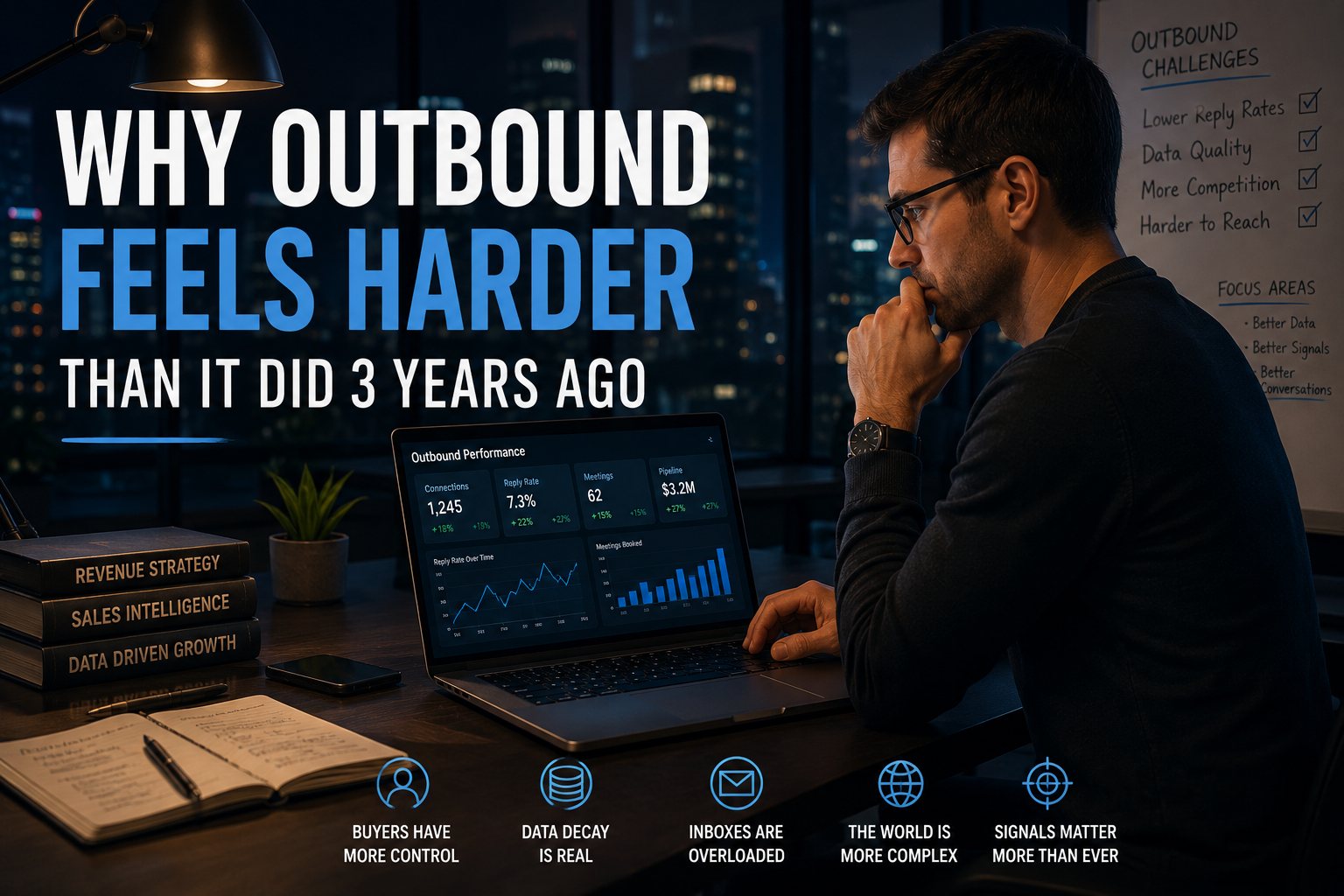
Talk to almost any SDR leader, founder, VP of Sales, CRO, or RevOps professional today and you'll hear some version of the same concern:
Outbound feels harder than it used to.
Three years ago, many sales teams could build a prospect list, launch a sequence, make a few hundred calls, and generate a relatively predictable flow of meetings. It wasn't easy, but it felt straightforward. More activity generally produced more opportunities. More prospects generally produced more pipeline.
Today, that relationship feels much weaker.
Teams have access to AI-powered sales tools, larger databases, more automation platforms, sophisticated sales engagement software, buyer intent platforms, and CRM enrichment systems. Yet many organizations are working harder than ever while seeing declining connect rates, lower response rates, and increasing difficulty generating predictable pipeline.
The natural assumption is that buyers have become harder to reach.
While that's partially true, it is far from the entire story.
What many revenue teams are experiencing is actually the result of several major shifts happening simultaneously. Buying behavior has changed. Prospect data has become harder to maintain. AI has flooded inboxes. Contact databases are decaying faster. Deliverability standards have tightened. Geographic prospecting has become more complex. And many organizations are still operating with outbound playbooks designed for a market that no longer exists.
The good news is that outbound is not dead.
The bad news is that the rules have changed.
The organizations continuing to generate consistent pipeline are not necessarily sending more emails or making more calls. They're adapting to how modern buyers actually buy.
Table of Contents
- Buyers Have Changed More Than Sales Teams Realize
- The Contact Decay Problem Nobody Talks About
- Why More Data Is No Longer the Answer
- The Rising Cost of B2B Data
- How AI Made Outbound Easier and Harder
- Why Intent Signals Matter More Than Ever
- The Geographic Challenge Most Teams Ignore
- What High-Performing Revenue Teams Do Differently
- The Future of Outbound Sales
- Frequently Asked Questions
Buyers Have Changed More Than Sales Teams Realize
For decades, sales teams controlled access to information. Buyers relied heavily on sales representatives to understand pricing, evaluate vendors, compare solutions, and learn how products worked. Reaching a prospect early often created a meaningful competitive advantage.
That world no longer exists.
Today's buyers can research products, compare competitors, watch demonstrations, read reviews, and gather peer recommendations without speaking to a salesperson. By the time many prospects enter an SDR sequence, they may already have a shortlist of vendors under consideration.
This shift fundamentally changes the purpose of outbound prospecting. Success is no longer about reaching the largest number of people. It is increasingly about reaching the right person at the right moment with the right context.
This is one reason many organizations are investing heavily in buyer intent data, growth signals, and trigger-event prospecting. The goal is not simply finding prospects. The goal is identifying prospects who are already moving toward a buying decision.
The Contact Decay Problem Nobody Talks About
One of the least discussed reasons outbound feels harder today is that prospect data deteriorates much faster than most organizations realize.
Every day, professionals change jobs. Companies restructure. Executives get promoted. Departments merge. Organizations are acquired. Remote employees relocate. Entire buying committees disappear and reform.
The result is that every CRM, every prospect database, and every sales intelligence platform is constantly fighting against data decay.
Most revenue teams don't notice this immediately. Instead, they experience the symptoms. Connect rates begin falling. Bounce rates increase. SDRs complain that lists feel stale. Pipeline becomes less predictable. Meetings become harder to generate.
What many organizations call an outbound problem is often a data freshness problem.
This is why conversations around revenue infrastructure, CRM enrichment, and verified contact data are becoming increasingly important. The challenge is no longer finding contacts. The challenge is maintaining accurate contacts.
Why More Data Is No Longer the Answer
For years, the default solution to outbound challenges was simple: buy more leads.
Need more meetings? Buy a bigger database. Need more opportunities? Add more contacts to the funnel.
That approach worked reasonably well when most teams had limited access to prospect data. Today, the opposite problem exists.
Many organizations are drowning in contacts while starving for context.
A list of 10,000 prospects sounds impressive until you realize only a small percentage are actively evaluating solutions. Meanwhile, a company that recently raised funding, expanded headcount, hired a new executive, or adopted new technology may represent a far more valuable opportunity than hundreds of random contacts.
This shift is one reason signal-based prospecting continues gaining momentum. As we discussed in our article on signal-based prospecting, modern outbound success increasingly depends on timing rather than volume.
The Rising Cost of B2B Data
Another reason outbound feels harder is that sales teams are spending more money than ever on data while often seeing diminishing returns.
Enterprise organizations routinely spend tens of thousands of dollars per year on sales intelligence platforms. ZoomInfo remains a dominant player because of its broad U.S. coverage, but many organizations struggle to justify the cost as budgets tighten. Apollo became popular because it offered an affordable alternative, yet many users eventually discover that maintaining data accuracy at scale remains an ongoing challenge.
Cognism has built a strong reputation in Europe and among organizations prioritizing GDPR compliance, but many U.S.-focused teams still evaluate additional providers to strengthen domestic coverage.
The reality is that the market has evolved beyond simply asking which provider has the largest database.
Revenue leaders increasingly ask different questions:
How accurate is the data?
How often is it refreshed?
Does it include verified direct dials?
Can it identify buying signals?
Will it improve SDR productivity?
These questions matter because the cost of inaccurate data is often much greater than the subscription itself.
Organizations evaluating the best B2B data provider increasingly prioritize accuracy and workflow efficiency over raw contact volume.
How AI Made Outbound Easier and Harder
Artificial intelligence has dramatically improved sales productivity.
Sequences can be generated in seconds. Personalized messaging can be drafted instantly. Research can be automated. Prospecting workflows can be scaled faster than ever before.
At the same time, AI has introduced a new challenge.
Everyone else now has access to the same capabilities.
Buyers are receiving more outreach than ever. Many inboxes are flooded with AI-generated emails that sound remarkably similar. Generic personalization has become easier to recognize. The average prospect can quickly identify messaging that was generated at scale.
This creates a paradox. AI helps teams increase output, but it also increases competition for attention.
As a result, simply sending more emails is becoming a less effective strategy. Relevance, timing, and accuracy matter more than volume.
Why Intent Signals Matter More Than Ever
If there is one trend separating high-performing outbound teams from average teams, it is the increasing emphasis on signals.
A prospect who recently downloaded content related to your industry, a company hiring aggressively, an organization that just raised capital, or a business implementing new technology often provides stronger buying indicators than thousands of cold contacts.
This explains why platforms offering buyer intent data, growth triggers, funding signals, hiring alerts, and technographic insights continue gaining popularity.
The future of outbound sales is not simply knowing who a prospect is.
The future is understanding why they may be interested today.
The Geographic Challenge Most Teams Ignore
Geography has quietly become one of the most important factors in modern outbound sales.
Ten years ago, many sales teams focused almost entirely on domestic markets. Today, organizations routinely prospect across North America, Europe, the United Kingdom, Australia, and emerging international markets.
This creates significant complexity.
A database that performs exceptionally well in the United States may not perform as well across Europe. A provider known for strong European mobile coverage may have weaker direct dial coverage within North America. Privacy regulations vary significantly by region. Buying behavior differs by market.
As outbound becomes increasingly global, revenue teams must think beyond database size and evaluate geographic coverage, compliance, and regional accuracy.
This is one reason many organizations evaluate multiple providers before committing to a long-term platform strategy.
What High-Performing Revenue Teams Do Differently
The organizations consistently generating pipeline today are not necessarily making more calls than everyone else.
Instead, they are focusing on accuracy, timing, and operational efficiency.
They maintain clean CRM records. They continuously enrich prospect data. They monitor buyer signals. They invest in verified contact information. They prioritize quality over volume.
Most importantly, they understand that outbound success is no longer driven by access to data alone.
It is driven by access to accurate data combined with meaningful context.
This is why concepts like data quality, buyer intent, and revenue infrastructure are becoming central topics in modern sales organizations.
The Future of Outbound Sales
Outbound sales is not dying.
It is evolving.
The organizations that continue relying on larger prospect lists, higher activity quotas, and increasingly aggressive automation will likely find outbound becoming more difficult every year.
The organizations that prioritize data quality, buyer timing, signal-based prospecting, CRM health, and verified contact information will continue generating predictable pipeline.
The future belongs to teams that understand a simple reality:
The problem is rarely a lack of contacts.
The problem is identifying who matters right now.
And the teams that solve that challenge will continue outperforming competitors regardless of how crowded the outbound market becomes.
Frequently Asked Questions
Why does outbound sales feel harder than it used to?
Outbound feels harder because buying behavior has changed, prospect data decays faster, AI has increased competition for attention, and many organizations are still using prospecting strategies designed for a different market environment.
What is contact decay?
Contact decay refers to the gradual deterioration of prospect data as people change jobs, companies reorganize, phone numbers change, and email addresses become inactive over time.
Why is data quality important in outbound sales?
Poor data quality reduces connect rates, increases bounce rates, hurts deliverability, wastes SDR time, and makes pipeline generation less predictable.
What are buyer intent signals?
Buyer intent signals are indicators that suggest a company may be actively researching or evaluating solutions, including content engagement, hiring activity, funding events, and technology adoption.
What should companies prioritize when evaluating a B2B data provider?
Companies should evaluate data accuracy, refresh frequency, direct dial coverage, buyer intent capabilities, CRM integration, geographic coverage, and overall impact on SDR productivity.
Recent Posts
Why Hundreds of Companies Are Leaving ZoomInfo for Lead411 in 2026
Why Hundreds of Companies Are Leaving ZoomInfo for Lead411 in 2026 For nearly a decade, ZoomInfo became synonymous with B2B sales intelligence. If a company needed direct dials, contact enrichment, buyer intent data, or outbound prospecting infrastructure, ZoomInfo...

ZoomInfo vs RocketReach: Why Most Sales Teams End Up Frustrated With Both
ZoomInfo vs RocketReach: Why Most Sales Teams End Up Frustrated With Both Most sales intelligence comparison articles make the same mistake. They compare: database size, contact counts, features, and pricing tiers. But that is not actually what most outbound teams are...
Signal-Based Prospecting: The New Outbound Playbook
Signal-Based Prospecting: The New Outbound Playbook Outbound sales changed quietly. Most companies just have not fully realized it yet. For years, the dominant outbound model was simple: build a giant list, load a sequence, send enough emails, and let volume do the...

- Sales Services
- Cybersecurity
- SaaS/Technology
- Energy / CleanTech
- Manufacturing
- Hospitality / Travel / Tourism
- Financial / FinTech
- Healthcare / MedTech
- Logistics / Transportation
- Account Based Marketing
- Recruiting
- Real Estate & Construction
- Professional Services & Consulting
- SLED Data Solutions
- Retail / E-Commerce
- Legal Services
resources
Zoominfo Intent vs Bombora Intent in 2026 | Top 3 B2b Buyer Intent Providers in 2026 | Zoominfo Pricing in 2026 | Linkedin Sales Navigator Competitors (2026) | Clearbit Pricing (2026) | Hubspot Pricing Review (2026) | Lead411 Competitors in 2026| Top 5 Linkedin Email Finders for 2026 | How to Find Someone's Phone Number in 2026 | Apollo.io vs. Lead411 Chrome Extension in 2026 | Apollo.io vs. Zoominfo in 2026 | Top 10 B2B Data Resellers in 2026 | Zoominfo API | Seamless.ai vs. Zoominfo in 2026 | 10 Best Clay Competitors for 2026 | What Does Lead Generation Look Like in 2026? | Zoominfo MCP Server |
7 Best B2B Data Providers for 2026 | 15 Best Sales Lead Databases for B2B in 2026 | Apollo.io MCP Server | Questions About Zoominfo
© 2026 Lead411 All Rights Reserved | Your Privacy Choices | Privacy Policy | Do Not Sell | CCPA | Terms Of Use | Lead411 is a registered data broker under applicable state laws, including under Texas law. To conduct business in Texas, a data broker must register with the Texas Secretary of State (Texas SOS). Information about data broker registrants is available on the Texas SOS website.
- Sales Services
- Cybersecurity
- SaaS/Technology
- Energy / CleanTech
- Manufacturing
- Hospitality / Travel / Tourism
- Financial / FinTech
- Healthcare / MedTech
- Logistics / Transportation
- Account Based Marketing
- Recruiting
- Real Estate & Construction
- Professional Services & Consulting
- SLED Data Solutions
- Retail / E-Commerce
- Legal Services
resources
Zoominfo Intent vs Bombora Intent in 2026 | Top 3 B2b Buyer Intent Providers in 2026 | Zoominfo Pricing in 2026 | Linkedin Sales Navigator Competitors (2026) | Clearbit Pricing (2026) | Hubspot Pricing Review (2026) | Lead411 Competitors in 2026| Top 5 Linkedin Email Finders for 2026 | How to Find Someone's Phone Number in 2026 | Apollo.io vs. Lead411 Chrome Extension in 2026 | Apollo.io vs. Zoominfo in 2026 | Top 10 B2B Data Resellers in 2026 | Zoominfo API | Seamless.ai vs. Zoominfo in 2026 | 10 Best Clay Competitors for 2026 | What Does Lead Generation Look Like in 2026? | Zoominfo MCP Server |
7 Best B2B Data Providers for 2026 | 15 Best Sales Lead Databases for B2B in 2026 | Apollo.io MCP Server | Questions About Zoominfo