
Why Sales Data Decays Faster Than CRM Syncs
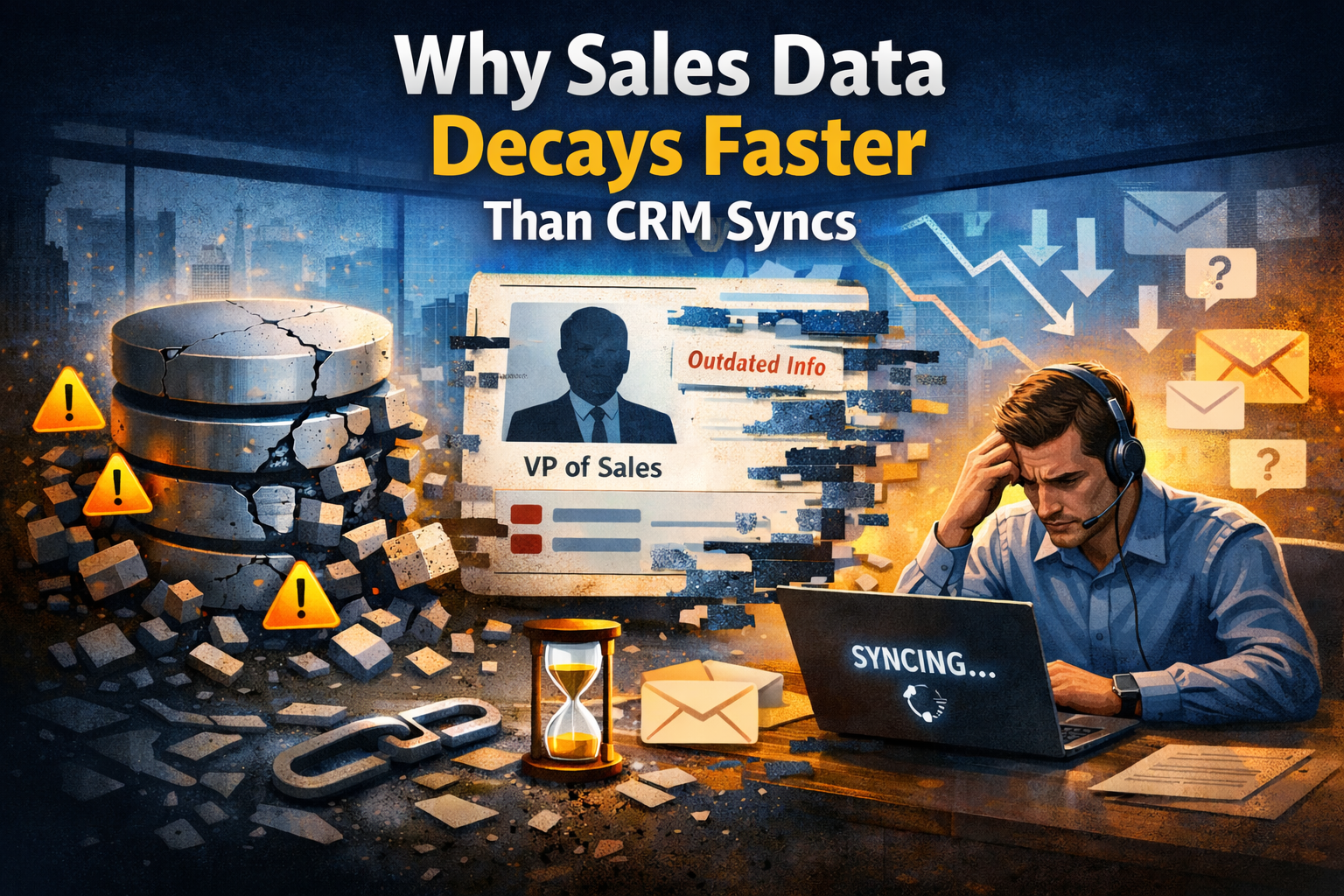
Why 2026 Sales Data Decays Faster Than CRM Syncs
In 2026, sales success isn’t about having more data. It’s about having data that reflects right now. Because when reality moves faster than your CRM, accuracy becomes temporary — and revenue depends on how quickly you recognize that.
Table of Contents
- What Changed About Sales Data in 2026
- Why CRM Syncs Can’t Keep Up
- How Job Titles Became the New Broken Field
- The Hidden Cost of “Technically Accurate” Data
- Why Verified Emails Still Fail Without Context
- What High-Performing Sales Teams Are Doing Differently
- The Real Risk of Ignoring Data Decay
What Changed About Sales Data in 2026
Sales data didn’t suddenly get worse — it got faster.
People move roles more often. Teams get flattened, expanded, then reorganized again within months. Decision makers aren’t fixed anymore, and decision authority shifts quietly as companies adapt to tighter budgets and faster growth cycles.
The result? Data that was accurate last quarter is now misleading.
This pressure shows up most clearly at the SDR level, where outdated records turn into missed meetings, ignored sequences, and frustration that feels personal even when it isn’t. That frustration is at the heart of what many teams are seeing at the SDR breaking point.
Why CRM Syncs Can’t Keep Up
Most CRMs were designed for stability, not velocity.
They assume titles change slowly, buying roles are predictable, and enrichment can happen in batches. That model worked when companies grew linearly. It doesn’t work in 2026.
Even daily syncs can’t keep up with internal changes that happen weekly. By the time a record updates, the context around that contact has already shifted. The CRM looks clean, but the reality behind it has changed.
This disconnect is one reason even highly rated tools listed in comparisons of best B2B databases struggle to deliver consistent results over time.
How Job Titles Became the New Broken Field
Email used to be the most fragile field in sales data. That’s no longer true.
Today, titles and responsibilities decay faster than email addresses. Someone might keep the same title while losing buying power. Another might gain influence without a public title change.
On paper, your data looks accurate. In practice, your messaging misses the mark.
The Hidden Cost of “Technically Accurate” Data
A contact can still be employed, reachable, and listed correctly — and still be useless for revenue.
When data is technically accurate but contextually wrong, it creates false conclusions. Teams think messaging is broken. SDRs think they’re failing. Leaders assume outbound is dying.
In reality, the data just stopped reflecting how buying decisions actually work.
Why Verified Emails Still Fail Without Context
Email verification matters. It always will.
But verified doesn’t mean relevant.
A valid email sent to someone who no longer owns the decision won’t bounce — it will just disappear. That’s why response rates drop even when deliverability looks perfect.
This is why understanding why verified emails matter now requires looking beyond inbox placement and into role relevance, timing, and buying intent.
What High-Performing Sales Teams Are Doing Differently
The best teams aren’t trying to sync faster. They’re trying to stay closer to reality.
They focus on continuous verification instead of periodic enrichment, signals that indicate role changes, and data freshness tied to buying activity rather than calendar dates.
They treat CRM data as something that expires — not something that stays accurate just because it synced.
The Real Risk of Ignoring Data Decay
Data decay doesn’t fail loudly. It fails quietly.
It shows up as lower reply rates, inconsistent pipeline, burned-out SDRs, and longer sales cycles.
By the time leadership notices, the problem feels systemic — when it started with stale records that were never questioned.
This year, sales success isn’t about having more data. It’s about having data that reflects right now. Because when reality moves faster than your CRM, accuracy becomes temporary — and revenue depends on how quickly you recognize that.
FAQ: Sales Data in 2026
- Why is sales data decaying so fast in 2026?
- Sales data moves faster than ever. People change roles, teams restructure, and buying authority shifts frequently. Data that was accurate last quarter can already be outdated, creating missed opportunities and frustrated SDRs.
- Why don’t CRM syncs keep up?
- CRMs were built for stability, not speed. Even daily updates can’t reflect weekly changes in roles or responsibilities. Your CRM may look clean, but the reality behind contacts has already changed.
- How have job titles become unreliable?
- Titles decay faster than emails. Someone may retain the same title but lose buying power, or gain influence without a title change. This makes messaging less effective, even when data appears correct.
- What’s the cost of “technically accurate” data?
- Contacts can be employed, reachable, and listed correctly, yet still useless for revenue. When data is contextually wrong, SDRs think messaging is failing and leaders assume outbound isn’t working.
- Why do verified emails sometimes fail?
- Verified emails ensure deliverability, but not relevance. Sending to someone who no longer owns the decision won’t bounce — it will just be ignored. Success now requires role relevance, timing, and buying intent.
- What are top-performing sales teams doing differently?
- High-performing teams focus on continuous verification, tracking role changes, and keeping data fresh based on buying signals rather than calendar syncs. They treat CRM data as temporary, adjusting strategies to match real-time reality.
- What happens if data decay is ignored?
- Ignoring data decay leads to lower reply rates, inconsistent pipelines, burned-out SDRs, and longer sales cycles. By the time leadership notices, it appears systemic — but the root cause is simply stale data.
Recent Posts

4 Tips To Finish 2020 Sales Strong and Make Your 2021 Sales Pipeline Even Better
Odds are if your end of the year sales goals are coming up a bit short, it could have something to do with your preparation in the beginning of the year. Sales pipelines are called pipelines for a reason, you need to turn the leads on early so they come out clients...

Sales and Baseball – It’s All About The Pitching
Sales and Baseball - It’s all about the Pitching A good pitcher in baseball is one of the most valuable players in the game. A pitcher can have an arsenal of fastballs, curveballs, sliders, knuckleballs, you name it, but If they don’t do their homework on the batters...

Differentiators – Stand Out From Your Competition
If you can’t identify how you are different from your competitors then you can’t grow as a company. The main ways to stand out from the competition depends on what problem you solve and how you solve it. A market research blog by Priority Metrics Group states that a...